Business
NNPCL battles liquidity pressure under President Tinubu’s direct revenue remittance order

…as federation account beneficiaries rake in record inflows
– Corporation scraps foreign trainings for staff
By AYOOLA OLAOLUWA
President Bola Tinubu’s new revenue remittance framework for the oil and gas industry has triggered a major shift in Nigeria’s public finance landscape, with the federal, states and local governments emerging as the biggest beneficiaries, while the Nigerian National Petroleum Company (NNPC) Limited grapples with mounting liquidity pressures, Business Hallmark can report.
According to BH findings, the national oil company is currently facing tighter cash flows and reduced financial flexibility with revenue earned from oil royalties, oil taxes, oil profits, gas profits, gas flare penalties and related incomes directly going into the Federation Account.
The development, our correspondent gathered, has impacted on the corporation’s ability to fund critical upstream investments, refinery rehabilitation projects and other strategic obligations in the last three months.
It would be recalled that President Bola Tinubu had on February 13, 2026, signed Executive Order 9 into law. The Order mandates government owned companies and agencies in the nation’s upstream, midstream and downstream petroleum sector to directly remit all oil and gas revenues into the Federation Account, and put an end to previous arrangement whereby government agencies retain and spend earned revenues on behalf of the nation before remitting what is left to government coffers.
Effective from February 13, 2026, the Order invoked Sections 5 and 44(3) of the 1999 Constitution to restore the federal, state and local governments constitutional entitlements to revenues earned through generating agencies.
Executive Order cripples NNPCL
With the presidential order, NNPCL lost its 30 per cent management fee on profit oil and gas from Production Sharing Contracts, Profit Sharing Contracts and Risk Service Contracts. The continued retention of PSCs fees is deemed unjustified given the corporation’s existing 20 per cent profit retention for operations and investments.
Also, the 30 per cent Frontier Exploration Fund (FEF) contributions, previously held by NNPC for speculative drilling, now goes straight into the Federation Account to fund priority projects like security, education, healthcare and power projects.
The Executive Order also stopped Gas flare penalty payments to the Midstream and Downstream Gas Infrastructure Fund (MDGIF), with proceeds now routed to the Federation Account instead.
The order also mandates operators to pay oil royalties oil, oil taxes, oil profits, gas profits and related interests directly into the Federation Account, bypassing NNPC.
The development has strengthened monthly allocations and provided much-needed fiscal relief to cash-strapped sub-national governments battling rising wage obligations and infrastructure deficits.
According to available data, NNPCL remitted a total of N1.804 trillion to the Federation Account at the end of February 2026, up from the N726 billion it paid into the account in January. The figure represents an appreciation of N1.078 trillion.
In March 2026, the corporation paid N2.88trillion into the Federation Account, against the N1.804trillion it remitted in February. The revenues remitted in April and May are yet to be released.
Cost Cutting
BH findings, however, revealed that while the direct remittance arrangement has significantly boosted distributable funds available to the three tiers of government, NNPC is facing tighter cash flows and reduced financial flexibility.
One of the casualties of the direct remittance order at the NNPC is the stoppage of overseas training for workers of the corporation.
Our correspondent reliably gathered that the stoppage of overseas training for staff is not limited to NNPCL, but cut across all government agencies in the nation’s petroleum sector affected by the policy.
It was learnt at the weekend that among the overseas trainings that are now done locally is the factory acceptance tests for Positive Displacement (PD) meters.
Several sources in the corporation confided in our correspondent that the management decided to prioritize local training programs over foreign capacity-building initiatives as a result of mounting liquidity pressures.
A top director in the corporation, who spoke on the condition of anonymity, said management took the decision to start conducting specialized training locally to help reduce costs and strengthen domestic institutional capacity.
The policy, sources disclosed, is presently causing disquiet in the organization as affected workers are said to be spoiling for war with management.
Aggrieved workers, BH learnt, are encouraged by the decision of their colleagues in the Nigerian Upstream Petroleum Regulatory Commission (NUPRC) to embark on industrial action last week to protest against the scrapping of foreign trainings for workers.
Employees of the NUPRC under the aegis of the Petroleum and Natural Gas Senior Staff Association of Nigeria (PENGASSAN) had on Monday, June 1, 2026, embarked on an indefinite nationwide strike to protest against the commission’s scrapping of foreign trainings.
The industrial action, which led to a total shutdown of regulatory activities at NUPRC headquarters in Abuja and all field offices nationwide, grounded administrative and operational functions of the upstream petroleum regulator.
ONSA Intervenes
In a bid to find lasting solution to the problem, top officials in the Office of the National Security Adviser (NSA), it was learnt, met severally with representatives of the striking workers and NUPRC management.
Apart from impacting the corporation’s ability to continue sponsoring workers abroad for capacity trainings, President Bola Tinubu’s executive order stopping revenue generating agencies from retaining their revenues, has drastically limited NNPC’s capacity to fund critical upstream investments, refinery rehabilitation projects and future strategic obligations.
Our correspondent gathered at the weekend that like other government agencies that get funding from the Ministry of Finance, the NNPC has started experiencing delayed fund releases for operational and capital projects.
“The resultant cash flow shortages and delayed releases of budgeted funds is causing inefficiencies in the system. If the trend continues, we’ll soon start to experience administrative and project failures.
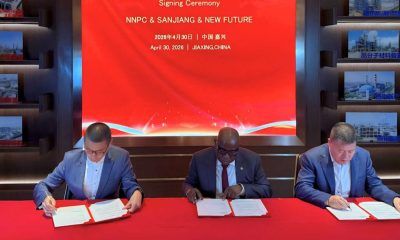
“I believe that’s one of the reasons the NNPC management recently decided to think outside the box by shopping for two Chinese companies to fund the rehabilitation of the Port Harcourt and Warri refineries, which they will later operate, instead of the old practice of pumping public funds into their rehabilitation.
“It is obvious that the NNPC is finding it difficult to raise funds internally to fix the moribund refineries, since the power to retain earned revenues was taken away by the president, thus the recourse to foreign help.
“Unfortunately, the cooperation is increasingly finding it difficult to secure foreign loans to help run its businesses. In the past, financial institutions market different loan options to the corporation. These loan loans are largely tied to the huge revenues that daily pour into the accounts of the corporation.
“But with the presidential order that mandated the payment of all revenues earned on behalf of the nation into the Federation Account, that door that NNPC exploited to the fullest is now closed. The leverage has shifted elsewhere”, an oil and gas expert who did not want his name in print confided in our correspondent.