Politics
Democracy Has Not Failed Nigerians, Says Otti in 2026 Democracy Day Address
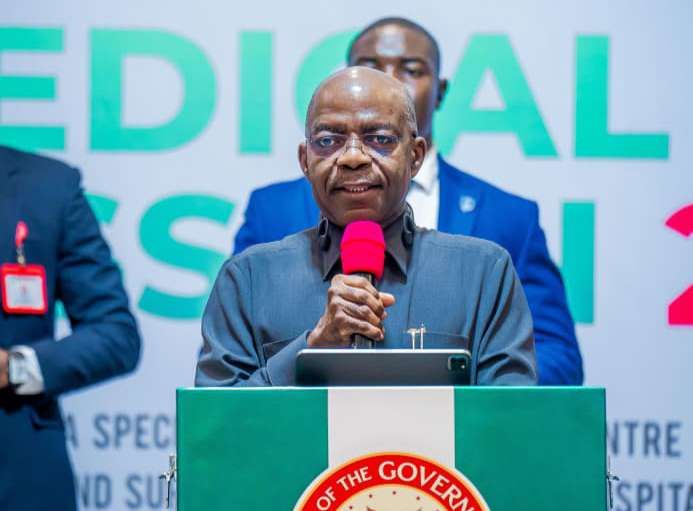
Abia State Governor, Dr. Alex Otti, has said that democracy in Nigeria has not failed, insisting that setbacks in governance and development should be attributed to human choices rather than the democratic system itself.
Otti made the assertion in his 2026 Democracy Day speech titled “Of Freedom and Development,” delivered on Friday, June 12, 2026.
The governor said Democracy Day provides an opportunity for Nigerians to reflect on the country’s democratic journey since 1999 and, more broadly, the struggle that followed the annulment of the 1993 presidential election.
He noted that while many citizens remain disillusioned by current realities, Nigeria must avoid “defeatist narratives” that dismiss democracy as a failed system.
According to him, the country’s challenges are not proof of democratic failure but evidence of “errors in collective and independent decisions” made by leaders and citizens over time.
Otti paid tribute to pro-democracy activists who fought against military rule, describing them as heroes who paid the ultimate price for Nigeria’s freedom.
He said their sacrifices must serve as a reminder that democracy remains “an unfinished struggle” that requires continuous commitment from citizens and leaders alike.
The governor stressed that democracy is not an end in itself but a system designed to guarantee freedom, accountability and development, adding that citizens must resist extremism, violence and any form of governance that undermines human dignity.
He also warned against electoral indifference, saying that citizens must remain actively engaged in the political process to safeguard the integrity of elections.
“The only reward for electoral indifference is misery,” Otti said, urging Nigerians to take responsibility for defending their votes and resisting vote-buying and electoral manipulation.
The governor further argued that credible elections depend on the vigilance of citizens, noting that democratic progress can only be sustained when the electorate remains informed and engaged.
While acknowledging challenges in Nigeria’s democratic journey, Otti maintained that periodic elections remain a significant achievement of the Fourth Republic and evidence of progress compared to past military rule.
Turning to governance in Abia State, the governor said his administration has recorded notable improvements in infrastructure, education, healthcare, security and public service reforms.
He said the state’s development trajectory demonstrates that democracy can deliver tangible results when leaders are accountable and committed to public service.
“In Abia, democracy has empowered us to take control of our destiny,” he said, adding that ongoing reforms were restoring public confidence in governance and attracting renewed investor interest.
Otti assured residents that his administration’s development agenda was irreversible, pledging continued investments in infrastructure and human capital development.
He also urged citizens to remain actively engaged ahead of future elections, stressing that democratic governance requires collective responsibility and informed decision-making.
The governor concluded by reaffirming his commitment to sustaining reforms in the state, while expressing gratitude to the people of Abia for their continued support.
“May the choices we make reflect the sincerity of our conviction,” he added.
Read full speech below:
OF FREEDOM AND DEVELOPMENT
Being the Text of the 2026 Democracy Day Speech by Governor Alex C. Otti, OFR, on Friday, June 12, 2026
1. The most appealing promise of democracy is the allowance for plurality of opinions, the freedom to interrogate ideas and the opportunity for periodic reflection. This day presents to us, members of the Nigerian community, a special invitation to evaluate our pace on the democratic track, interrogate assumption and estimate our measure of progress on 2 fronts, first, since the dawn of the Fourth Republic in May 1999 and more importantly, over the last 33 years following the annulment of the 1993 presidential election won by Chief Moshood Kashimawo Olawale Abiola, GCFR. The point of looking back is not to cast blames or point fingers for subpar outcomes but to shape behaviour and reset priorities. Millions of our compatriots are disillusioned, the gulf between the pre-1993 expectations and the lived experiences of many is widening and as I said on this day 12 months ago, it would be uncharitable to dismiss the legitimate concerns of the men and women who bear the brunt of these contradictions. Even then, we shall be removing ourselves from the promises of the future if only we stay fixated on the frustrations of the present. Yes, a lot may have gone wrong but there is still so much to fight for — for ourselves and those coming after.
2. The years between 1993 and 1999 were defined by the courage and resilience of our compatriots who made very difficult sacrifices to remove Nigeria from the shackles of military dictatorship; they held nothing back, not even their lives. A great price was paid to restore democracy to this land. It then follows that we have to regularly remind ourselves that the rights, freedom and privileges we enjoy today are borne from the toil and tears of thousands of men and women who refused to give in to the threats and shenanigans of military dictatorship. Many of the warriors who fought through multiple trenches to defeat the terror of leadership by the barrel of the gun are no longer with us but in their passing, they left us eternal lessons in courage, patriotism and faith. It is fitting that a day like this is set aside to honour the memories of these brave patriots and fighters and to remind all of us, the living, that the struggle for freedom and development remains unfinished.
3. Many of us have lived through the setbacks and disappointments of the Fourth Republic but it would be defeatist to give in to the cynicism of the hour; agreed that we could have done a lot better on several critical development frontlines, with particular respect to the welfare and security of the population, I, however, do not share the pessimism of those who insist that it has been all doom and gloom. Even then, it is important to make it clear that it is not democracy that has failed, we have only been let down by the errors in our independent and collective decisions. The blame for the disappointments of the post-1999 years belongs entirely to us, as leaders and citizens, not to democracy or its foundational principles. Those who came ahead of us were unyielding in their conviction that democracy is the only genuine vehicle for national development and millions of us today still hold strongly to the same idea but as I had said before, the advantage of democracy itself is the freedom to interrogate even the assumptions that we hold most dearly. As we mark the 2026 Democracy Day celebration, we are duty-bound to rethink our disposition to the ideals and values that sustained the pro-democracy efforts of the last decade of the 20th century here in Nigeria.
4. We do not look back to remain stuck in the past but to identify the points of disconnect between the dreams of yesterday and the reality of the hour. The exploits of our heroes past are proofs that we are capable of great things. The men and women who gave their last full measure of devotion that democracy may flourish in our country deserve our eternal gratitude for lighting the torch of liberty that we now carry forward. The pioneers who charted the path we tread upon in the present age came from all walks of life; they were statesmen, soldiers, lawyers, journalists, teachers, business moguls, traders, students, artisans, housewives and just about anyone with an ounce of patriotism in their veins. If they could defy threats of imprisonment, loss of personal and family fortunes and death in the pursuit of their conviction, what then is our excuse? In honour of their collective memory, we are called to continue the never-ending struggle of the pursuit of liberty and justice.
5. Democracy in itself is not an end; the ultimate goal is to build a free society where the rights of individuals are never up for negotiation. We have a definite responsibility to resist those who profit from misery; terrorists and merchants of public anxiety, by whatever name they go by, have no place in our land. We must, therefore, deploy every legitimate tool at our disposal to confront the nightmare of terrorism which steal lives, shatter dreams and make refugees of vulnerable people, especially children. Beyond the troubling invasion of violent crimes in our public life, we must also not lose sight of the factors that enable extremism. The time is now ripe to effectively denounce the evil of economic and political greed, sectarianism and other behavioural dispositions that are incompatible with democratic values and principles. The heroes of the June 12 struggle came from diverse ethnic and religious backgrounds but were united in the compelling philosophy that democracy held superior proposition for the actualisation of the dreams of our founding. The baton has been handed to us to continue the struggle for which many paid the ultimate price; it is only right that we rise collectively to renounce the forces that are in opposition to this assignment.
6. Democracy is not ideal because it is perfect, it is preferable for the simple reason that there are no superior alternatives. Our reflection on this day should therefore go beyond the well-known limitations and imperfections of democracy but instead focus on how we can make the most of the range of freedom that a democratic system of government offers. Intolerance and other expressions of extremism are antithetical to the course we have taken but again, we are also not bereft of legitimate channels of expressing whatever grievances that we hold. Therefore, there is practically no need to engage in violent conducts just to be heard. I am particularly glad that for all the setbacks we have experienced over the last 7 electoral cycles since the beginning of the Fourth Republic, periodic elections have now become a standard feature of our democratic practice. Every 4 years, citizens get the opportunity to elect those who will function in different elective posts across the states and in Abuja. We may have a reason or two to disagree with the outcome of an election but the mere fact that we get the opportunity to return to the polling stations every 4 years tells an important story of how far we have come in the last 27 years of unbroken democracy.
7. At any rate, elections are a plain waste of resources if they are only conducted as a matter of periodic ritual; the truest measure of the validity of any election is expressed in how its outcome reflect the aspirations and preferences of an informed voting population. Even then, it has also been established, especially in older democracies, that the only guarantee of the credibility of any polling exercise is the vigilance of the citizens, without which, anything is possible. The task for us, as we continue preparations for another round of elections next year, is to rise to the duties of active citizenship, pay attention to the events and developments within the polity, challenge every attempt to manipulate the will of the people before, during and after the conclusion of polls. The only reward for electoral indifference is misery so the price of inattentiveness is too steep that none of us, however wealthy, can afford. An abiding lesson of the multi-year struggle for the restoration of democracy is that no authority, however powerful, has the latitude to eternally resist the resolute will of the people. May I also use this auspicious occasion to announce to us that we strip ourselves of the right to accountable governance when we begin to accept bribes from politicians and political parties for votes; the same thing also happens when we offer ourselves as instruments of violence or perhaps sell our platforms to those who promote bigotry, hatred or sectarian triumphalism. When we do any of these or engage in conducts that dim the bright flame of freedom that democracy promotes, we simply become one with those who desecrate the sacred trust of public office in pursuit of narrow objectives — we become conspirators!
8. In our push for change however, it is important to realise that the outcome we seek may not manifest overnight for progress is a marathon, not a dash. We would do well to appreciate the pitfalls of believing those who make impossible promises, politicians whose desperation for power blind them to obvious realities. We must, however, reject the excuses that characterise inaction or mask patterns of incompetence for even while progress may not happen overnight, they need not take eternity, especially in the face of existential threats. Ultimately, indolence and democracy cannot go together for progress, which is an essential fruit of democracy, requires collective vigilance — an ever-present readiness to interrogate outcomes, demand accountability and insist that only the best is good enough for our community.
9. In Abia, democracy has empowered us to take control of our destiny. Yes, we have been served the short end of the stick a few times but the good news is that our refusal to give up did ultimately pay off. We are better today because we kept faith with democracy, refusing to be frustrated by the disappointments that attended previous endeavours. Through enormous investments in infrastructure, human capital development, public welfare, security and other frontlines of progress, we have demonstrated that freedom and genuine development need not be at conflict. The pride of our land is being restored, not by the benevolence of an individual dictator, but rather for the singular reason that our people took the opportunity that democracy offers to elect leaders who appreciate the thrust of public office. As one who bears the weight of the people’s trust, I am bound to thank you once again, umunne m ndi Abia, for finding us worthy to serve. Let me reiterate my commitment to the principles and aspirations that informed your trust and loyalty to this cause. May I assure that our progress is irreversible, we are never returning to the old order of mediocrity for the light has shone in our path. Just like I hinted, progress may be slow but need not be a mirage. As we prepare for the next round of general election, it is incumbent on all of us to be attentive to everything happening around us for democracy demands knowledge which is the foundation of informed decision-making. Remember a resolute commitment has been made to march forward as a community of people united by a common heritage and bound by shared dreams of the future, let the choices that we make reflect the sincerity of our conviction.
10. Thank you and may God bless you.
Dr. Alex Otti, OFR
Governor, Abia State
June 12, 2026.