

Health
Abia Urges Residents to Prioritise Eye Checks as Glaucoma Cases Rise
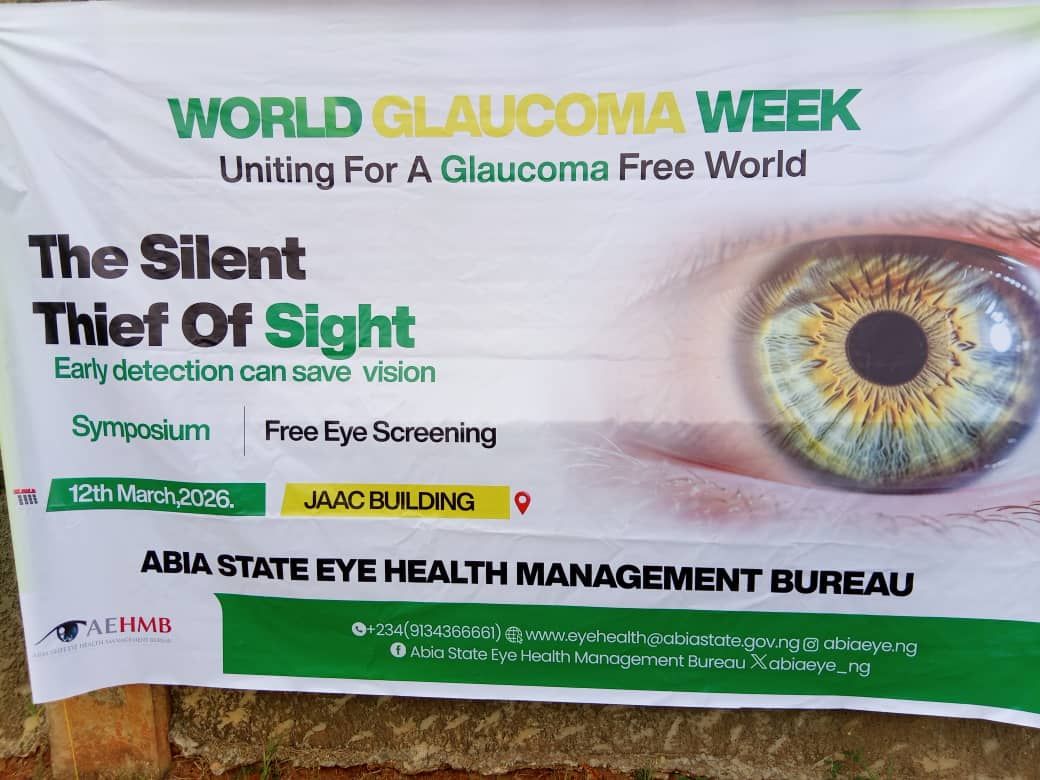
The Abia State Government has urged residents to visit qualified optometrists regularly for eye examinations in order to prevent complications arising from glaucoma.
The call was made on Thursday during an event marking World Glaucoma Day at the JAAC Building in Umuahia, the state capital.
Speaking at the programme, the Commissioner for Health, Dr Ogbonnaya Uche, who represented the state governor, said vision lost to glaucoma cannot be restored, stressing the importance of early detection and regular eye screening.
He disclosed that Abia recently emerged the best performing state in the South East Primary Healthcare Leadership Challenge and noted that the government had expanded optometry services across primary healthcare centres in the state.
According to him, the government has also introduced Smart Primary Healthcare Centres, known as E PHCs, to improve access to medical services and support telemedicine.
“We are building smart primary healthcare centres. Just yesterday, a group of media professionals from across the country visited to assess the digital transformation of our health sector. While in my office, I was able to consult with a patient in Bende Local Government Area through the digital platform,” he said.
“We have begun these services to assist optometrists and other doctors in counselling patients, especially those in remote communities.”
Responding to questions from participants, the Commissioner warned individuals and organisations against engaging unverified medical personnel, saying they would bear responsibility for any consequences arising from such actions.
He added that the state government would not tolerate unregulated medical outreaches and emphasised that all medical outreach programmes must receive prior approval from the Ministry of Health and be conducted by qualified professionals at recognised medical facilities.
Earlier in her address, the Administrator of the Abia State Eye Health Management Bureau, Dr Betty Emeka Obasi, revealed that the state had recorded 6,381 confirmed glaucoma cases since September 2024.
She condemned the activities of traditional healers who recommend unverified herbal substances for the treatment of eye conditions, warning that such practices had worsened visual complications for many residents.
Dr. Obasi also urged traditional rulers to discourage uncertified herbal practitioners within their communities.
She said that since July 2024, following the mandate of Governor Alex Otti, the bureau had upgraded four public eye health centres, treated more than 20,000 patients and carried out over 2,000 restorative eye surgeries.
Dr. Obasi added that the bureau had also established 10 vision centres within primary healthcare facilities across the state, among other initiatives aimed at improving eye care services.
In a lecture delivered at the event, Professor Bernadine Ekpeyong outlined preventive measures against glaucoma and explained that eye pressure, optic nerve assessment and side vision tests are the primary methods used in diagnosing the condition.
She said symptoms of glaucoma include blurred vision and tunnel vision, adding that although the disease has no cure, it can be managed if detected early.
According to her, patients with glaucoma may still have long distance vision but often lose the ability to see effectively from the sides.
Professor Ekpeyong, a professor of Public Health Epidemiology and Head of the Epidemiology, Global Health and Biostatistics Unit, explained that medically prescribed eye drops, surgical procedures and laser treatments are key methods used in managing the condition.
She also advised the public to maintain regular exercise, eat balanced diets and avoid smoking and excessive alcohol consumption in order to support overall eye health.
In his closing remarks, a former Chief Medical Director of the Federal Medical Centre, Umuahia, Dr Abali Chukwu, stressed the importance of professionalism in medical practice.
He called for stronger policies to ensure safe medical services and to eliminate quackery in the health sector.