Business
Otti, Mbah, Soludo, Ohanaeze push South East Vision 2050, call for energy, infrastructure and regional synergy
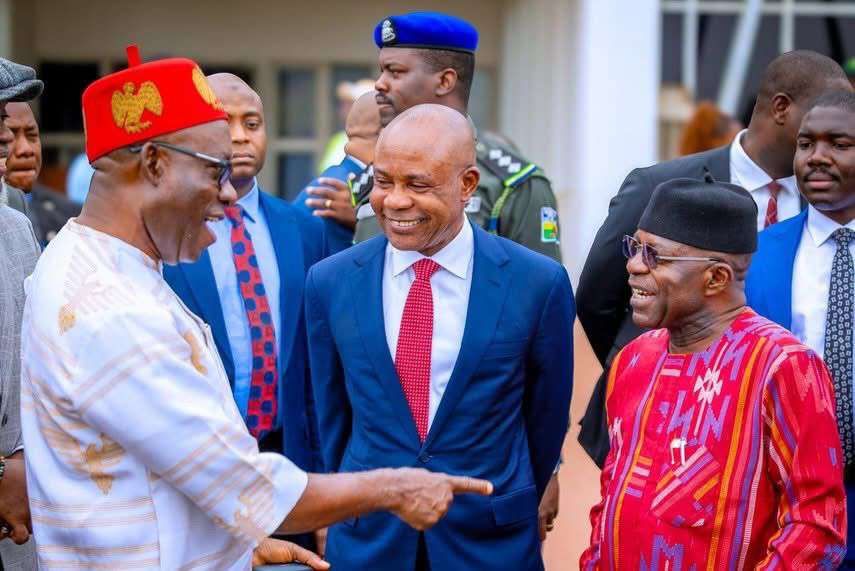
Governors, policymakers, and regional leaders in Nigeria’s South East have unveiled ambitious plans under the South East Vision 2050 framework, focusing on energy sufficiency, infrastructure development, and regional integration as the foundation for long-term prosperity.
The four-day South East Vision 2050 Regional Stakeholders Forum, convened under the auspices of the South East Development Commission (SEDC) and the Office of the Vice President, Senator Kashim Shettima, brought together governors Alex Otti (Abia), Peter Mbah (Enugu), Charles Soludo (Anambra), Francis Nwifuru (Ebonyi), and representatives of Imo State. Ministers, lawmakers, and community leaders were also in attendance.
Otti champions regional energy masterplan
Governor Alex Otti of Abia State made a strong case for a coordinated regional energy strategy to drive industrialisation, job creation, and economic revival. Speaking at the forum, Otti stated that the South East has the potential to generate between 10,000 and 15,000 megawatts of electricity over the next decade if its abundant energy resources – including natural gas, crude oil, coal, solar, hydropower, and biomass – are optimally harnessed.
“Power is the foundation of industrial growth, and the modern Aba is proof that investments and higher enterprise outputs are functions of steady and predictable electricity supply,” Otti said, citing the success of the Geometric Power plant and the Aba ring-fenced electricity zone as models for replication across the region.
He outlined a three-pronged regional energy strategy:
Resource identification and optimisation – mapping and leveraging untapped energy resources.
Sustained investment in energy infrastructure – including power plants, transmission lines, and metering systems.
Adoption of a suitable market model – initially de-risked by governments, later run efficiently by private sector operators under robust regulatory oversight.
Otti emphasised the importance of fair electricity pricing, metered billing, and regional collaboration, noting that cooperation among South East states would be more effective than individual efforts.
Soludo advocates a Marshall-style plan for the South East
Anambra State Governor Charles Soludo echoed calls for regional collaboration, urging a development plan that is indicative rather than prescriptive, attracts investment, and delivers tangible results.
“A Marshall-style plan for the South East could be the way forward – a focused, time-bound agenda addressing our region’s unique challenges,” Soludo said. He highlighted three priority areas:
Regional security – sustainable funding and advanced surveillance to protect communities.
Infrastructure – superhighways, rail lines, gas pipelines, power plants, and seaports.
Institutional framework – strong coordination across states for effective implementation.
Soludo stressed that collective action and strategic leadership are key to unlocking the South East’s potential.
Mbah pushes South East as a single economic bloc
Governor Peter Mbah of Enugu State proposed a South East Common Market, a borderless integration of commerce, talent, infrastructure, and industry, designed to attract investment at scale. He noted that Vision 2050 must go beyond rhetoric to execution, prioritising cross-state projects, integrated logistics corridors, coordinated regional security, and harmonised investment rules.
“This is not about prestige or rivalry; it is about building systems that create jobs and shared prosperity,” Mbah said.
Ohanaeze calls for funding and reconciliation
John Azuta-Mbata, President-General of Ohanaeze Ndigbo Worldwide, urged President Bola Tinubu to adequately fund the South East Development Commission, describing it as a vehicle for both development and reconciliation.
“The South East has contributed immensely to Nigeria’s development, yet feelings of exclusion and unresolved grievances persist. Supporting SEDC demonstrates the federal government’s commitment to equity and justice for the region,” Azuta-Mbata said.
Vision 2050: a roadmap for the South East
The forum, chaired by SEDC Chairperson Emeka Wogu and managed by SEDC Managing Director Mark Okoye, is intended to produce a unified, long-term development framework for the South East. Okoye said the forum would culminate in a prioritised pipeline of regional projects within six to seven weeks, covering energy, infrastructure, security, and institutional development.
With Vision 2050, the South East aims to transform into a globally competitive industrial hub, leveraging strategic leadership, regional cooperation, and deliberate investment to end decades of