Business
Oil majors’ return signposts renewed confidence in Nigeria’s oil sector
….as nearly $40bn of new investments sustain ongoing rally
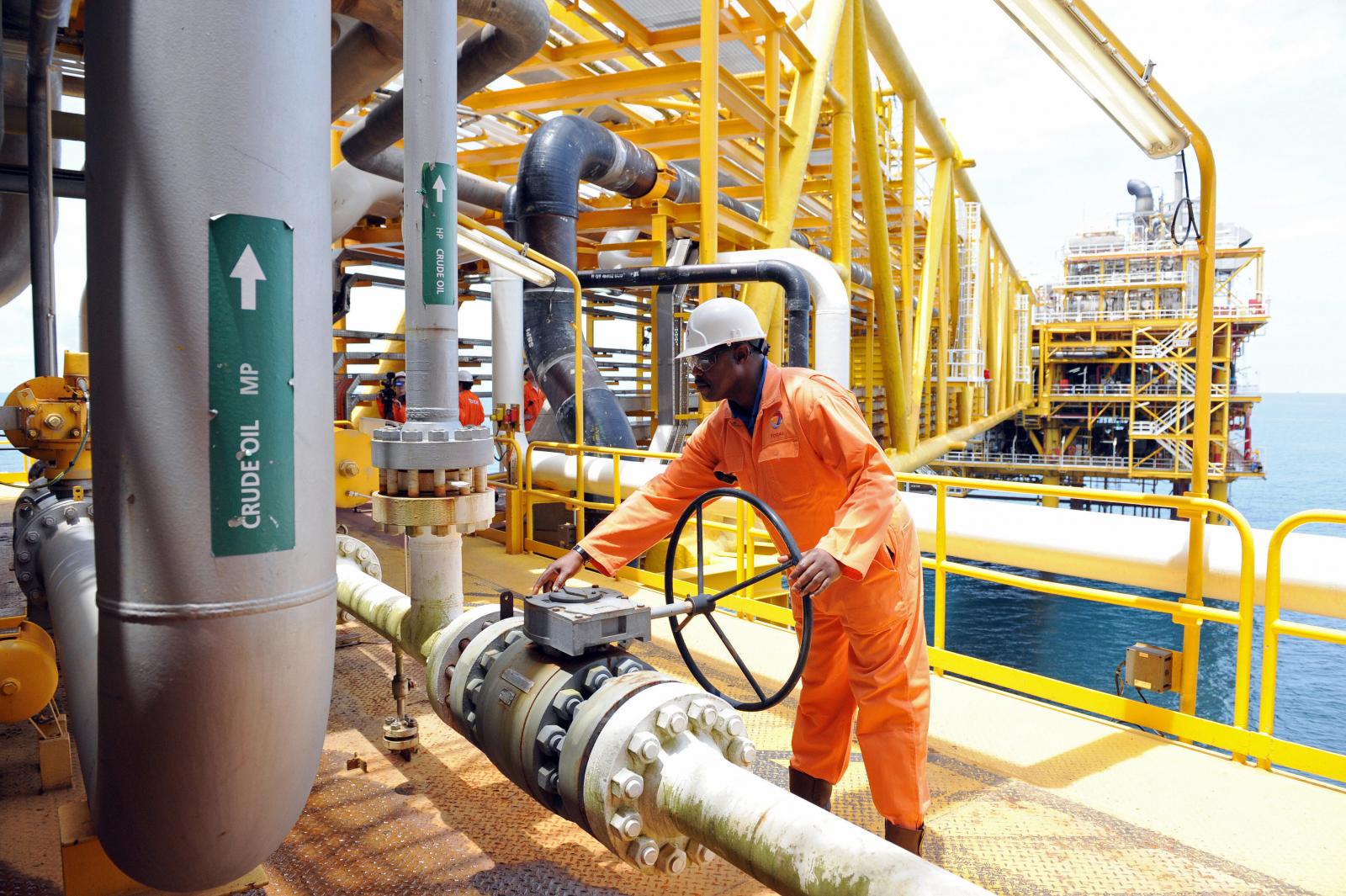
Nigeria’s oil and gas industry is experiencing a major surge from a flurry of investments indigenous and international oil companies (IOCs) are pumping into the sector, Business Hallmark can report.
From the reopening of abandoned onshore oil wells by indigenous oil companies, to the expansion of offshore oil projects and the signing of Final Investment Decision (FIDs) for new projects by IOCs, the oil industry is experiencing a surge not seen in the last 25 years.
From a low of 940,000 barrels per day in September 2022, oil production has climbed to an average of 1.8million barrels per day (including condensates).
The sharp u-turn to the path of growth is largely attributed to the concerted efforts by the present administration to address the challenges that had bogged down the industry.
These efforts by government, apart from helping to revive abandoned oil wells, are bringing in new investments which are now reshaping the nation’s oil and gas industry.
It would be recalled that the nation’s oil and gas industry had before now been in the news for all the wrong reasons. Owing to years of government neglect, inadequate funding, policy somersaults, institutional corruption, hostilities from host communities, massive oil theft, and low investors confidence, the oil and gas sector, which positively drove Nigeria’s economy in the 70s, 80s, and 90s, witnessed a sharp decline.
Reversing The Decline
Owing to dwindling returns and their inability to cope with the challenges in the oil and gas sector, International Oil Companies (IOCs), starting from 2010, began exiting the nation’s troubled oil and gas industry.
The IOCs exit, coupled with myriad of problems in the oil industry, led to the crash of Nigeria’s crude oil output.
From a peak of 2.64 millions barrels per day of crude oil in 2010, Nigeria’s oil production crashed to its lowest level of 940,000 barrels per day in September 2022.
Expectedly, the attendant fall in crude oil production led to significant revenue losses for operators and the three-tier of government, with slow down in developmental projects and many states unable to pay workers salaries and wages.
However, the tide has turned, and the hitherto struggling sector is now one of the best performing economic sectors in the country.
At the end of 2025, average daily crude oil production climbed to 1.8million barrels, while gas production stood at 7.4 billion standard cubic feet per day (bscfd).
Meanwhile, the turnaround is expected to be sustained in coming years with a flurry of investments in oil and gas assets by indigenous and international oil companies (IOCs).
From available data, in the last one year, more than 20 major investments translating to billions of dollars have been made in the sector.
The most recent investment decision of $20 billion was announced in January during the visit of the management team of British oil giant, Shell, to Nigeria.
Shell’s Chief Executive Officer, Wael Sawan, who made the announcement during a meeting of the firm’s top management team with President Bola Tinubu at the Presidential Villa, Abuja, said the $20 billion worth Bonga South West deep-water oilfield project had already been green lighted.
Sawan added that Shell and its partners hope to take Bonga South West to a final investment decision in 2027.
According to him, half of the money will be devoted to capital projects, with the other half budgeted for operating expenses and others. The Shell CEO also revealed that his firm is interested in Nigeria’s exploration license round, meaning more investments in the industry from the company is coming.
In his reaction, a visibly happy President Tinubu said incentives by his administration will be ring-fenced and focused on new capital, incremental production and strong local content delivery.
“My expectation is clear: Bonga South West must reach a final investment decision within the first term of this administration,” the president stated.
Shell’s Leading Role
This is not the first investment decision Shell will be embarking on. BH checks revealed that in the past one year alone, the company invested about $10 billion in the nation’s oil and gas sector.
They included the $5 billion pumped into the Bonga North deep-water project, the $2 billion in the Bonny HI Offshore Gas Project that will feed into Nigeria Liquefied Natural Gas (NLNG), and the $122 million investment in the Iseni Gas Project.
In 2025, Shell acquired a stake in TotalEnergies that raised its share in the Bonga oilfield to 65%. Other shareholders of the Bonga deep-water project include Italian and American oil giants, ENI and Exxon Mobil.
In the same vein, French oil giant, TotalEnergies, recently boosted Nigeria’s oil and gas production, when it announced a $550 million Final Investment Decision (FID) on the Ubeta Field Development Project.
Once on stream, the Ubeta field, which is located in OML58, North-West of Port Harcourt, Rivers State, will produce about 350MMScf/day of gas and 10,000 BBLS/day of associated liquids, tapping into the vast gas reserves and contributing towards securing gas supply to the Nigeria Liquefied Natural Gas (NLNG).
The gas condensate field will be developed with a new 6-well cluster connected to the existing Obite facilities through an 11km buried pipeline. Gas production at the field is expected to commence in early 2027,
Apart from the Ubeta Field Development Project, TotalEnergies recently developed two gas projects, the Ikike and Akpo West Fields.
Like their foreign counterparts, indigenous oil companies are also driving development in the nation’s oil and gas sector by recovering abandoned oil fields and increasing domestic production capacity.
Indigenous Firms Involved
According to BH checks, indigenous oil firms have invested over $7 billions of dollars to acquire and develop onshore and shallow water assets abandoned by international oil majors.
This investments have helped the government move closer to its goal of boosting oil output by an additional one million barrels per day by 2027.
In December 2025, Heirs Energies, owned by the Chairman of United Bank for Africa (UBA), Tony Elumelu, announced the reactivation of over 100 dormant wells within 100 days.
Speaking at a media event in Lagos, the Chief Executive Officer of Heirs Energies, Osa Igiehon, said one of the wells had been shut down for the past 37 years.
According to him, there was nothing wrong technically with the well, but security and community issues, which the company was able to resolve to get it back to life.
While hailing the company’s prowess in brownfield operations and approach to reviving dormant assets, Igiehon stated that Heirs Energies focused on removing operational, regulatory and social risks that had historically hindered output.
“We have de-risked all the issues and constraints. We have taken away all excuses. We have strong relationships with our JV partner, regulator, and host communities, which has enabled a new way of working. Running a 67-year-old asset at more than 85–90 per cent uptime is remarkable, by a 100 per cent Nigerian team.
“We are known for our expertise in brownfields. We have achieved all this without drilling new wells. We call our approach, which is proprietary, brownfield excellence: making the most of existing investments before creating new ones,” Igiehon added.
Speaking on the continued recovery of the oil and gas sector, industry experts attributed it to the determination of the present administration to free the industry from the shackles holding it down.
“The introduction and implementation of oil sector reforms by incumbent President Bola Tinubu aimed at jump-starting the stagnant sector has set the sector on the path of growth.
“When the president started the reforms, especially the signing of Executive Orders that ease up the bottlenecks inherent in the system, many people doubted him.
“Today, he has shamed detractors. Even foreign oil companies that hurriedly left the country because of the harsh operating environment are now coming back in droves.
“Frankly, the upsurge in activities in the oil and gas industry and the flurry of investments by indigenous and international oil companies (IOCs) signposts a more promising future for the recovering oil sector,” said Kunde Olujimi, CEO of an oil servicing firm based in Port Harcourt.