Politics
Senate approves state police bill, gives governors power to appoint police commissioners
The Senate on Wednesday approved a constitutional amendment bill seeking the establishment of state police, a significant move that could transform Nigeria’s security framework and end decades of exclusive federal control over policing.
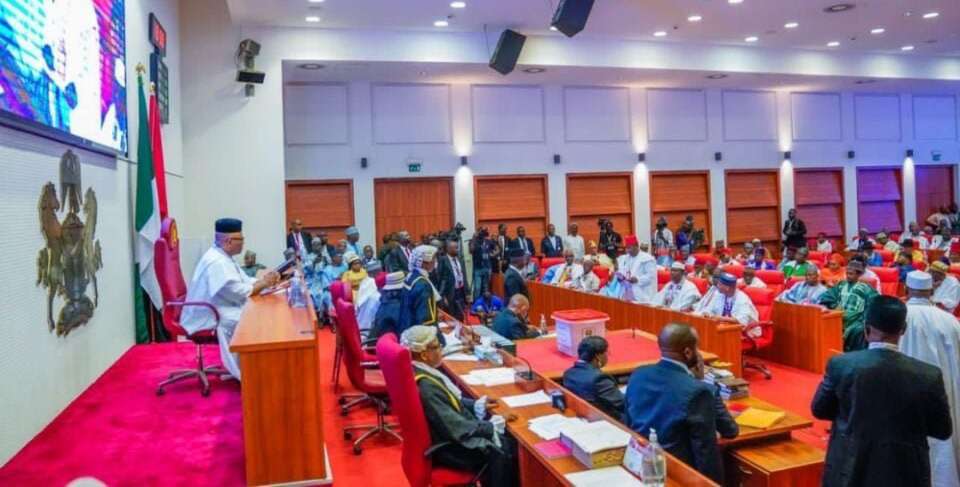
The bill scaled its final legislative hurdle in the upper chamber after securing the support of more than two-thirds of senators during a manual voting exercise conducted on the floor of the Senate.

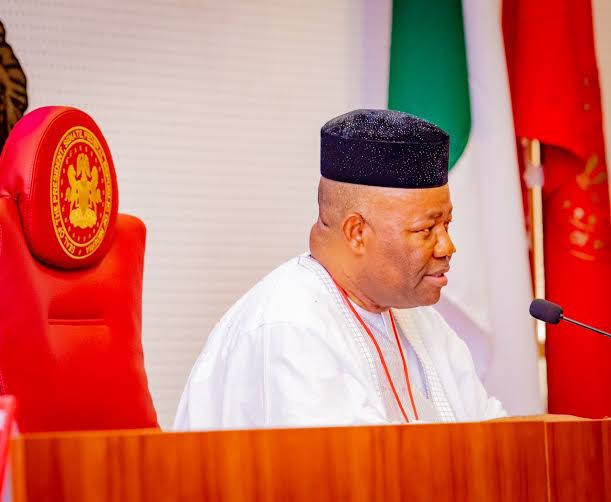
Senate President Godswill Akpabio announced the passage of the legislation following overwhelming support from lawmakers during plenary.
The bill was considered after the presentation of a report by the Senate Committee on the Review of the Constitution, chaired by Deputy Senate President Barau Jibrin. Senators first examined the provisions at the Committee of the Whole before adopting them and proceeding to a final vote.
Leading debate on the measure, Senate Leader Opeyemi Bamidele urged lawmakers to support what he described as a crucial reform designed to strengthen the nation’s capacity to tackle growing security challenges.
Under the proposed amendment, state police services will operate alongside the existing federal police structure, creating a dual policing system across the country.
One of the major provisions of the bill empowers state governors to appoint Commissioners of Police for their respective states, subject to confirmation by the state Houses of Assembly.
The legislation provides that while the Nigeria Police Force will continue to be headed by the Inspector-General of Police, each state police command will be led by a commissioner appointed by the governor and approved by the state legislature.
The bill also defines the relationship between governors and state police authorities, allowing governors to issue lawful written directives on matters relating to public safety and public order within their states.
To address concerns that state police could be used for political persecution, lawmakers inserted safeguards aimed at protecting citizens’ rights and democratic freedoms.
The proposed amendment expressly prohibits state police commissioners from arresting, detaining, investigating or deploying force against individuals, political parties or groups solely for criticising a government, except where such actions are permitted by law.
Lawmakers said the provision was intended to prevent abuse of the proposed policing system and ensure adherence to due process and constitutional rights.
The passage of the bill followed the Senate’s decision to abandon plans to use an electronic voting system for the consideration of constitutional amendment proposals.
Senators opted for manual voting after concerns were raised that technical issues affecting some electronic devices could prevent full participation and compromise the credibility of the exercise.
Bamidele moved the motion for manual voting, arguing that every senator should have the opportunity to participate in the historic decision.
Akpabio endorsed the proposal, stating that an open voting process would guarantee transparency and allow Nigerians to see how their representatives voted on critical constitutional matters.
Several prominent government officials witnessed the proceedings, including Kaduna State Governor Uba Sani, Ogun State Governor Dapo Abiodun, Ondo State Governor Lucky Aiyedatiwa, and Chief of Staff to the President, Femi Gbajabiamila.
The state police proposal has long generated intense national debate, with supporters arguing that a decentralised policing system would improve intelligence gathering and response to local security threats such as banditry, terrorism, kidnapping and communal violence.
Opponents, however, have repeatedly expressed fears that governors could use state police formations to harass political opponents and suppress dissent.
Despite the concerns, Wednesday’s vote represents a major milestone in the effort to reform Nigeria’s security architecture.
The bill will now proceed to the next stage of the constitutional amendment process, including consideration by state Houses of Assembly, before it can become part of the Constitution.
If eventually adopted, the reform would pave the way for the establishment of state-controlled police services operating alongside the federal police structure for the first time in Nigeria’s history.