Politics
Presidency insists Tinubu met Kagame amid controversy over AI photo
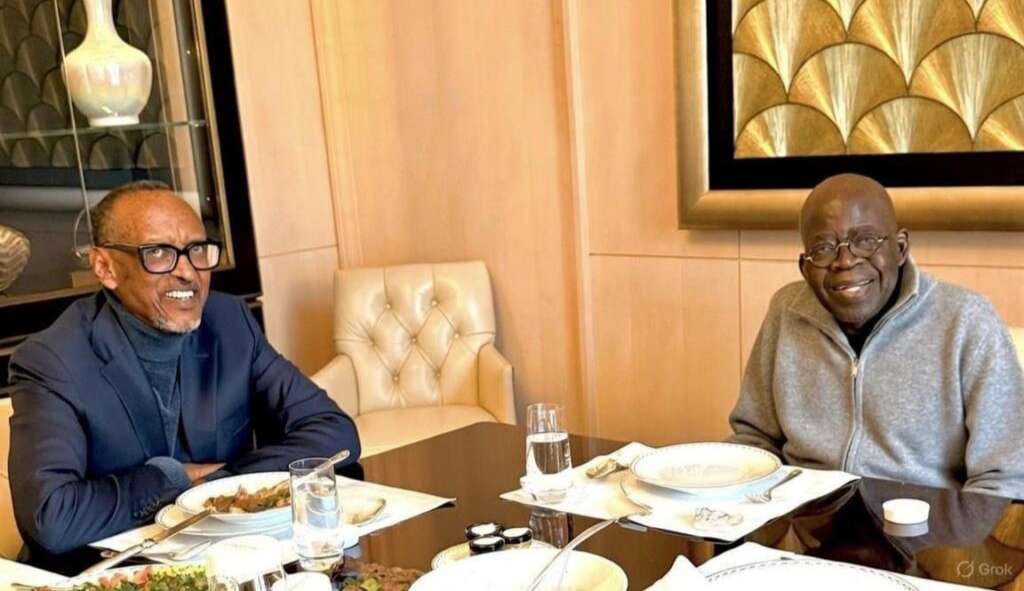
The Presidency has dismissed claims that President Bola Tinubu’s recent meeting with Rwandan President Paul Kagame was fabricated, insisting that the engagement took place as reported despite controversy surrounding a photograph shared on social media.
The clarification followed a wave of online speculation after an image of the two leaders was posted on President Tinubu’s verified X (formerly Twitter) account on Sunday, January 4, 2026. The photograph, which showed the presidents during a private lunch in Paris, France, drew attention after users noticed a “Grok” watermark—linked to Elon Musk’s xAI chatbot—prompting allegations that the image was generated using artificial intelligence.
Reacting on Monday, the Senior Special Assistant to the President on Media and Publicity, Temitope Ajayi, rejected the claims, describing them as a misrepresentation of facts.
“The narrative that the picture of Presidents Bola Tinubu and Paul Kagame taken in Paris yesterday was AI-generated is not correct,” Ajayi said in a statement. “The media reports and social media comments that followed are misrepresentations of facts.”
Ajayi confirmed that the meeting between the Nigerian and Rwandan leaders indeed took place in Paris as part of President Tinubu’s diplomatic engagements during his year-end break. He explained that the two presidents met for lunch on Sunday before later joining French President Emmanuel Macron for dinner the same evening.
According to him, the controversy arose from a misunderstanding surrounding the image’s production. He said the photograph was taken with a mobile phone, which affected its initial quality, and was later enhanced using digital tools to improve clarity.
“The picture is real and not AI-generated as claimed. The photographer later used Grok to improve the picture quality. That is not a reason to conclude it was AI-generated,” Ajayi said.
He added that greater care should have been taken before drawing conclusions about the authenticity of the image.
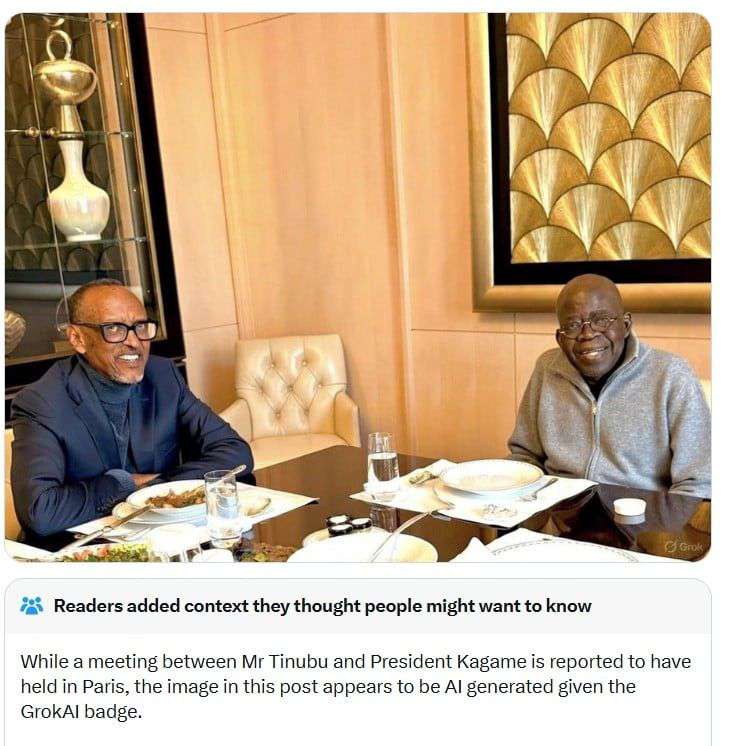
“The writer or editor should have asked questions before this wrong conclusion,” he stated.
The Presidency said the clarification was necessary to counter misinformation and reaffirm the authenticity of the President’s diplomatic engagements, urging the public to exercise caution when interpreting visual content shared on social media.