Business
Trump claims “fantastic trade deals” after Xi summit, but details remain unclear
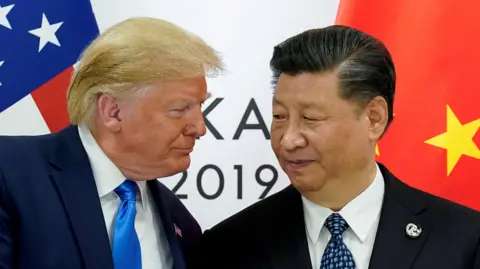
United States President Donald Trump has said he struck “fantastic trade deals” and resolved several outstanding disputes during high-level talks with Chinese President Xi Jinping this week, although neither Washington nor Beijing has released detailed agreements confirming the claims.
Trump made the remarks after a series of meetings in Beijing on Friday, where he said progress had been achieved across trade, energy, aviation, agriculture, and emerging technologies such as artificial intelligence. However, hours after the summit concluded, official documentation outlining any concrete deal remained unavailable, and Chinese authorities did not confirm the specifics of the US president’s statements.
The American leader had gone into the talks aiming to secure major economic concessions, including expanded access for US agricultural exports, aviation deals, and cooperation in technology. He also sought to ease tensions in several strategic areas that have strained relations between the world’s two largest economies.
Following the first day of discussions, Trump claimed that Xi had agreed to a series of major commitments, including helping to address tensions around the Strait of Hormuz, purchasing 200 Boeing aircraft, and increasing imports of US oil and soybeans. However, these assertions were not independently verified, and Beijing has not issued any formal confirmation.
China’s foreign ministry, when asked about the claims, declined to either confirm or deny them, instead reiterating general diplomatic positions. The cautious response reflected the restrained tone Beijing has maintained throughout the summit, even as Trump publicly described Xi as a “great leader” and “friend.”
Despite the lack of clarity on agreements, Trump maintained that the visit had produced significant outcomes. Speaking after a walk with Xi in the gardens of Zhongnanhai, a central leadership compound in Beijing, he said the two sides had made progress on long-standing disputes.
“We’ve made some fantastic trade deals, great for both countries,” Trump said. “We’ve settled a lot of different problems that other people wouldn’t have been able to solve,” he added, without providing further details.
Xi, in his own remarks, described the visit as a “milestone” and said the two countries had established what he called a “new bilateral relationship of constructive strategic stability.” He also reportedly offered symbolic gestures, including a promise to send Trump seeds for the White House Rose Garden.
The summit also touched on sensitive geopolitical issues, including tensions in the Middle East and global energy security. In a post-summit interview with Fox News, Trump said Xi had indicated willingness to assist in efforts linked to the Strait of Hormuz, a vital global shipping route that has faced disruptions due to escalating regional tensions.
According to Trump, Xi expressed support for keeping maritime routes open and offered to assist if needed. “If I can be of any help whatsoever, I would like to help,” Trump quoted Xi as saying. However, China’s foreign ministry later issued a general statement calling for a “comprehensive and lasting ceasefire” in relation to regional conflicts, without directly addressing Trump’s account.
When pressed further at a regular briefing, a ministry spokesperson avoided confirming whether Xi had made any specific commitments regarding Hormuz or other security issues.
Trade discussions reportedly included significant commercial expectations from the US side. Trump said one major outcome was an agreement for China to purchase 200 Boeing aircraft, alongside increased imports of American oil and agricultural products such as soybeans. Beijing, however, has not confirmed any such procurement commitments.
The US president also suggested that discussions touched on artificial intelligence cooperation, including possible “guardrails” for advanced technology development. Treasury Secretary Scott Bessent told CNBC that both sides discussed AI-related frameworks, noting that “the world’s two AI superpowers are going to start talking.”
Despite the optimism expressed by the US delegation, no joint statement was issued at the conclusion of the talks, and no formal economic or security agreement has been published.
Tensions over Taiwan also remained a sensitive backdrop to the meeting. Chinese state media reported that Xi warned Trump that missteps on Taiwan could lead to confrontation between the two countries. Trump did not publicly address the issue during the summit, although US officials later reiterated that Washington’s policy on Taiwan remains unchanged.
US Secretary of State Marco Rubio reaffirmed this position in comments to NBC, while Taiwan’s government expressed appreciation for continued US support.
On the streets of Beijing, public reaction to the summit was muted. Some residents said expectations had been low from the start, with little anticipation that the talks would produce major breakthroughs.
Analysts also cautioned against overstating the outcome. Yue Su of the Economist Intelligence Unit said the tone suggested cautious progress rather than substantive change. She described the relationship as one of “fragile stability” that may reduce immediate tensions but does not resolve deeper disagreements.