Business
Nigeria’s agric mechanization project threatened over abandoned billion Naira of equipment
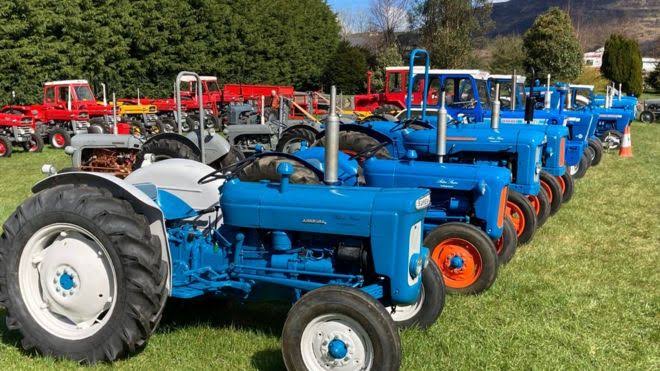
Idle tractors, harvesters expose waste
Food insecurity worsens, farmers remain trapped in manual cultivation
By AYOOLA OLAOLUWA
Multi-billion naira agricultural equipment procured under the Renewed Hope National Agricultural Mechanisation Programme (RHNAMP) have been abandoned in various parts of the country at a time millions of Nigerians are struggling with soaring food prices and worsening hunger, Business Hallmark’s investigation has revealed.

Findings showed that tractors, harvesters, planters, threshers and other mechanized farming equipment acquired under the scheme with huge public investments are lying idle, deteriorating from months of neglect and bureaucratic bottlenecks, instead of being deployed to boost food production and ease the burden on farmers.
The development has raised fresh concerns over the waste of public resources and the government’s commitment to achieving food security.
It would be recalled that President Bola Tinubu had on Monday, June 22, 2025, launched the Renewed Hope National Agricultural Mechanisation Programme in June 2025 during a ceremony held at the National Agricultural Seeds Council (NASC), Sheda, along the Abuja–Lokoja Expressway, Abuja.
Speaking during the event, President Tinubu reaffirmed his administration’s commitment to transforming Nigeria’s agriculture sector by modernizing farming practices and ensuring national food security.
Ambitious Agenda
Describing the initiative as a landmark moment in his administration’s food security agenda, the president said it would empower farmers and stimulate rural development.
“We are very proud of what we are doing. We made a promise when we came in. We are fulfilling that promise. Two years ago, I sounded the alarm on our nation’s food security crisis. I demanded immediate and innovative solutions. That, again, is answered today, this is the first phase of it.
“We envision Nigeria as a global agricultural powerhouse, supplying quality produce to international markets while ensuring every citizen can access affordable, nutritious food.
“That’s why we took a bold decision to establish this new agricultural mechanisation programme. We are just beginning”, the president said.
The president assured that the 2,000 tractors and accompanying implements would be distributed nationwide through a service-provider model to support smallholder farmers with access to modern equipment, reduce manual labour and increase yields.
He added that they are expected to support more than 550,000 farming households, cultivate over 500,000 hectares of farmland annually and boost food production nationwide.
In all, 2,000 tractors, 10 combine harvesters, 12 mobile workshops and over 9,000 delivered agricultural implements were unveiled. The contractors smiled to the bank, while the nation is still languishing in food scarcity and hunger, and public resources wasted.
Apart from supplying the agricultural equipment, Belarusian experts are expected to transfer technology and provide training support for Nigerian farmers.
BH learnt that the landmark deal, packaged by international partners, especially the Republic of Belarus, was facilitated by a Belarusian businessman and former classmate of the president at the University of Chicago, Alex Sigman.
Public loss, Private Gain
However, more than a year after the agricultural equipment was launched and declared ready for use, they are largely idle and deteriorating at sheds where they are being kept.
Our correspondent learnt that many Nigerian farmers are currently lacking access to the equipment because of bureaucratic bottlenecks originally put in place to protect the initiative from abuse. These safeguards, it was gathered, have contributed to the slow take-off of the programme.
Sources in the Federal Ministry of Agriculture and Food Security informed BH that in an effort to safeguard the scheme from abuses that killed past initiatives, the government decided to structure the RHNAMP along the service-provider model, rather than direct ownership by farmers.
They disclosed that the task of overseeing a transparent and sustainable framework for allocation, maintenance and repayment was assigned to the Bank of Agriculture (BoA)
After a long wait of about eight months which the Bank of Agriculture blamed on the need to draw up effective framework for implementation of the Renewed Hope National Agricultural Mechanisation Programme, it opened applications for expressions of interest from mechanisation service providers willing to manage the farming equipment.
The service provider model will establish tractor service centers in farming communities, allowing smallholder farmers to lease tractors as needed.
Cog in the Wheel
At the end of the bidding exercise, which attracted more than 100,000 expressions of interest from mechanisation service providers, the Renewed Hope National Agricultural Mechanisation Programme finally commenced in February 2026, eight months after it was launched.
However, due to the tough requirements needed to access the tractors, planters, harvesters and other farming tools, many farmers have not been able to switch to mechanisation, but continued to rely on outdated cultivation methods that limit productivity and increase production costs.
Many of the equipment, especially tractors, planters, and harvesters are in bad state. Sources in the Works Department of the Federal Ministry of Agriculture disclosed that parts of the machines have deteriorated and need servicing, or outright replacements due to non-use.
Affected parts include batteries, tyres, cylinder walls, engine bets, transmission and engine oils and other critical components.
“It is quite unfortunate that many of these equipment purchased with hundreds of millions of dollars are parked without being put to use and allowed to rot away.
“Automobiles, whether cars, trucks or heavy vehicles like tractors and harvesters, are designed to be run like horses. You cannot buy a horse and make it stand, or sit idle all day, they are meant to be ridden else they will develop problems. So as vehicles.
“As a general rule of checking, three things in vehicles; the battery, anything that is rubber (serpentine belt, tyres), and the fluids (oils, coolant) must be put to use regularly.
“When we were moving some of them in June, their batteries had already gone bad despite the fact that they had been disconnected from the terminals.
“But what many people don’t know is that even if you disconnect a vehicle’s battery, it cannot retain all the liquid inside it forever. It will drain eventually and reduce its life.
“Many of the service providers had to look for spare batteries to move the tractors. For those that didn’t come fully prepared, we normally source for batteries to help jump-start the tractors and harvesters”, said a mechanic with the works department of the Federal Ministry of Agriculture, FCT.
Apart from battery issues, a large percentage of the equipment imported from Belarus have also experienced deterioration.
“The belts and wires of several of the equipment have also deteriorated due to inactivity over a long period. While preparing them for handover, we found out that the serpentine belts of many of them are corroded, while rodents have chewed up wires while they were idle.
“The valves and cylinder walls of many of the tractors were also corroded due to lack of oil or movement inside.
“Apart from these, another major challenge we are facing with these motorized equipment is dried out seals. When a seal, like an engine rear main seal and differential seals, are left unused for long periods of time, they dry out. When this happens and you use the vehicle, it has a tendency to rip or tear the seals and cause massive oil leaks.
Lost of Hope
“We (works department mechanics/technicians) experience this daily while preparing the tractors and harvesters for delivery.
“Unfortunately, some of the seals are usually in tight spots where you cannot easily get to them. Many tractors, which their seal defects could not be identified on site broke down on the road and had to be towed and repaired at huge expense.
“The wheels of some of the trucks also got jammed as a result of them being stationary in one place for months. Thankfully, they are parked far away from coastal states like Lagos, Delta, Rivers and Akwa Ibom where machines are prone to seawater corrosion.
“We’ve also recorded several instances where interior electrical parts like power windows and electric seats got jammed; engine oil and brake fluid break down and lose their ability to lubricate and have to be replaced”, the senior senior tech officer said.
BH findings also revealed that more than one year after the official takeoff of the national agricultural mechanisation programme, none of the 52 tractor stations/centres the Federal Government promised it would build to manage or maintain the tractors have been officially commissioned.
Meanwhile, the slow take-off of the national agricultural mechanisation programme has deprived thousands of smallholder farmers of access to modern farming equipment, forcing them to rely on crude manual methods that limit productivity, increase production costs and contribute to persistent shortages of staple foods.
The consequences are reflected in rising food inflation, shrinking harvests and growing dependence on food imports.
Speaking on the development, agriculture experts, farmers’ associations and policy analysts called for the removal of all bottlenecks impeding the successful takeoff of the programme.
According to them, making the equipment available to farmers could significantly raise crop yields, lower production costs and strengthen Nigeria’s food security.
They also called for an independent audit of the programme, accountability for abandoned equipment and a comprehensive overhaul of the country’s agricultural mechanisation strategy to prevent further waste of taxpayers’ money.
In its own submission, the umbrella body of rice millers in Nigeria, Rice Millers Association of Nigeria (RIMAN), applauded the Federal Government’s efforts to improve mechanisation, but argued that the high cost of equipment and the prevailing economic situation are discouraging many operators from participating.
RIMAN Chairman, Peter Dama, said many farmers and millers, who are in the majority are unable to take advantage of the Federal Government’s agricultural mechanisation drive because they lack the financial capacity to either rent or purchase the equipment.
“The process is on, but people are not really signing up for it because the money is not there? People don’t have the money to really buy all those things because things are very expensive”, he said.
He urged the government to focus on affordable mechanisation options that would benefit smallholder farmers, particularly irrigation equipment and small-scale tractors.
“We told them that the truth of this matter is that you can do mechanisation by supplying solar pumps for irrigation.
“You can also get small tiller tractors or tillers that you can use for farming. They use very little fuel to till your ground, to till your farm.
“Those are some of the equipment people go for, and you can see a lot of Chinese and Japanese are bringing in those small tiller tools”, Dama explained.
Association Decries Neglect
Dama also expressed concern over the financial burden of the “farm equipment service-provider model”, lamenting that financing remained a major obstacle for most farmers.
According to him, only wealthy farmers or cooperatives with members in the same location could realistically benefit from tractor acquisition schemes.
“The Bank of Industry (BOI) is the people I know who are in charge of anything tractor-related. And unless you are a big or rich farmer with access to funding, or farmers in one location coming together as cooperatives, it will be extremely difficult to adopt mechanized farming.
“But in a situation like the one we have in our association when a farmer is in Niger, one is in Enugu, another is in Calabar, and yet another in Kaduna, how can you come together as a cooperative association to pull money together? If I am in Niger, I will want the tractor to come and work for me after making my own contribution”.
He maintained that despite government efforts to promote mechanisation, inadequate financing continues to limit participation by farmers across the country.
“The tractorisation thing is a problem. People don’t have the money”, he said.
Agriculture stakeholders who spoke to BH on the matter warned that unless affordable financing is made available to farmers to acquire modern farming equipment, the country will continue to grapple with low yields, rising food prices and increased dependence on imports.
They urged the Federal Government, commercial banks and development finance institutions to expand access to low-interest agricultural credit and accelerate mechanisation programmes to boost productivity and strengthen national food security.