Business
NEW GOLD: Dangote pushes new economic frontier

Says marine, blue economy can generate 500,000 jobs
By BUKOLA LONGE

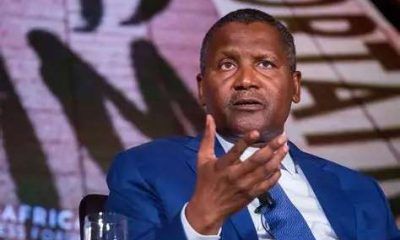
Billionaire industrialist, Alhaji Aliko Dangote, has thrown his weight behind the development of the country’s blue economy, saying strategic investment in maritime and coastal resources could generate no fewer than 500,000 jobs while opening a new frontier for economic growth and diversification.
Dangote stated this in Lagos while speaking at the recent Second Quarter 2026 Citizens’ and Stakeholders’ Engagement of the Federal Ministry of Marine and Blue Economy.
According to Dangote, Nigeria’s vast coastline, inland waterways and marine assets remain significantly underutilized despite their enormous potential to boost industrialization, expand exports and strengthen the country’s non-oil revenue base.
He urged government and private investors to accelerate investments in ports, logistics, fisheries and other marine-based industries.
The engagement, themed “From Policy to Action: Mobilizing Sub-National Governments for Effective Implementation of Nigeria’s National Policy on Marine and Blue Economy”, brought together government officials, diplomats, development partners, industry leaders, academics and representatives of state governments.
In his paper presentation titled, “Driving Private Sector Investment and Industrialization in Nigeria’s Marine and Blue Economy: Opportunities for Sustainable Economic Growth”, Dangote, who was represented by the Managing Director of Dangote Port Operations, Simeon Omole, said: “This is not merely a food security challenge; it is an industrial and investment opportunity.
“Strategic investment across the fisheries value chain, from aquaculture and hatcheries to feed production, cold-chain logistics, processing, and export infrastructure, supported by private sector leadership and an enabling government environment, can strengthen food security, reduce imports, conserve foreign exchange, create over 500,000 jobs, and position Nigeria as a competitive exporter of fisheries products”.
Dangote explained that the successful implementation of the National Policy on Marine and Blue Economy would depend largely on sustained private sector participation.
He noted that the policy targets the creation of three million jobs within its first four years, annual sectoral growth of seven per cent and the reservation of at least 50 per cent of new jobs for young people aged 18 to 35.
He said the Federal Government’s approval of major deep seaport projects in various parts of the country would stimulate industrial clusters incorporating agro-processing, petrochemicals, shipbuilding, cold-chain logistics and maritime technology, while boosting Nigeria’s competitiveness.
Dangote further identified the fisheries value chain as a major investment opportunity, noting that despite rising domestic production, Nigeria still imported fish worth nearly $1billion annually because of a significant supply deficit.
He also stressed that public-private partnerships should go beyond financing arrangements to become strategic collaborations involving government, investors, research institutions and coastal communities.
According to him, coastal industrial clusters supported by modern ports, Special Economic Zones, and digital infrastructure would attract long-term investment and accelerate industrialization.
Earlier, the Minister of Marine and Blue Economy, Adegboyega Oyetola, called for stronger collaboration among the Federal Government, state governments, the private sector and development partners to accelerate the implementation of Nigeria’s National Policy on Marine and Blue Economy, describing sub-national participation as critical to unlocking the sector’s vast economic potential.
Oyetola said Nigeria had moved beyond policy formulation and must now focus on implementation capable of delivering measurable economic benefits.
The minister said the National Policy on Marine and Blue Economy had provided a strategic framework for harnessing Nigeria’s oceans, inland waterways, fisheries and coastal resources, but stressed that its success depended on coordinated action across all levels of government.
Oyetola said reforms under President Bola Tinubu’s Renewed Hope Agenda had strengthened stakeholder engagement, attracted investment, improved maritime safety and enhanced the competitiveness of Nigeria’s ports.
He added that ongoing port modernization and plans to develop new deep seaports in Akwa Ibom, Bayelsa, Cross River, Lagos and Ondo states would further strengthen Nigeria’s position as West Africa’s preferred maritime hub.
The minister also noted that improved port operations had contributed to Nigeria recording a national trade surplus consistently since 2024.
In his keynote address, the Bayelsa State Governor, Senator Duoye Diri, commended President Tinubu for establishing the Federal Ministry of Marine and Blue Economy, describing it as a strategic step towards diversifying Nigeria’s economy.
He said Bayelsa followed suit by creating its own Ministry of Marine and Blue Economy in June 2024 to drive the blue economy component of the state’s A-S-S-U-R-E-D Prosperity Agenda.
Diri said the state ministry had commenced major fish production at the Bayelsa Aquaculture Village in Yenogwa, where an operational hatchery was breeding high-quality catfish fingerlings and juveniles to boost food security and create jobs.
He added that the state had expanded its marine transport fleet and was aggressively pursuing the development of the proposed Agge Deep Seaport as the next maritime gateway for the Niger Delta.