Nation
Lagos loses fight against waste
By Temi Salako
Lagos has flooded before. In June 1998, 237 millimetres of rain fell in a single day,nearly an entire month’s rainfall before lunch. In July 2011, another 233 millimetres poured down within 24 hours, swallowing low-lying communities across the city. A year later, Nigeria suffered its worst flood disaster in four decades: hundreds died, and more than two million people were displaced nationwide.

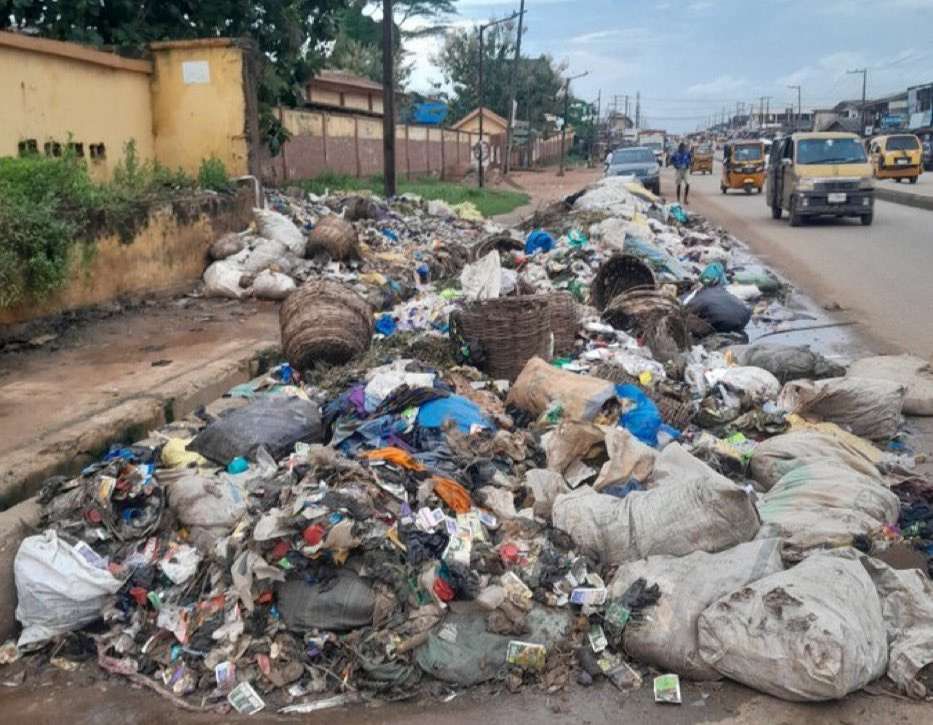
Three governments. Three commissioners. Multiple ministries of environment. Yet one thread runs through every disaster: drains choked with the waste Lagosians dump into them, and a government that rediscovers this reality each rainy season as though it were a new revelation.
Fourteen years after the 2011 floods, the script remains unchanged. Only the commissioner has changed, and the comment section has grown louder.
A CITY THAT GENERATES MORE THAN IT CAN COLLECT
Lagos produces about 13,000 tonnes of waste every day, roughly the weight of a naval destroyer, generated daily by a metropolis expanding faster than any agency assigned to clean up after it. Commissioner Tokunbo Wahab has cited May’s figures more than once: about 418,500 tonnes cleared across the month, an average of 13,200 tonnes a day, moved by 442 registered PSP operators across a road network that floods every time the sky takes itself seriously.
Those numbers sound impressive until you sit with them. A system clearing 13,200 tonnes against a daily load of 13,000 is not winning, it is treading water with its chin just above the surface. One bad rainy season, one fuel spike that grounds half the PSP trucks, one round of route disputes, and the balance tips. Lagos saw exactly that this year, refuse piling up long enough to force the governor into an emergency evacuation order in June, the kind of directive that reads less like leadership and more like an admission that the ordinary system had already failed.
GRV’S EIGHT, AND THE ELEVEN HE ACTUALLY WROTE
Gbadebo Rhodes-Vivour, the architect and 2023 Labour Party governorship candidate now aligned with the African Democratic Congress, has made himself the loudest outside voice on this file. Under his Our Lagos platform, he laid out an eleven point environmental plan in March 2025, and the core proposals are worth taking seriously regardless of who is saying them. Move away from central mega landfills like Olusosun toward decentralised, Scandinavian style processing. Introduce biofilters that convert organic waste on site instead of trucking it across the city to rot in one place. Capture landfill gas instead of venting it. Build modern water treatment infrastructure. Subsidise waste collection for low income communities who cannot afford PSP levies. Stop further sand filling in central Lagos, which destroys wetlands that would otherwise absorb stormwater. Extend sanitation to underserved areas like Sagbo Koji. Plant trees at scale instead of felling them for road projects. Improve drainage with specialised filters that catch solid waste before it reaches the canals.
Whether the number is eight or eleven depends on which statement you count, and it does not matter much. The substance is a systems argument, not a slogan. GRV’s repeated line, that government treats logistics, collection, sorting, transfer, disposal, recycling, as an afterthought to public relations, lands because it is demonstrably true. You cannot fix a 13,000 tonne a day problem with a Saturday morning broom.
“Impact is felt, not explained in 1,578 words,” Rhodes-Vivour told Wahab in June, after the governor’s emergency evacuation order. It was cruel. It was also accurate.
WAHAB’S SLAPSTICK, AND WHETHER ANY OF IT IS PRODUCTIVE
Commissioner Wahab is not short of activity. Under his watch, Lagos has banned single use plastics, begun converting the Olusosun landfill into a waste to energy facility, deployed biogas plants in markets, partnered with Lafarge on turning refuse into industrial input, and revived the monthly environmental sanitation exercise that shuts the state down for two hours every last Saturday. He has also, within months, called Rhodes-Vivour by a childhood name meant to wound rather than persuade, resurfaced old social media posts to paint a rival as sympathetic to a banned separatist movement, and told Lagosians that flooding is partly their own fault for dumping refuse in drains, which is true, and beside the point when the state has spent three decades failing to build drainage that can carry what the city now produces.
Is any of it productive? Some of it, yes. The landfill to energy conversion and the biogas deployment are genuine infrastructure, not press lines, and if delivered at scale they would represent the first real structural shift in how Lagos handles solid waste since the LAWMA reforms of the 1990s. The plastic ban, if enforced rather than announced, would cut the single largest contributor to drain blockage overnight. But the monthly sanitation exercise is theatre. Closing a city of 20 million people for two hours once a month to sweep the same streets that will be dirty again within the week is not policy, it is a photograph. And the personal attacks on Rhodes-Vivour, however satisfying they may feel in the moment, spend political capital that could have gone toward building consensus on drainage financing, which is the one thing every administration since 1998 has needed and never fully secured.
Eye service is the fair word for the parts that are performance. The landfill conversion is not eye service. The Saturday broom exercise, dressed up as a movement, is.
THE ECONOMICS, FROM THE KID HAWKING PURE WATER TO THE PRADO OWNER
Waste management in Lagos is not a government problem in isolation. It is an economic chain, and every link has to move for the whole thing to hold.
Start with the child hawking sachet water and soft drinks in traffic on Third Mainland Bridge or along Osborne Road. That child produces waste too, empty sachets and wrappers, and has no incentive to carry them anywhere because there is no bin within reach and no PSP truck coming for a pedestrian’s rubbish. A functioning system gives that child a place to put what they generate, and ideally a small payment for returning recyclable material rather than throwing it into the nearest drain. Lagos has piloted small buyback schemes before. None has scaled to match the informal economy that generates the bulk of street level plastic waste.
Move up to the market trader in Mile 12 or Oyingbo, who pays informal levies to area boys but rarely a registered PSP operator, because the operator’s route does not reliably reach her stall. Move up again to the middle income household in Ogba or Egbeda, who pays their PSP bill some months and skips it others, because enforcement is inconsistent and the risk of non payment is close to zero. Then arrive at the Prado owner in Lekki Phase 1 or Banana Island, whose estate runs private waste contracts that bypass the public system entirely, and whose road never floods because the estate paid privately for the drainage the rest of the city was promised and never received.
That is the real economics of waste in Lagos. It is not that Lagosians do not understand sanitation. It is that the cost of proper disposal falls hardest on the people least able to pay it, while the people most able to pay have already opted out of the public system altogether. A waste architecture that depends on voluntary compliance from a population with wildly different capacities to comply was never going to hold, and every flood since 1998 has been the physical proof of that failure arriving on schedule.
WHAT IMPLEMENTATION WOULD ACTUALLY REQUIRE
A workable version of GRV’s plan, or frankly any serious plan, has to be layered by who is expected to do what.
For the hawking child and the informal trader: subsidised access points, actual bins at bus stops and markets, and a buyback rate for plastic that makes collection worth the walk. Not awareness campaigns, infrastructure they can touch.
For the PSP operator and LAWMA route management: transparent route allocation reviewed on a real cycle, not only when complaints pile up, and financing that does not depend on voluntary payment compliance, since that will always be patchy in a city this size. A tiered levy collected through existing utility billing, tied to property size rather than goodwill, closes that gap faster than any enforcement drive.
For the estate and the private compound alike: mandatory contribution to public drainage funding regardless of private waste contracts, because floodwater does not respect gate codes. The Lekki resident whose road stays dry benefits from citywide drainage capacity built with public money, and should pay into it whether or not their own bin gets collected privately.
For government: fewer Saturday morning photo opportunities, more multi year capital commitment to drainage that can carry what the city produces now, not what it produced when the 1998 master plan was drawn up. And less energy spent trading insults with the opposition, since none of that moves a single tonne of refuse off a blocked canal.
THE BOTTOM LINE
Lagos does not have a waste awareness problem. It has a waste economics problem, where the true cost of disposal has never been fairly distributed across 20 million people with wildly unequal ability to pay it. GRV’s plan correctly names logistics as the issue and public relations as the distraction. Wahab’s ministry has real infrastructure moving in the right direction, and real theatre alongside it, and Lagosians deserve a clearer account of which is which. Until financing is restructured so the hawking child, the trader, the PSP operator, and the Prado owner are all genuinely inside the same system, rather than three of them subsidising the fourth’s escape from it, the rains of 1998, 2011 and 2012 will keep finding new years to repeat themselves in.