Politics
FCT council polls deepens election integrity crisis for 2027
…as all the old demons reared their head
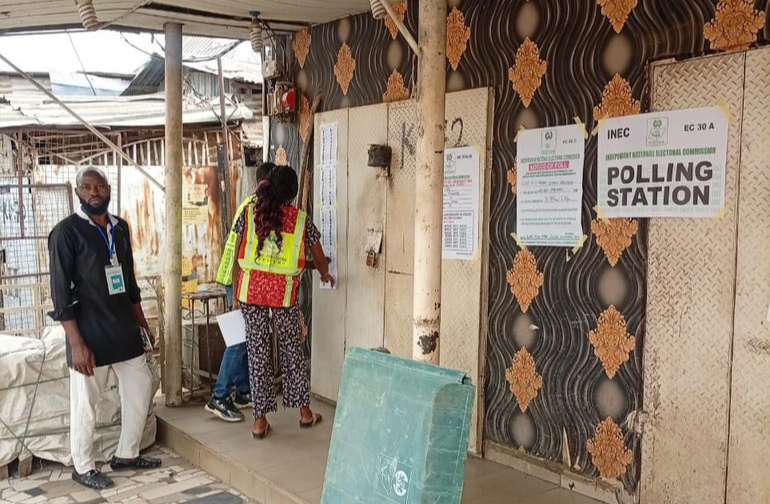
The February 21, 2026 Federal Capital Territory (FCT) Area Council elections – dominated by the All Progressives Congress (APC) after winning five out of six council polls – were widely expected to serve as a litmus test for Nigeria’s amended Electoral Act and a preview of the 2027 general elections. Instead, the exercise has ignited a far-reaching debate over logistics, technology, voter confidence and the implications of retaining manual collation provisions in the 2026 law.

Conducted by the Independent National Electoral Commission (INEC), the FCT polls were the first major electoral exercise since President Bola Tinubu signed the amended Electoral Act 2026 into law last week. While the election was largely peaceful, reports of late openings, malfunctioning Bimodal Voter Accreditation System (BVAS) machines, confusion over polling unit relocation, alleged vote buying and delayed uploading of results to the IReV portal have prompted questions about the country’s preparedness for 2027.
Delays and Logistical Gaps
Observers from Yiaga Africa, under its Watching the Vote initiative, deployed across the 62 wards in the FCT, reported that many polling units did not commence accreditation and voting at the official time.
In its preliminary statement signed by Executive Director, Samson Itodo, and Director of Programmes, Cynthia Mbamalu, the group noted: “As of 9:00 a.m., set-up activities were still ongoing in the majority of polling units observed, indicating that essential preparatory procedures had not been completed within the timeframe prescribed by electoral guidelines.”
In parts of Abuja Municipal Area Council (AMAC), particularly Wuse and Gwarinpa wards, accreditation reportedly commenced after 10:00 a.m., with officials still arranging materials well past the official start time.
Yiaga Africa also documented isolated cases of missing election materials. In Polling Unit 004, Wuse Ward, Zone 2 Primary School, the voter register was initially unavailable and was only produced after concerns were raised.
In Abaji Area Council, some polling units reportedly lacked voting cubicles, while an ink pad required for voting was missing in at least one location.
The organisation further raised concerns about the redistribution of voters to newly created polling units without timely communication. “Although INEC reportedly sent SMS notifications to affected voters, many received the messages on Election Day, in some cases hours after polling had commenced,” the statement said. It added that numerous voters spent over an hour trying to locate their designated polling units, leading to congestion and possible disenfranchisement.
Security Concerns and Voter Intimidation Allegations
Beyond logistics, there were reports of security-related disruptions. In Bwari Area Council, tear gas was reportedly fired near a polling location, forcing voters to disperse before voting could begin. A caller on a live radio programme described chaotic scenes, saying: “They tear-gassed us; they don’t want us to vote. People are crying. People fasting. People that managed to come out, all of them don’t want to come out now.”
Security personnel reportedly denied responsibility, and no official clarification had been issued as of press time. Elsewhere, voters alleged ethnic profiling during accreditation at a polling unit in Saburi Village, Gwa Gwa Ward, AMAC. A video circulating online showed an intending voter claiming that “once it sees an Igbo name, it would reject,” referring to the BVAS device.
An INEC ad-hoc staff member at the unit, however, reassured voters that the malfunction was technical and not targeted at any ethnic group, urging patience as efforts were made to restore functionality. Normalcy was said to have gradually returned after the glitch was resolved.
These incidents have added to concerns about operational readiness ahead of the 2027 general elections.
Delayed Upload of Results
Perhaps the most contentious issue arising from the FCT polls was the delayed upload of results to INEC’s Results Viewing (IReV) portal. Although voting in many polling units concluded before 3:00 p.m., uploads did not begin until evening. As of 9:00 p.m., uploads were still ongoing, with Kwali Area Council chairmanship results at 56.72 per cent completion and Gwagwalada at 65.68 per cent.
The delay immediately triggered suspicions among some stakeholders, who argue that real-time transmission is central to electoral transparency.
Former INEC National Commissioner, Oluwole Osaze-Uzzi, speaking on television, dismissed suggestions that network coverage remains a major obstacle to electronic transmission. “Technology is not our problem,” he said. “Regrettably, ahead the president mentions something like that. And that is what some senators who were opposed to the electronic transmission of results alluded to. They forget or mischievously don’t recall that we have passed that stage.”
He recalled that during deliberations in the 8th National Assembly, INEC and the Nigerian Communications Commission (NCC) presented evidence of extensive network coverage. “The NCC, which is the body in charge of that, came and said we had more than 93 percent coverage,” he stated. “A technical committee was set up between INEC and the NCC… and that committee came up with a report that with 2G, 3G and 4G – as at that time, that’s eight years ago – there was more than 93 percent coverage. And provisions could be made for those blind spots.”
Osaze-Uzzi warned that allowing room for manual incident forms could open the door to manipulation. “It makes nonsense of the whole thing because we’re back to the dark days of the incident forms because the law allows for it. They do all manner of manipulation in the incident forms,” he said.
Fears for 2027
Former INEC Commissioner, Mike Igini, also raised concerns about the potential implications for 2027. Recalling his experience during the 2023 elections, Igini said: “I would have been a dead man by now. My colleague in Kano, his entire family was wiped out, because we’re trying to do the right thing for our country.”
He warned that the combination of manual collation provisions and delayed electronic uploads could endanger electoral officers in future polls.
“At the polling units, presiding officers’ lives are going to be in danger,” he said. “Because where Nigerians are gathered, and the results of the polling unit have been announced, and everyone could look at his telephone and see network, but the presiding officer says that there is no network, you are going to put the life of that presiding officer in danger.”
He added: “Meanwhile, the children of all the political elite are not going to be at the polling unit, it is the youth Corpers that are going to be there.”
Activist Randy Peter Akah was even more direct in his criticism, alleging that the amended Electoral Act could be used to influence the 2027 outcome. “The Electoral Act that Tinubu hurriedly signed is to pave the way for the manipulation of the 2027 election,” he said. Referring to the FCT polls, he added: “You use your fingers to count the number of people who came out to vote, because people have lost confidence in the system. And it’s deliberate.”
He further argued that collation centres remain vulnerable points in the electoral chain. “That’s why they are insisting on manual collation, because that collation centre is the centre of rigging,” he said.
Despite the criticisms, other stakeholders maintain that the amended law strikes a balance between technology and practical realities. President Tinubu, while signing the amended Electoral Act into law, directly addressed the controversy surrounding electronic transmission and manual processes.
He said he had “followed the debate on the document at the National Assembly closely” and commended lawmakers for managing the process in a manner that ensured “there has been no confusion, no disenfranchisement of Nigerians, and that we are all going to see democracy flourish.”
According to the President, “the essence of democracy is to have very solid brainstorming discussions committed to national development, nation-building, and the stability of the nation.”
Addressing concerns about electronic transmission, he argued that elections in Nigeria remain fundamentally manual in character.
“As long as you appear personally as a manual voter in any polling booth, a ballot paper is given to you manually. You decide in a corner and fingerprint the person you choose. You cast your vote without hindrance or interference,” he said.
“Ballots are subsequently counted manually. It’s just the arithmetic accuracy that is entered into it from easy thinking. It is still manual, essentially.”
On the question of transmission, Tinubu said: “The transmission of that manual result is what we’re looking at. And we need to avoid glitches, interference, and unnecessary hacking in this age of computer inquisitiveness. Nigeria will get there.”
Supporters of the amendment argue that the law provides flexibility in a country where connectivity may still vary, especially in remote areas, and that over dependence on technology without fallback options could expose elections to new vulnerabilities.
Senate President Godswill Akpabio described the signing ceremony as “a truly significant day,” noting that both chambers of the National Assembly had worked on the amendments for two years.
Technology and Legal Interpretation.
Andrew Mamedu, Country Director of ActionAid Nigeria, provided further insight into how the BVAS and transmission systems are designed to function.
“Before the 2023 election, we had an amendment in 2022 and in that amendment accreditation was made compulsory,” he explained. “So before now you could use incident forms, but in 2022 amendment it was made compulsory that you must be accredited up to the extent that if the BVAS is not working, election would be suspended until a functional BVAS were provided.”
He stressed that the BVAS device used for accreditation is the same device used to capture and transmit results.
“If these same BVAS have the capability of accrediting all registered voters within that polling unit, it is the same machine that is used to snap the result and transmit the results to IReV,” he said.
Mamedu clarified that IReV serves as a viewing portal, while INEC also has an internal collation system.
“Now the argument that Supreme Court held on to was that IReV is not a collation system,” he noted. “The lawyers of INEC did not go with the collation system that they have, which should also have the information.”
On network issues, he explained: “At the point of snapping, whether you have network or not, and you click send, it is retained in the memory that cannot be tampered with until you get to where there’s network.
So it can function with or without network. As soon as it hits network, it then transmits automatically.”
This technical explanation has been cited by critics who argue that delayed uploads in Abuja – a city with relatively strong connectivity – are difficult to justify purely on technical grounds.
Political Reactions and Legal Moves
The FCT election results showed the All Progressives Congress (APC) winning chairmanship seats in Abaji, Kwali, AMAC and Bwari, while the Peoples Democratic Party (PDP) clinched victory in Gwagwalada.
However, the PDP has since announced its decision to challenge aspects of the election outcome.
In a statement signed by its National Publicity Secretary, Ini Ememobong, the party alleged “widespread irregularities and voter intimidation.” It described the Gwagwalada victory as significant, stating that it came despite what it termed “unprecedented intimidation, high-powered money politics and brazen executive brigandage.”
The party also claimed that there were reports and video evidence showing instances where armed security personnel allegedly removed result sheets from polling units and influenced outcomes in certain areas.
To pursue its grievances, the PDP inaugurated a legal team headed by its National Legal Adviser, Shafi Bara’u, Esq., urging candidates with complaints to act swiftly due to the time-bound nature of election petitions.
The party further linked low voter turnout in the FCT to dissatisfaction with the Electoral Act 2026, arguing that many Nigerians have lost confidence in elections conducted under the current framework.
For his part, the Minister of the Federal Capital Territory, Nyesom Wike, defended the overall conduct of the election. “The low turnout of voters is very unfortunate,” he said. “What is important, however, is that the election is peaceful – no violence, snatching of ballot papers or the ballot boxes.”
Indeed, Yiaga Africa acknowledged that “overall, the election was conducted in a largely peaceful atmosphere,” with voters who presented themselves afforded the opportunity to cast their ballots.
Yet, the organisation warned that logistical lapses, delayed openings, vote buying and early closure of some polling units could undermine public confidence if not addressed.
Looking ahead, Yiaga Africa urged INEC officials to ensure that Form EC60E (the People’s Results Sheet) is posted at polling units and that Form EC8A results are properly uploaded to the IReV portal.
“This measure is critical to strengthening transparency, building citizens’ trust in the election management process and reducing suspicion of manipulation,” the group stated.