Business
N1.3bn Budget Mystery: Nigerians Question Presidency’s PFIPC Denial Amid Gbajabiamila Bribery Allegations

The controversy surrounding the alleged existence of the Presidential Foreign Intervention Promotion Council (PFIPC) has taken a dramatic turn, with a growing number of Nigerians questioning the Presidency over what they describe as glaring inconsistencies in its response to allegations made by Prince Adeniyi Adeyemi against the Chief of Staff to the President, Femi Gbajabiamila.
While the Presidency has maintained that the PFIPC is a fictitious organisation and described Adeyemi as an impostor who forged government documents, public debate has shifted beyond that defence to what many observers consider unanswered questions about how the agency appeared in the 2026 Appropriation Act with a budgetary allocation of over N1.3 billion, operated from the Federal Secretariat, maintained accounts with the Central Bank of Nigeria, and hosted meetings with foreign diplomats.

The questions intensified after Adeyemi, who describes himself as Director-General of the PFIPC, accused Gbajabiamila of collecting N400 million through a proxy and demanding another N200 million to facilitate his appointment.
He further alleged that the Chief of Staff demanded 48 percent of the agency’s proposed take-off grant of N27.4 billion, a request he claimed to have rejected.

Prince Adeniyi Adeyemi in his office
According to Adeyemi, the fallout from his refusal led to the Presidency’s denial of the agency’s existence.
“The major rationale behind the disagreement between myself and the Chief of Staff is because he allegedly requested 48 per cent of the take-off grant (N27,395,510,136) from the same agency, which he denies, to which I rejected after he collected a total sum of N400 million by proxy, with a remaining balance of N200 million to secure the said appointment,” he alleged.
Adeyemi insisted that if the PFIPC truly did not exist, then the presence of the council in the 2026 budget raised serious constitutional and administrative concerns.
“If the agency does not exist, yet found its way into the Nigerian national budget, what that means is that the entire 2026 appropriation budget is a fraud and should be discarded.
“For President Bola Tinubu to append his signature to a budget that includes a non-existent agency, according to his Chief of Staff, is an embarrassment to this hardworking government,” he said.
Beyond the budgetary allocation, Adeyemi maintained that the agency had operated openly for more than one year, occupying office space at the Federal Secretariat, operating domiciliary, pounds sterling and Treasury Single Accounts domiciled with the Central Bank of Nigeria.
He also challenged the Chief of Staff to produce official documents proving his claims while calling for an independent investigation into an alleged assassination attempt against him and the mysterious death of Babatunde Tanimola, whom he identified as the intermediary in his dealings with Gbajabiamila.
Presidency insists agency is fake
Responding to the allegations, the Presidency, through the Special Adviser to the President on Information and Strategy, Bayo Onanuga, dismissed Adeyemi as an impostor and described the PFIPC as a non-existent organisation.
According to Onanuga, the Office of the Chief of Staff had, as far back as October 2025, petitioned the Department of State Services and the Nigeria Police over forged appointment letters allegedly issued in the name of the Presidency.
The statement said investigations led to Adeyemi’s arrest in October 2025, during which police allegedly recovered forged documents from his office and residence.
It further claimed that police investigations established that Adeyemi forged appointment letters, fraudulently obtained a CBN account, falsely represented himself as head of a government agency, and used fake documents to seek diplomatic privileges, including a note verbale from the Ministry of Foreign Affairs.
The Presidency also disclosed that police charged Adeyemi and two accomplices before the Federal High Court on an eight-count charge bordering on forgery, impersonation and obtaining by false pretence.
Onanuga urged politicians and members of the public to await the outcome of the court proceedings rather than accept Adeyemi’s claims.
Budget allocation sparks fresh controversy
Despite the Presidency’s detailed defence, public attention has increasingly focused on one issue that critics argue remains unanswered – the appearance of the PFIPC in the 2026 budget.
Financial analyst and public affairs commentator, Kalu Aja, described the situation as deeply troubling.
“This situation is quite concerning.
“Femi Gbajabiamila, the Chief of Staff to the President, claims that the Presidential Foreign Intervention Promotion Council (PFIPC) does not exist within the structure of President Bola Ahmed Tinubu’s administration.
“However, this very council is listed in the budget of the Presidency, not in some distant ministry or agency; it’s allocated within the budget of the Presidency itself.
“This raises two possibilities: either the Presidency is unaware of its own budget, which is meant for its own operations, or the Secretary to the Federal Government is being dishonest.
“What surprises me is that the Secretary is making a definitive statement on an issue that can be easily verified.
“I’ve attached a screenshot from the Federal Budget Office, which shows what the National Assembly voted on and what the President approved.
“The amount in question is N1.3 billion.
“We will be closely observing how the President responds to this situation.”
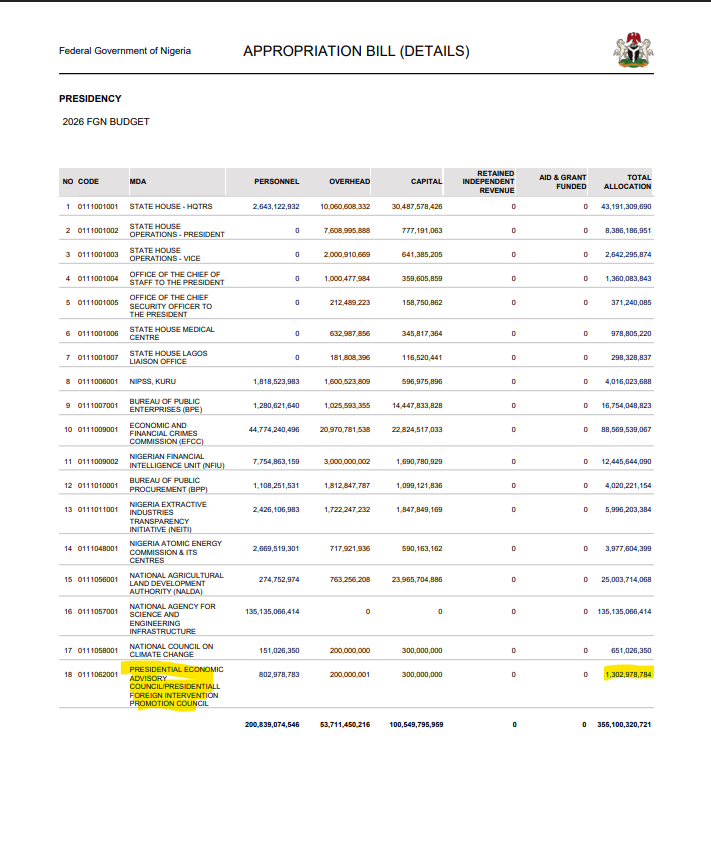
Alleged budget allocation to the agency
Atiku’s aide demands answers
Paul Ibe, media adviser to former Vice President Atiku Abubakar, also challenged the Presidency to explain the budgetary allocation.
Addressing Onanuga directly, he wrote:
“Dear Bayo,
“You have said so much, but we want answers to the following:
“Who smuggled N1.3 billion for Prince Adeniyi Adeyemi’s Presidential Foreign Intervention Promotion Council (PFIPC) in the 2026 Budget?
“Did Chief of Staff Femi Gbajabiamila receive N400 million alleged bribe from Adeyemi?
“Don’t you think that your Presidency gives itself away as one big scam if an individual can easily secure office space at the Federal Secretariat for the purposes of the so-called ‘scam’ PFIPC operations?”
Activist questions contradictions
Youth activist, Ambassador Serah Ibrahim, argued that the entire episode raised disturbing governance concerns.
“This story is actually insane and nobody is talking about it, and the key witness has apparently died in a hotel fire.
“Prince Adeniyi Adeyemi accused Femi Gbajabiamila of collecting N400 million from him for a N600 million deal for the appointment to become DG of Presidential Foreign Intervention Promotion Council (PFIPC).
“Gbajabiamila claims the company does not exist and that Prince Adeyemi is telling lies, but the 2026 Appropriation Act currently contains a N1.3 billion budget allocation for the PFIPC on page 50 and 51.
“So how did a ‘non-existent’ agency receive a budget allocation?
“The criminality happening under Tinubu is abysmal.”
Journalist highlights institutional failures
Journalist and publisher of Daily Nigerian, Jaafar Jaafar, also questioned the official explanation.
“This man created a fake government agency called Presidential Foreign Intervention Promotion Council, appointed himself as DG, secured office space at the Federal Secretariat, opened a CBN account in its name, got N1,302,978,784 allocation in the 2026 budget, summoned ambassadors to meetings, held strategic sessions with ministers, and even represented Nigeria at international conferences.
“The audacity is almost unbelievable.”
“Who are they trying to deceive?”
Social media commentator Malam Imran U questioned how multiple government institutions allegedly interacted with a non-existent agency.
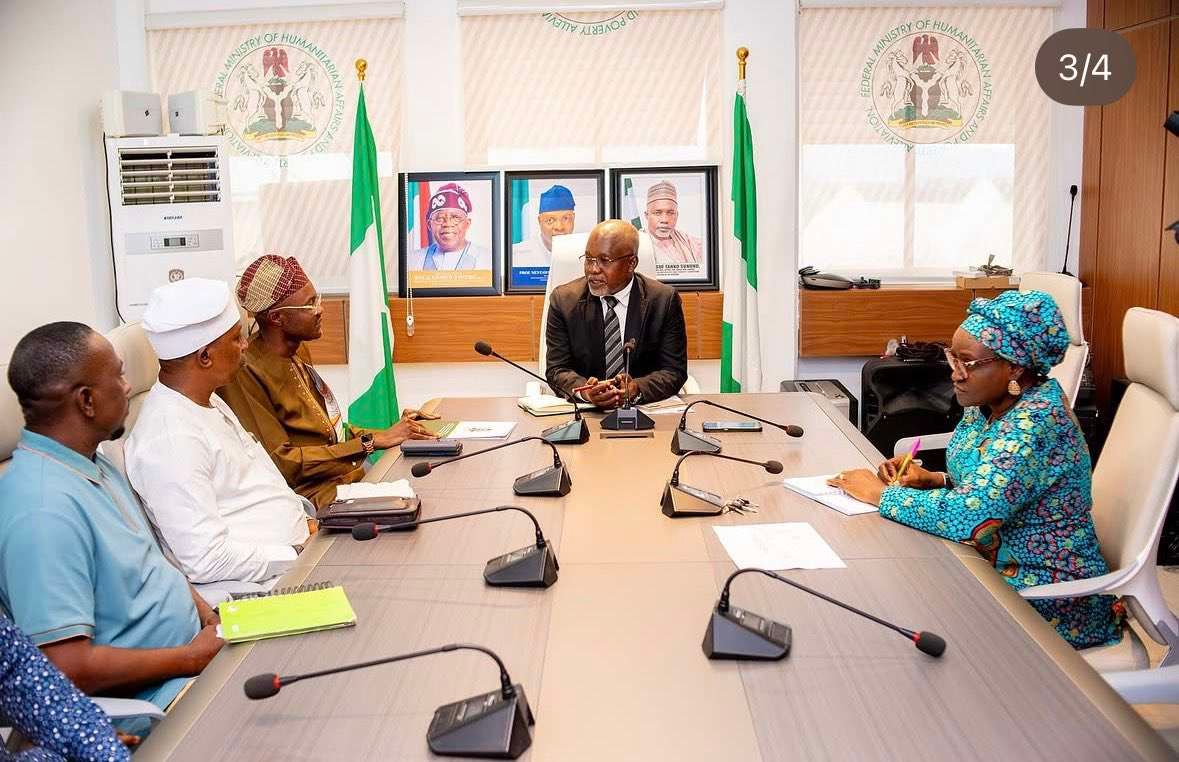
“The Senate and House of Representatives wrote letters to a non-existing agency.
“Even got an office in the Federal Secretariat all without knowledge of the government.
“Please who told Bayo, Tinubu and Femi Gbaja that we are this stupid?
“The longer Gbaja keeps his job, the more complicit he is making the President look.”
Elnathan John mocks official narrative
Author and public affairs commentator Elnathan John criticised what he described as an unbelievable official explanation.
“Behold, Nigeria’s smartest con artist, who was somehow able to get an appointment letter from the Presidency, smuggle the name of his agency into the budget, find the high-level documents necessary to open an official CBN account, employed staff, got an office in the Federal Secretariat, got a budget for his office, was able to summon and have meetings with ambassadors and international business people…
“A superhero. A genius. Houdini would be proud.”
Lawyer dismisses government’s explanation
Lawyer Malachy Odo II also rejected the official account.
“You must think we are all APC supporters with mosquito coil for brains.
“He opened a CBN account and used it to mislead the Office of the Accountant-General of the Federation.
“I guess he also misled the Budget Office and the National Assembly.”
Solomon Dalong raises governance concerns
Former Minister of Youth and Sports, Solomon Dalong, said the Presidency’s statement had created more questions than answers.
“I think the Presidency’s statement was clearly intended to shut down public scrutiny. Ironically, it has achieved the exact opposite.
“Let us assume, for a moment, that every allegation against Prince Adeyemi is true.
“Even then, the statement leaves glaring gaps that no amount of rhetoric can paper over.
“You are asking Nigerians to believe that one private citizen woke up one morning, invented a presidential agency, forged his own appointment, secured office space inside the Federal Secretariat, recruited staff, held meetings with diplomats, corresponded with government institutions, allegedly opened a CBN account through official channels and, if the official budget documents are anything to go by, the same ‘non-existent’ agency found its way into the Appropriation Act with an allocation running into billions.
“If that is truly what happened, then this is no longer just the story of an alleged fraudster. It is also the story of spectacular institutional failure.”
Dalong said the silence over the budget allocation was particularly troubling.
“How does a fictitious agency appear in the national budget?
“Budget allocations do not descend from heaven.
“They pass through ministries, the Budget Office, executive review and legislative approval.
“Who introduced the line item?
“Who processed it?
“Who signed off on it?
“Who failed to ask whether the agency even existed?
“Those are not political questions.
“They are governance questions.”
He also questioned how office space inside the Federal Secretariat was allegedly obtained and why the circumstances surrounding the death of Babatunde Tanimola had not been fully explained.
“The public deserves more than a carefully written press statement.
“It deserves answers backed by records, timelines and evidence.
“Until those answers are provided, this matter is far from settled.”
More Nigerians demand accountability
Public affairs commentator Tunde Akogun said the budget allocation remained the biggest issue.
“If the Chief of Staff says PFIPC ‘does not exist’ in Tinubu’s Presidency, but PFIPC is line-itemed in the Presidency’s own budget passed by the National Assembly, signed by the President, with N1.3 billion attached then someone is lying.
“That is not just an anomaly; it is gross sloppiness.
“How did you appropriate N1.3 billion for a fictitious agency?
“How did Adeyemi allegedly secure CBN account access, a Federal Secretariat office and meetings with diplomats?
“Until these questions are answered, your press statement is preposterous and does not close the matter. Rather, it deepens it.”
The debate also spread across Facebook, where many users expressed scepticism over the official explanation.
Chris Jesuitism Chris wrote:
“I managed to read to the end but unfortunately I didn’t understand anything Uncle Bayo was trying to tell us.”
Akin Malaolu commented:
“The hunter has finally become the hunted.
“Adeyemi revealed what we have always been hearing behind the walls.”
Enobong Oton questioned the government’s denial.
“The ease in which a private individual supposedly started a fake agency, secured for himself a fake appointment, secured offices in the Federal Secretariat, opened an account for the fake agencies in the Central Bank of Nigeria and secured budgetary allocation in this financial year makes government denial of complicity difficult to believe.”
Emma Emeka Anyagwa also highlighted what he described as omissions in the Presidency’s statement.
“You didn’t talk about the man’s use of the Federal Secretariat and its facilities as well as how his budget became gazetted.”
As public scrutiny intensifies, attention is increasingly shifting away from the competing claims of Adeyemi and the Presidency to broader questions about the integrity of government processes.
For many Nigerians, the central issue is no longer simply whether the PFIPC exists, but how an organisation officially described as fictitious allegedly obtained office accommodation within the Federal Secretariat, engaged foreign diplomats, secured banking arrangements with the Central Bank of Nigeria, and appeared in the 2026 national budget with an allocation of N1.3 billion.
Until those questions are comprehensively addressed with documentary evidence, critics insist that the controversy surrounding the PFIPC and the allegations against the Chief of Staff is unlikely to subside.