Politics
ADC ticket faces power-sharing crisis
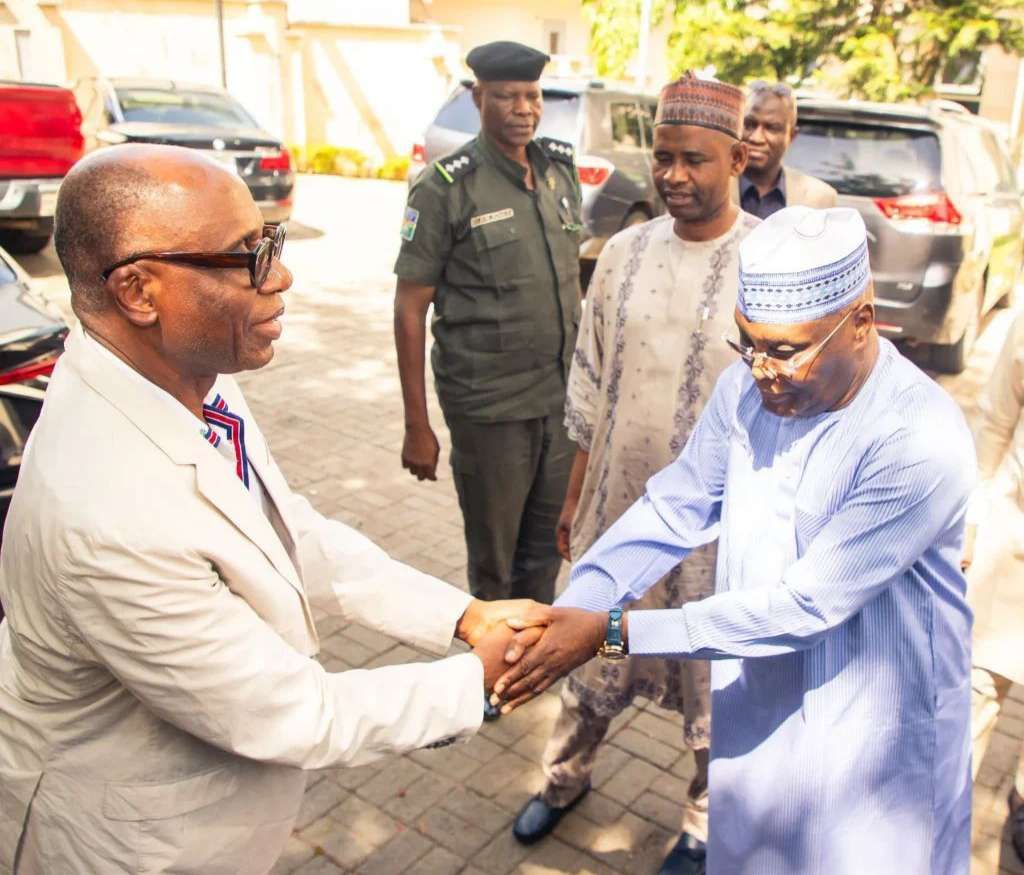
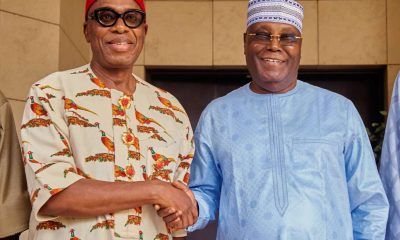
Barely two weeks after the African Democratic Congress (ADC) unveiled former Rivers State governor and ex-Minister of Transportation, Rotimi Chibuike Amaechi, as the running mate to its presidential candidate, Atiku Abubakar, the ticket that was expected to project unity has, instead become the subject of intense uncertainty, exposing fault lines within the opposition coalition and raising fresh questions about its readiness for the 2027 presidential election.
Although the ADC leadership has repeatedly insisted that Amaechi remains Atiku’s vice-presidential candidate, a growing body of evidence suggests that the arrangement is far from settled.

The prolonged silence of both principal actors, conflicting narratives from party insiders, and reports of unresolved negotiations have fuelled speculation that the coalition is grappling with a delicate power-sharing dispute capable of undermining its campaign before it formally begins.
The controversy has become particularly significant because the Atiku-Amaechi pairing was intended to signal the emergence of a formidable opposition platform capable of challenging the ruling All Progressives Congress (APC).
Instead, it has generated uncertainty over whether the coalition’s leading figures can overcome competing ambitions and build the trust necessary for a united campaign.
For many political observers, the issue is no longer whether Amaechi was announced as the vice-presidential candidate, but whether all the key stakeholders have genuinely signed on to the arrangement.
Official announcement versus political reality
The uncertainty began shortly after the ADC’s National Publicity Secretary, Bolaji Abdullahi, announced on June 15 that Amaechi had been selected as Atiku’s running mate.
Presenting the ticket as a “unity and rescue” platform ahead of the 2027 presidential election, Abdullahi sought to project confidence that the party had concluded one of the most delicate stages of its presidential campaign.
Ordinarily, such an announcement would have been followed almost immediately by a joint appearance by both candidates, coordinated messaging across party structures and public endorsements by influential stakeholders. Instead, none of those expected political rituals occurred.
Neither Atiku nor Amaechi personally confirmed the announcement through their official communication channels. Their silence quickly became the subject of speculation, particularly because both politicians are known to be active in engaging the public through social media and political statements.
Checks on Amaechi’s official social media platforms reveal that his last significant political update came in May, when he criticised the conduct of the ADC presidential primary that eventually produced Atiku as the party’s flag bearer. Since then, he has remained conspicuously silent.
That silence has become increasingly difficult to ignore. While the ADC leadership continues to insist that nothing has changed, sources familiar with ongoing discussions told Business Hallmark that negotiations have continued behind closed doors.
“It is still an ongoing conversation,” one party source told Business Hallmark. “Amaechi is not enthusiastic about being the running mate, and some issues have come up. But hopefully, the issues would be resolved soon.”
That statement captures the dilemma confronting the coalition. On paper, the ticket exists. In practice, negotiations appear to be continuing.
Conflicting narratives deepen uncertainty
The uncertainty has been compounded by contradictory public statements emerging from different corners of the coalition.
On one hand, Atiku’s camp insists that the matter has been settled. Responding to growing speculation, one of Atiku’s media aides, Abdulrasheed Shehu, dismissed reports of disagreement.
“Atiku/Amaechi is settled. His Excellency is on a short business trip. Once he returns, Amaechi will be officially unveiled in a few days as the VP candidate. Stop posting fake news.”
His explanation attributed the delay solely to Atiku’s travel schedule, but it’s been two weeks now, and Atiku has not as much as addressed the speculation on X where he remains active. Yet that assurance sits uneasily alongside reports from individuals close to Amaechi, who insist that the former Rivers State governor has not formally accepted the nomination.
According to Amaechi’s ally and personal assistant, Alhaji Kalgo, the announcement was made primarily to avoid creating a political vacuum while negotiations continued. If that account is accurate, then the public announcement preceded the completion of negotiations – a highly unusual development in Nigerian presidential politics, where vice-presidential choices are ordinarily finalised before they are made public.
The differing accounts have created an impression of confusion rather than coordination.
The power-sharing question
Perhaps, the most contentious aspect of the controversy concerns reports that Amaechi presented a series of conditions before accepting the vice-presidential nomination.
Although neither Amaechi nor Atiku has publicly confirmed the claims, the alleged demands have circulated widely within political circles.
Among the reported conditions are the right to nominate key office holders in a future administration, including the Chairman of the Nigerian National Petroleum Company Limited (NNPCL), the Chairman of the Economic and Financial Crimes Commission (EFCC), the Governor of the Central Bank of Nigeria (CBN), the Chief of Army Staff, two ministerial nominees and about twenty Director-General positions.
Even more politically sensitive is the reported demand for a legally binding agreement committing Atiku to serve only one term and to support Amaechi’s presidential ambition in 2031.
Business Hallmark reached out to Abdullahi, the party’s spokesperson via his known phone line, but he had not responded to inquiries as the time of filing this report.
Whether these demands are entirely accurate or not, they point to a broader issue that frequently shapes coalition politics in Nigeria, the distribution of power before votes are even cast.
Political alliances are rarely built on shared ideology alone. They are often cemented through negotiated understandings over future appointments, succession arrangements and influence within government.
For a coalition bringing together politicians from different parties, regions and political traditions, such negotiations are almost inevitable. The difficulty arises when those negotiations become public before consensus is reached.
Why Atiku needs Amaechi
Political calculations help explain why Atiku appears determined to retain Amaechi despite the apparent complications.
Beyond his status as one of the ADC’s most recognisable southern political figures, Amaechi brings extensive campaign experience, national visibility and a formidable political network built over decades in public office. He also has a respectable war chest.
His influence extends beyond Rivers State into sections of the former APC political establishment, making him an important bridge between different blocs within the coalition.
There is also the financial dimension. Party insiders maintain that Amaechi’s substantial political resources contributed significantly to Atiku’s decision.
Business Hallmark had earlier reported that Atiku’s choice was influenced partly by Amaechi’s capacity to contribute meaningfully to campaign financing at a time when the former Vice President is widely believed to have lesser financial resources than in previous election cycles. The was the reason for his 2023 voice of Ifeanyi Okowa, then a sitting governor, who was later accused by the EFCC of spending N 1 trillion.
Campaign financing remains one of the defining features of Nigerian presidential contests, making wealthy political allies, particularly valuable. Losing Amaechi at this stage could, therefore, weaken both the coalition’s political reach and its financial muscle. However, his demands are preposterous.
From Amaechi’s perspective, however, accepting the vice-presidential position may not be as straightforward as it appears.
Having served as Speaker of the Rivers State House of Assembly, two-term governor, Chairman of the Nigeria Governors’ Forum, and Minister of Transportation, he possesses one of the most extensive political resumes in contemporary Nigerian politics.
Many of his supporters believe he has earned the right to negotiate from a position of strength rather than simply accept a subordinate role.
Reports that he wants guarantees regarding succession, appointments and influence thus, reflect broader concerns about avoiding political marginalisation within a future administration.
The Obi factor refuses to disappear
Complicating matters further are persistent suggestions that the ADC has not entirely abandoned hopes of bringing Nigeria Democratic Party (NDC) presidential candidate, Peter Obi into its presidential calculations.
Political analyst and Director of the Abuja School of Social and Political Thought, Dr. Sam Amadi, has repeatedly questioned why Atiku himself has not formally announced his running mate.
“A week ago, I asked why Atiku had not announced his choice of vice president even though he is very communicative, and Amaechi had not accepted his reported nomination,” he wrote.
“Like I said, it is not yet done until it is done. I had good intel. It may still be or may not be.”
Earlier, Amadi had hinted that discussions involving Obi remained active.
“When I read social media insiders with no insider information, I laugh. The things I know about ADC and search for VP is radically different from what you read here. The search is frantically on and they still badly want Mr. Clean. I won’t say more.”
His reference to “Mr. Clean” was widely interpreted as Peter Obi.
However, although Obi and NDC now faces legal setback following the decision of a Federal High Court sitting in Lokoja, Kogi State to set aside its earlier judgment directing the Independent National Electoral Commission (INEC) to deregister NDC) as a political party, the idea of Obi becoming Atiku’s running mate appears completely out of the question.
The NDC has since rejected the Kogi court decision and headed to Appeal Court.