

Politics
US-France tensions rise as Paris bars Amb Kushner from govt officials
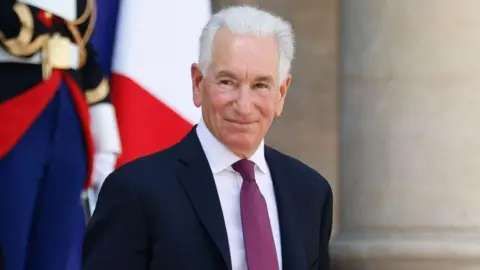
Diplomatic relations between the United States and France have intensified after the French government restricted U.S. Ambassador Charles Kushner from direct access to senior French officials.
The decision followed Kushner’s failure to appear for a summons issued by the French Ministry of Foreign Affairs over comments he and the U.S. Embassy in Paris made regarding the death of far-right activist Quentin Deranque.
Deranque was reportedly beaten to death earlier this month during a confrontation with suspected hard-left activists in Lyon. The U.S. State Department’s Bureau of Counterterrorism and the U.S. Embassy in Paris described the incident as evidence of “rising violent radical leftism,” warning that it posed a threat to public safety. French authorities, however, rejected the remarks, describing them as interference in France’s domestic debate.
“Following the publication by the U.S. Embassy of comments on a tragedy that occurred in France and concerns only our national public debate, which we refuse to allow to be exploited, Ambassador Charles Kushner was summoned today to the ministry. He did not show up,” a French diplomatic source said.
French Foreign Minister Jean-Noël Barrot confirmed the action, warning that Kushner would be barred from exercising his diplomatic functions until he responds to the summons. “There is nothing more usual than summoning an ambassador when explanations need to be made,” Barrot told France Info. “When these explanations have taken place, the U.S. ambassador in France will, naturally, regain access to members of the French government.”
This is reportedly the second time Kushner has failed to comply with a French summons. In August 2025, he was called to explain public remarks regarding rising antisemitic incidents in France and criticized the government’s response. Instead of attending personally, he reportedly sent the embassy’s chargé d’affaires.
Kushner, who is also the father-in-law of former U.S. President Donald Trump’s son-in-law Jared Kushner, was nominated as U.S. ambassador to France in November 2024. His appointment attracted scrutiny due to his prior federal convictions for tax evasion and witness tampering, for which he was pardoned by Trump in 2020.
Observers say the current row underscores a delicate balance between diplomatic freedom of expression and respect for a host country’s internal affairs. Analysts warn that continued commentary by foreign diplomats on sensitive domestic issues could further strain bilateral relations if proper protocol is ignored.
French authorities stressed that the restriction is a standard procedural measure designed to uphold diplomatic protocol. “Faced with this apparent misunderstanding of the basic expectations of an ambassador who has the honour of representing his country, the minister requested that he no longer be allowed direct access to members of the French government,” a source said. The measure will remain until the ministry is satisfied that established procedures are being followed.
The incident comes amid broader scrutiny of U.S. diplomatic conduct in Europe. Analysts note that statements issued by Kushner and the U.S. Embassy in Paris, highlighting violent radical leftism, were interpreted by French authorities as exploiting a national tragedy for political purposes. Barrot emphasized that France rejects any instrumentalization of the incident and asserted that the country expects foreign diplomats to respect domestic processes and public debate.
The U.S. Embassy and Kushner’s representatives have not issued an official comment on the latest restrictions. Meanwhile, observers caution that the dispute could deepen tensions if similar commentary continues, potentially complicating U.S.-France relations on security, counterterrorism, and broader diplomatic cooperation.