Business
Presidency’s forex bill hits N34bn in two years as travel costs draw scrutiny
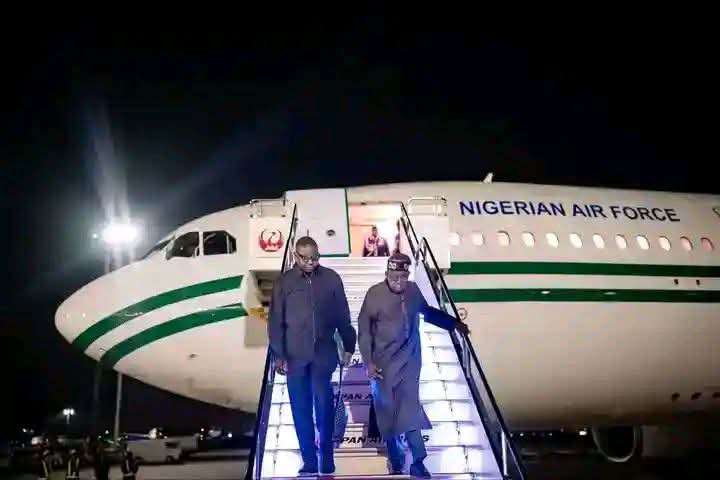
At least N34.39bn was spent by the Presidency on foreign exchange purchases for international travel and related official obligations between 2024 and 2025, according to data compiled from GovSpend, the public expenditure tracking platform managed by BudgIT.
The records, covering transactions by the State House, the Presidential Air Fleet (PAF), the Office of the Chief of Staff, and activities linked to the President, Vice President, First Lady and their aides, show that the bulk of the spending occurred in 2024, with a significant drop recorded the following year.
An analysis of the data shows that N29.35bn was spent on forex purchases in 2024, while N5.04bn was recorded in 2025 — a year-on-year decline of 82.8 per cent.
The forex purchases were largely tied to official overseas trips, aviation logistics, estacodes, training programmes and other international engagements involving top government officials. While the Presidency maintains that such trips are essential for diplomacy, investment drives and bilateral cooperation, the scale of the spending has attracted attention in light of Nigeria’s economic challenges and foreign exchange pressures.
A major contributor to the 2024 outlay was the Presidential Air Fleet, which is responsible for transporting the President, Vice President and other senior officials. The fleet’s forex transactions were described as “presidential air fleet forex transit funds.”
Between March and May 2024, the PAF recorded repeated purchases of about N1.27bn on March 7, March 9, April 6, May 11 and May 25. Larger tranches were also recorded, including N5.08bn on April 23 and N2.43bn on May 8.
Additional aviation-related payments followed in July and August, including transfers of N1.25bn, N2.21bn, N1.24bn and N902.9m, further pushing up the air fleet’s forex bill.
Beyond aviation, the State House Headquarters recorded several forex transactions directly linked to specific trips by the President, Vice President and First Lady.
In February 2024 alone, over N2.5bn was spent on forex purchases for official travel. These included N426.88m for the Vice President’s trip to Switzerland, N1.04bn for the President’s visit to Ethiopia, N750m for a trip to Dubai, N176.77m for Côte d’Ivoire, N149.79m for the First Lady’s trip to France, and N86.76m for another vice-presidential trip to Liberia.
March also saw notable spending, including N202.39m for the First Lady’s trip to Mozambique, N144.57m for Addis Ababa, and N126.30m for London. The Vice President’s engagements added N201.12m for Côte d’Ivoire and N169.54m for estacodes tied to UK and US training programmes.
Forex purchases intensified from July, with multiple same-day transactions recorded on July 17 amounting to over N1.5bn. Further payments were made in late July, August and October, including a significant N1.36bn purchase on October 28.
Spending remained elevated into the final quarter of the year. Several forex purchases were recorded in November, while December added another N736.20m, underscoring the sustained demand for foreign currency throughout 2024.
However, the spending pattern changed sharply in 2025.
Total forex purchases for the year stood at N5.04bn, reflecting a substantial reduction. Transactions were generally smaller and less frequent, suggesting efforts to curb forex outflows.
On April 30, 2025, several transactions were recorded ranging from N23.67m to N535.82m. Even the larger figures linked to the Presidential Air Fleet in mid-2025 -N1.29bn, N1.28bn and N626m – were fewer and spaced out over time.
By the second half of the year, spending had tapered further, with August transactions as low as N7.67m and N11.14m, while November and December recorded modest payments by the Office of the Chief of Staff and the Air Fleet.
The reduction coincided with relative stability in the foreign exchange market in 2025, following reforms that improved dollar inflows and eased pressure on the naira.
Overall, the data reflect a sharp contrast between the two years and have renewed attention on the cost implications of official travel, particularly during periods of economic strain.