Business
Trump ‘targets’ Venezuela’s vast crude reserves after Maduro’s capture

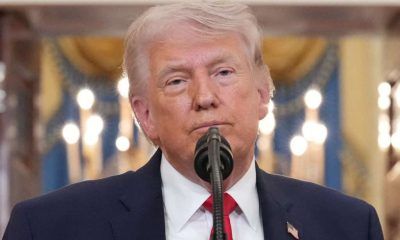
United States President Donald Trump has said his administration will allow American oil companies to move into Venezuela to exploit its vast crude oil reserves following a dramatic US military operation that led to the capture of President Nicolás Maduro.
Speaking at a news conference in Florida on Saturday, Trump said major US energy firms would be permitted to invest billions of dollars in reviving Venezuela’s battered oil infrastructure after years of sanctions, mismanagement and underinvestment.
“We’re going to have our very large United States oil companies, the biggest anywhere in the world, go in, spend billions of dollars, fix the badly broken infrastructure – the oil infrastructure – and start making money for the country,” Trump said.
The announcement followed early-morning US air strikes on Venezuela’s capital, Caracas, which Trump said resulted in the capture of Maduro and his wife. According to the US president, both were flown to New York City, where they now face charges related to drug trafficking and weapons offences.
Despite the proposed oil push, Trump stressed that Washington’s embargo on Venezuelan crude remains in place, underscoring that any new engagement would occur strictly under US control.
“The embargo on all Venezuelan oil remains in full effect,” he said.
The United States first imposed broad economic sanctions on Venezuela in 2017, tightening the noose with oil sanctions two years later. Washington has long accused the Maduro government of using oil revenues to finance criminal activities, including what Trump described as “drug terrorism, human trafficking, murder and kidnapping.”
Venezuela currently produces just under one million barrels of crude oil per day, according to the Organisation of Petroleum Exporting Countries (OPEC), a fraction of its potential output. Much of that oil is reportedly sold on the black market at heavily discounted prices due to sanctions and logistical constraints.
At the beginning of his second term in 2025, Trump revoked licences that had allowed several multinational oil and gas companies to continue operating in Venezuela despite the sanctions. US energy giant Chevron remained the lone exception, operating four oil fields in partnership with Venezuela’s state-owned oil company, PDVSA, and its affiliates.
Washington has also enforced a total blockade on sanctioned oil tankers travelling to and from Venezuela, further constraining the country’s ability to export crude legally.
Although Venezuela holds an estimated 17 per cent of the world’s proven oil reserves – according to the International Energy Agency in 2023 – it has fallen far behind as a global producer after years of corruption, operational decay and poor governance.
Venezuelan crude is generally heavier and of lower quality, making it more suitable for diesel and industrial byproducts such as asphalt rather than gasoline. However, the United States maintains refineries along the Gulf of Mexico specifically designed to process this type of oil.
Energy analysts say the US move is driven more by politics than necessity. “The United States is doing just fine without Venezuelan oil,” Stephen Schork of the Schork Group told AFP last month, noting that Washington’s actions are shaped largely by strategic and geopolitical considerations rather than supply needs.
Trump’s latest comments suggest that with Maduro removed, Venezuela’s oil – long a symbol of squandered wealth – could become a new front in Washington’s effort to reshape the country’s political and economic future under US terms.