Opinion
FOR THE RECORD: Speech delivered by Peter Mbah at the presentation of Enugu’s 2026 budget
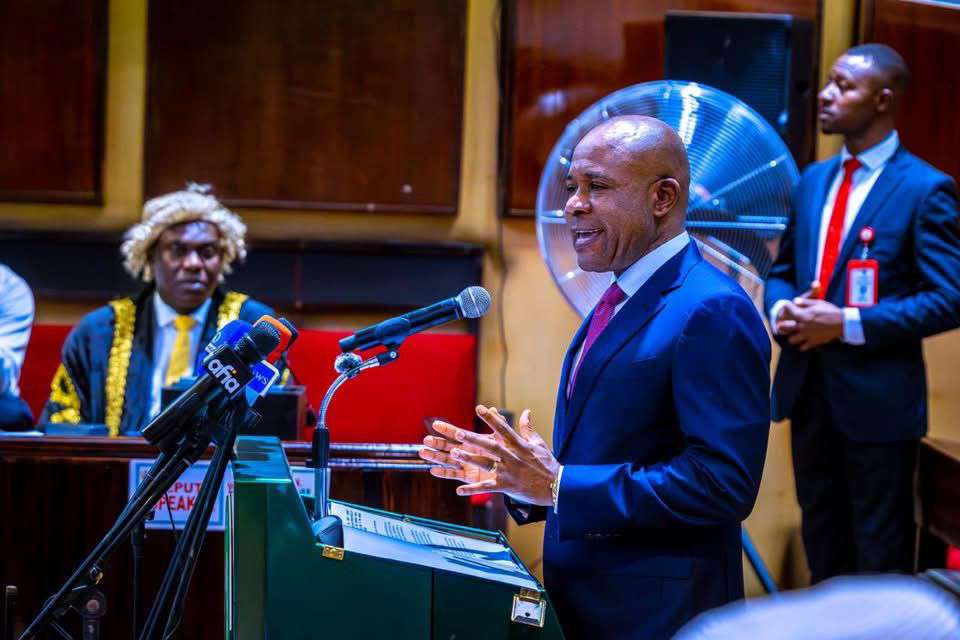
Full text of my speech delivered today at the presentation of the Enugu State 2026 Budget Estimates before the House of Assembly.

Mr. Speaker, Honourable Members of this esteemed House,
I stand before you today with profound gratitude and a renewed sense of purpose as we present the Enugu State 2026–2028 Multi-Year Budget – a budget designed to consolidate our gains, accelerate growth, and deliver on our promise of a prosperous, modern, and competitive Enugu State.
About one year ago, when I presented the second full-year budget of this administration, we were still in the early hours of a long night. The vision was clear, the destination defined – but the light was not yet visible. We could sense the dawn, but the sun had not yet broken the horizon. This past year, that changed.
2025 was the moment when the promise of our reforms became visible – when the first clear light of a new day shone across our state and confirmed that the dawn we felt was real. It was the year Enugu moved from anticipation to evidence, from hope to progress, from faith to fulfilment.
Today, I am proud to report that we have made tangible strides. These gains are the product of disciplined fiscal management, bold economic reforms, and the rigour of our development agenda. They were reinforced by the diligent oversight of this Honourable House.
Mr. Speaker, Honourable Members, I thank you sincerely for your partnership – for your prompt consideration of the last budget and for the seriousness with which you have approached this shared mandate. Your cooperation continues to strengthen the bond between the Executive and Legislative arms of government, and this can only be good for our people.
As we approach the third-year mark of our first-term journey, your collaboration remains essential. It is so because while the 2025 Budget yielded significant and encouraging outcomes, 2026 requires sustained action. This is not a year for easing the pace. It is a year for renewed momentum.
Why? Because we are planning not just for the next fiscal cycle, but for the next generation.
Mr. Speaker, Honourable Members, just one year ago our tenure was still in its infancy. Many of the reforms we introduced were new, unfamiliar, and demanding. Our bold economic reset, our push to expand the tax net, our insistence on plugging leakages and enforcing fiscal discipline – all of it required courage from government and patience from the people.
At that time, many of our early gains were real but modest. And for the average citizen walking through Ogbete Main Market – weaving past the stalls, the dust, the traffic, the noise – the big promises we made still felt distant.
A trader might have felt the pinch but not the pay-off. He would have heard talk of new schools, new infrastructure, new services. He might have felt a flicker of hope rise in his chest. But as he carried his goods through the same old bottlenecks, past broken gutters and hazardous roads, he would also wonder: When will all this become real? When will these changes reach my own life?
That was because while the reforms were underway, the bolder interventions – the major infrastructure, the deeper economic shifts – were still in their infancy. Some were still on paper. Others had barely begun. The full picture had not yet come into view.
And yet, Ndi Enugu chose to lean in – and that act of faith has been the sun on our face as we raised our gaze to the future.
In 2025, the changes we made were no longer abstract – people could feel them in their daily lives.
For the father driving to work at dawn, the new road network meant he no longer left home early to navigate potholes that once damaged his vehicle and drained his income.
For the mother in a rural community, the upgraded Type-2 Primary Healthcare Centre meant her child could receive treatment in minutes, not hours, and without travelling to the city in fear and uncertainty.
For students, the Smart Schools were no longer an idea on a billboard – they are real buildings, bright, digital, alive with learning. Children now walk into classrooms with computers instead of chalk boards, and for the first time, parents can imagine their sons and daughters competing with the world.
For traders in Ogbete, Abakpa, and Garriki, the improved security network – from AI-supported surveillance to faster response units – brought Monday markets fully back to life. Shops stayed open. Business recovered. The streets were safe again.
Across our communities, revived assets like Nigergas, Sunrise Flour Mill, United Palm Products, the Hotel Presidential – together with our 200-hectare Farm Estates, the new Land Bank, and the revived Tractor Assembly Plant – meant jobs returning, higher yields, better incomes, and an agricultural sector shifting from subsistence to a meaningful contributor to Enugu’s GDP.
And everywhere – from Nsukka to Nkanu East – people felt the effect of a government that finally plugged leakages, strengthened public-sector systems, and grew our internally-generated revenue to unprecedented levels not seen before.
These achievements now form the foundation for the Budget of Renewed Momentum we seek in 2026.
In preparing this budget, we listened carefully. Through our citizens’ engagements and community dialogues, we heard from fathers and mothers, farmers and bus drivers, teachers, traders, professionals, and students – real people whose daily experiences now reflect the changes we have made.
We also studied the global, regional and national economic realities shaping our future. And from all this, we crafted a budget built on four clear pillars:
1. Empowerment and Education.
2. Inclusive and People Centred Development.
3. Good Governance.
4. Economic Transformation.
EMPOWERMENT AND EDUCATION
In the last two years, we have moved from talking about youth and education to building for them at scale. Across all 260 wards, our Smart Green Schools are now at or near completion – digital classrooms, devices, science labs, solar power, and modern facilities designed to prepare our children for a tech-driven world.
We have devoted roughly one-third of two consecutive state budgets to education because the most valuable resource for the future of Enugu is the head, hand, and heart of our young people.
Beyond the classrooms, our youth programmes are creating real pathways to opportunity.
Through the Enugu SME Centre’s digital skills and innovation grants, thousands of young people are training in software, creative media, data skills, and other globally relevant fields. Others are entering practical trades through the Youth Technical Empowerment initiatives such as agro-enterprise, fish farming, poultry, fabrication, and other income-generating skills that allow them to stand on their own feet.
At SUMAS in Igbo-Eno, the new teaching hospital is positioning Enugu to produce world-class doctors, nurses, and medical specialists – ensuring that jobs and expertise stay within our state.
INCLUSIVE AND PEOPLE-CENTRED DEVELOPMENT
Mr Speaker, Honourable Members,
Our focus has remained simple and consistent: development must reach real people in real communities. And this year, the progress has been concrete.
We are now at or near completion of 260 Type-2 Primary Healthcare Centres, each solar-powered, staffed, and operating 24 hours a day. This means that families across every ward – rural and urban – now have access to basic healthcare without travelling long distances or relying on crowded city hospitals.
For the first time in decades, extensive water supplies have been restored to Enugu City. The 9th Mile Water Scheme and the revived Oji River Scheme are delivering sufficient volumes of water, ending chronic shortages that affected homes, schools, and small businesses.
Our road infrastructure has expanded at scale. Over 1,000 kilometres of roads have been completed or fixed.
Public transportation has been modernised. Our five new state-of-the-art bus terminals at Holy Ghost 1 & 2, Abakpa, Garriki, and Nsukka have been commissioned. Combined with the rollout of CNG buses and the upcoming hybrid city taxis, daily commuting is becoming efficient and more affordable.
We have also strengthened inclusion. The establishment of the State Disability Commission ensures that persons with disabilities are recognised, protected, and supported.
GOOD GOVERNANCE
Mr. Speaker, distinguished Members,
Good governance is not a slogan for us – it is the organising principle of this administration. It is the reason we introduced the Enugu State Citizens’ Charter, the first in our state’s history, to formally commit government to measurable service standards and to give every citizen a clear basis on which to hold us accountable.
We have strengthened transparency across all ministries and agencies. Through the automation of revenue systems, digital receipts, and bank-linked payment platforms, we have removed human interference and shut down leakages that drained our resources for decades. This is why our internally-generated revenue has risen sharply – not because people are paying more, but because the system captures more.
This year’s budget builds on those reforms. We are deepening public financial management so that every naira spent is traceable, justified, and connected to real, measurable impact. Procurement rules have been tightened.
Reporting requirements have been strengthened. Performance-based budgeting is now the standard.
But good governance is not only about systems – it is about trust, and trust must be earned.
For too long, the political pillar of our society has been weakened by broken promises and the normalisation of low expectations. Across the world, we have seen what happens when leadership becomes transactional, when institutions bend, and when citizens stop believing that government can act in their interest.
In Enugu State, we have chosen a different path. We are deliberately building institutions that are unbreakable – institutions that do not rise or fall on the mood of the moment, the pressure of politics, or the temptation of corruption.
Through transparency and a culture of accountability, we are rebuilding the social contract. We want the people of Enugu to expect more, to trust more, to enjoy more, because they see consistent evidence that government acts with integrity.
And none of these reforms could happen without security. A government cannot earn trust if it cannot guarantee safety.
From the outset, we built a tech-driven, intelligence-led security framework anchored in our Command and Control Centre. With round-the-clock AI surveillance, integrated response units, and coordinated community intelligence, we have achieved over 80% reduction in violent crime.
ECONOMIC TRANSFORMATION
Mr. Speaker, distinguished Members,
Our economic transformation is not the result of isolated projects. It is the outcome of an interconnected ecosystem where security, infrastructure, technology, agriculture, tourism, and human capital all work together. Over the past year, we focused on strengthening this ecosystem.
Because these foundations are now stronger, Enugu’s economy is expanding faster and more broadly than it has in decades. Our current GDP trajectory puts the $30 billion target within real reach – not through one sector, but through a coordinated push across all parts of the economy.
Digitization has been a major driver. Through the Enugu Geographic Information System land records are now fully digitized.
Business registration and land transactions are quicker and more transparent. And with automation reducing leakages, our IGR continues to grow.
We also unlocked new engines of economic activity. The launch of Enugu Air, the operation of our modern bus terminals, and the commissioning of the 5,000-capacity International Conference Centre have brought life back into our service economy. When over 20,000 lawyers attended the NBA Conference here, hotels filled up, transport operators earned more, vendors prospered, and money circulated throughout the state.
Our tourism and cultural investments are beginning to show similar returns. With the ICC Hotel underway, the revitalisation of Awgu Games Village, and new attractions – including Nigeria’s first zipline – we are positioning Enugu to welcome up to 3 million visitors annually in the coming year.
Agriculture remains a major pillar of this transformation. Our 300,000-hectare Land Bank, Smart Farm Estates in all 17 LGAs, and the Tractor Assembly Plant are shifting farming from subsistence to scale. Thousands of farmers and young people now have access to land, mechanization, storage, and processing hubs.
Through the Enugu United Palm Products project and agro-processing expansion, we are reviving cash crops and strengthening rural incomes.
Looking ahead, we are doubling down on private-sector-led growth. Our industrial parks, agro-processing zones, renewable-energy projects, and transport systems will all run on public-private partnerships.
Our most strategic objective remains clear: to dramatically reduce dependence on Federal allocations and build a self-sustaining state economy. We will grow our revenue base by improving efficiency, optimising natural resources, and ensuring every sector contributes meaningfully – never by overburdening citizens.
THE BUDGET IN SIMPLE TERMS
Mr. Speaker, Honourable Members,
Let me put the performance of the 2025 budget in clear terms.
For context…last year, you approved a budget of about ₦971 billion.
Firstly, the revenues. The money coming into Enugu State has grown in ways we have never seen before.
From Abuja, our FAAC inflow did not just meet expectations – it exceeded them by more than half. We projected about ₦150 billion but we received ₦230 billion – over 50% above projection.
This is not accidental. It reflects the impact of President Bola Ahmed Tinubu’s bold economic reforms. The removal of fuel subsidies, unification of FX rate and other fiscal measures have strengthened key macro indicators – inflation has declined and continues to trend downwardly, interest rates have eased, and the exchange rate has stabilised. And our foreign reserve has continued to be strengthened, and recently hit the $46 billion mark.
On our own end, our internally generated revenue is set to exceed ₦400 billion by the end of the year. It is not yet where we ultimately want to be, but it is already the highest IGR in the history of Enugu State – a 221.6% increase over 2024.
Altogether, by the end of fourth quarter of 2025, we would have already brought in ₦826 billion in total revenue.
Now to the spending. We have spent ₦138 billion on salaries, pensions, and essential government services – about 92% of the plan.
And crucially, we invested ₦667 billion in capital projects: roads, schools, hospitals, water infrastructure, transport terminals, and revived state assets.
When you put everything together, by the end of the year we would have delivered about 83% of the overall budget. In plain language, by the end of the year, almost everything we planned for 2025 will already be in place.
This does not mean the remaining projects have stalled…it means they are in motion, with the largest ones peaking in the final quarter or early 2026. [The data below provides an exact summary…]
2025 REVENUE PERFORMANCE
The total recurrent revenue was 692,179,000,000.00; but Actual was 676,214,331,501.33 (97.7%)
Capital Receipts – The budgeted 278,905,000,000.00
The Actual was – 150,009,920,000.00 53.7%
Total Inflow 971,084,000,000.00 826,224,251,501.33 (85.08%)
Recurrent Expenditure
Budgeted – ₦133,140,000,000.00.
Revised150,140,000,000.00.
Actual₦138,480,194,193.00 92.2%
Total Capital Expenditure
Budgeted ₦837,944,000,000.00
Revised ₦820,944,000,000.00
Actual ₦667,177,562,000.00 81.2%
TOTAL Budget ₦971,084,000,000
Actual ₦805,657,756,193.00 82.9%
OVERALL BUDGET PERFORMANCE
Mr. Speaker, Distinguished Members,
Let me present the overall picture of our 2025 spending in clear terms.
So far, we have spent about ₦806 billion.
This means we have utilised 97.5% of all the money that came into the state, and achieved 83% of the total budget implementation – against a revised budget of ₦971 billion.
This is what gives us the momentum we now carry into the 2026–2028 Budget.
MOVING FORWARD INTO 2026–2028
In the year ahead, Enugu will move from laying foundations to scaling transformation across every sector.
We have built the base. Now we lift the entire system.
In education, after completing 260 primary schools, we move upward into secondary and tertiary development with new smart secondary schools and technical and vocational colleges.
In infrastructure, we shift from opening roads to delivering an unprecedented expansion, reconnecting communities, markets, and industry across the state.
Our transport upgrade steps up sharply. The fleet grows. More buses. More terminals. More taxis. More aircraft. A bigger, cleaner, more organised system for our people.
Tourism moves from a few upgraded sites to a full visitor economy, with new attractions taking shape across the state.
Our major state assets begin to hum again, and long-dormant facilities return to productivity. All 260 Farm Estates gain full traction, pushing agriculture to scale.
At the centre of this expansion is the New Enugu Smart City, moving from groundwork to real construction, with land and infrastructure sales set to generate major revenue for the state.
2026 BUDGET HIGH LEVEL OVERVIEW
Mr. Speaker, Honourable Members,
With these initiatives in mind, and with our commitment to keep Enugu firmly on its growth path, we have proposed a total budget size of about ₦1.62 trillion.
This represents a 66.5 percent increase over the 2025 fiscal budget.
BREAKDOWN OF REVENUE
IGR – N870 billion
FAAC – N387 billion
Capital Receipts – N329 billion
2026 ESTIMATED CAPITAL AND RECURRENT EXPENDITURE
Personnel Cost- N149,995,350,000
Overhead 120,359,650,000
CRF 50,950,000,000 CRF 17.
Total Recurrent 321,305,000,000 = 20%
Capital Expenditure 1,296,092,465,000.00 =80%
Total Budget Size 1,617,397,465,000
This very high capital allocation is deliberate. It reflects the scale of work ahead and our determination to sustain and accelerate the growth momentum across major sectors of the state.
Sectoral Breakdown
(unchanged, as highlighted)
Administration sector N128,008,775,061 = 8%
Economic sector 825,947,710,209 = 51%
Law and Justice sector 15,885,090,435 = 1.54
Regional sector 2, 826,932,360 = 0.17
Social sector 644,728,973,935 40.1
In simple terms, 2026 is the year Enugu moves from building foundations to delivering impact at full scale.
And now, allow me to present the changes this budget will support.
ECONOMIC SECTOR
Allocating ₦868 billion representing 61.4% of the capital expenditure, to the Economic Sector is strategic and deliberate.
When we invest in agriculture, industry, and trade, we create jobs, reduce poverty, and generate revenue that strengthens the entire economy. The performance of this sector remains central to our vision of achieving a seven-fold GDP growth in Enugu State.
AGRICULTURE
Agriculture remains crucial to our pursuit of poverty eradication and self-sufficiency, with its potential to create massive job opportunities and expand our revenue base.
Next year, we will complete the construction of all 260 Farm Estates. Each 200-hectare Farm Estate will be equipped with key infrastructure: central warehouses for produce aggregation and processing, tractor sheds, irrigation systems, electricity, and water supply.
TRANSPORTATION
Transport is the lifeblood of commerce. Without efficient mobility, no economy can thrive.
In 2026, we will construct five new Transport Terminals located at:
• Emene
• Udi
• Awgu
• 4-Corners
• Obollo Afor
To further boost mobility, we have also made provisions for the procurement of 2,000 sedans for our City Taxis.
Enugu Air continues to serve as an economic enabler and a strategic platform for our emergence as a regional hub. Next year, we will acquire an additional 14 aircraft, bringing the fleet to 20.
TOURISM
Enugu’s natural attractions – its hills, waterfalls, caves, and lush vegetation – position the state as a natural tourism destination.
We will sustain the major upgrades already underway. This includes the revamp of Awhum Waterfall and Caves, Okpatu, Nsude, and Ngwo Pine Forest, where we will unveil the first zip line in Nigeria. A similar upgrade will take place at Akwuke Sand Beach next year.
ROADS/INFRASTRUCTURE
Quality roads not only aid movement and beautify cities; they drive growth.
In 2026, we will pave 1,200 urban roads and a significant number of rural roads. Every Local Government Area has a major road project in the budget.
We will complete the 40-kilometre Owo-Ubahu-Amankanu-Neke-Ikem Dual Carriageway, opening a new gateway to the North-Central region.
The dualisation of the Abakpa Nike – Ugwogo Nike – Ekwegbe – Opi – Nsukka Road – one of the busiest economic corridors – will also be completed, as will the ongoing 21.65-kilometre Enugu-Abakaliki Expressway.
At the State Secretariat, the completion of the C Wing will ensure all ministries are finally housed in one location.
HOUSING
Over 15% of the total budget has been allocated to Housing – reflecting our strong focus on mass housing.
We will deliver 15,000 mass housing units next year, forming the first phase of the 30,000 units planned for our first term.
The New Enugu Smart City Project exemplifies our commitment to creating a world-class environment for residence, work, and recreation. Next year, we will complete its infrastructure. This project is projected to generate over N300bn for the state next year.
SOCIAL SECTOR
We remain committed to ensuring development reaches every citizen and every community – a central theme of this budget.
Next year, we will allocate N20bn to clear longstanding gratuities. Our workers should not wait years to receive benefits they have earned.
We will enhance the welfare of our traditional rulers by procuring vehicles for principal officers as well as increasing the salaries of all our traditional rulers. We will also settle the severance benefits of former councillors.
EDUCATION
Education holds a defining place in our development strategy. For the second consecutive year, over 30% of the budget is dedicated to education. This is a deliberate investment to secure the future of our children and build a workforce capable of attracting global investment.
With the Smart Schools infrastructure largely in place, our focus next year shifts to Smart Secondary Schools and Technical and Vocational Education Training.
For us, education remains a permanent frontier.
This explains why we have, in two consecutive budget cycles, devoted over 30% of our total budget to the sector. This is not mere symbolism; it is a deliberate investment in our children.
Next year will be no different, because our greatest asset is in the head, the hand, and the heart of our people.
We have boldly demonstrated this with 32.27% allocation to Education in the 2026 Budget.
There are some who might look at what we spend on education and cringe.
But what we spend currently on education is largely insignificant weighed against the future social cost of having a disproportionate population of out-of-school children.
When we invest in education, we are not just securing their future – but our future too.
Our goal is to build a competitive, innovation-driven workforce capable of attracting global investment opportunities.
HEALTHCARE
Our philosophy is simple: where you live should not determine the quality of healthcare you receive. Ten percent of the total budget goes to the health sector.
The construction of 260 Type-2 Primary Healthcare Centres across all wards will be completed and fully equipped in 2026. We will upgrade 51 secondary healthcare facilities.
The 300-bed Enugu International Hospital – built to provide advanced and specialised medical care – will be completed in 2026, alongside the structural upgrade of Parklane.
SPORTS
Enugu’s rich sporting heritage and its potential for unity and economic opportunity form the basis of our renewed investment in sports.
As hosts of the 23rd National Sports Festival, we are determined to deliver the most memorable edition in its history. We will complete the extensive renovation of the Nnamdi Azikiwe Stadium and the Awgu Games Village.
SECURITY
Our achievements rest on a foundation of security.
Next year, N11bn will fund the second phase of our security surveillance system, expanding coverage to areas not included in the first phase and to 12 additional local government areas.
HANDLING DOUBTS, CONCERNS AND PUSHBACK
Mr. Speaker, Honourable Members, I recognise that with a budget of this scale, caution is not only reasonable, it is essential.
The first concern, naturally, is revenue performance. This year, despite strong gains, we did not hit 100% of our revenue projections. We will close 2025 at roughly 82–85% performance, largely because certain revenue streams could not mature until the assets behind them were completed.
That is why this budget remains balanced, not deficit-driven. We have matched our ambitions to real, measurable income flows and kept our spending firmly tied to what we can responsibly generate.
Next year’s revenue projection is higher – close to ₦1.3 trillion from non-FAAC sources – and it is right to question that growth. But unlike last year, we now have revenue engines that were not operating before: the bus terminals, the International Conference Centre, the Hotel Presidential, revived industries, and the New Enugu City whose sales are projected to yield at least ₦300 billion once the final infrastructure phase concludes next year. These are not theoretical streams; they are assets already built, activated, or in the final stages of completion.
The second concern is capacity – the human resources, the supervision, and the quality control needed to manage a project load far larger than anything Enugu has undertaken before.
It is true: the structure built to manage ₦200 billion in annual spending cannot manage a trillion-naira development programme. That is why we must expand our workforce, strengthen oversight units, and tighten quality assurance so that as we build more, we build well.
Rapid recruitment carries risks, and we acknowledge them. But acknowledging them is how we guard against them. We will maintain a rigorous selection process and reinforce a monitoring framework that ensures transparency, accountability, and value for money.
Weather disruptions will also remain a variable – as they were this year – but even with those delays, we still delivered over 80% performance because we stayed disciplined and balanced the books at every step.
So yes, this budget is a reach. But it is a responsible reach – grounded in track record, backed by new revenue assets, protected by strict governance controls, and built on the momentum of a state that has already proven it can deliver more than was once thought possible.
CLOSING
Mr. Speaker, Honourable Members,
The dawn we spoke of two years ago is no longer a promise on the horizon – it is now upon us, revealing roads where there were none, water where there was none, schools now standing in every ward of our state.
And now, with this Budget of Renewed Momentum, we stand at the edge of a new day – not for government, but for every family, every worker, every child who believes that Enugu can rise and claim its place among the great centres of growth in our nation.
This is our moment to keep pushing, to keep building, to keep proving that a once-overlooked state can show the entire country what discipline, partnership, and vision can achieve.
I extend my deepest gratitude to this Honourable House for the speed and sincerity with which you have worked with the Executive branch. You have treated progress not as politics, but as a much-needed rite of passage for Ndi Enugu.
And now I ask you – once again – to join us in stepping forward into this new day. Let us pass this budget with the urgency it deserves, so that the light we see now becomes the full brightness of the tomorrow we have promised our people.
As we enter this month of December, I wish every Member of this House, and every home across Enugu State, a blessed season of hope, peace, and renewal. May this Holy Season strengthen our unity and may the year ahead meet us in building the future our children deserve.
Tomorrow is no longer coming – Tomorrow is here.
By Peter Mbah, Enugu State governor