Politics
2028: Atiku turns to Amaechi as running mate, but…
• Ticket faces Southern hurdles
As Nigeria’s political landscape gradually shifts towards the 2027 presidential election, former Vice President Atiku Abubakar appears to have settled on one of the most consequential decisions of his latest presidential quest, the choice of a running mate.
Following weeks of uncertainty, intense consultations and strategic calculations within the African Democratic Congress (ADC), all indications suggest that former Rivers State governor and ex-Minister of Transportation, Rotimi Chibuike Amaechi, has emerged as Atiku’s preferred vice-presidential candidate.
The development comes amid mounting concerns within the opposition coalition over the viability of Atiku’s presidential ambition, especially after the departure of Peter Obi and Rabiu Musa Kwankwaso from the ADC coalition platform and the growing perception that the former vice president faces diminishing electoral prospects in southern Nigeria.
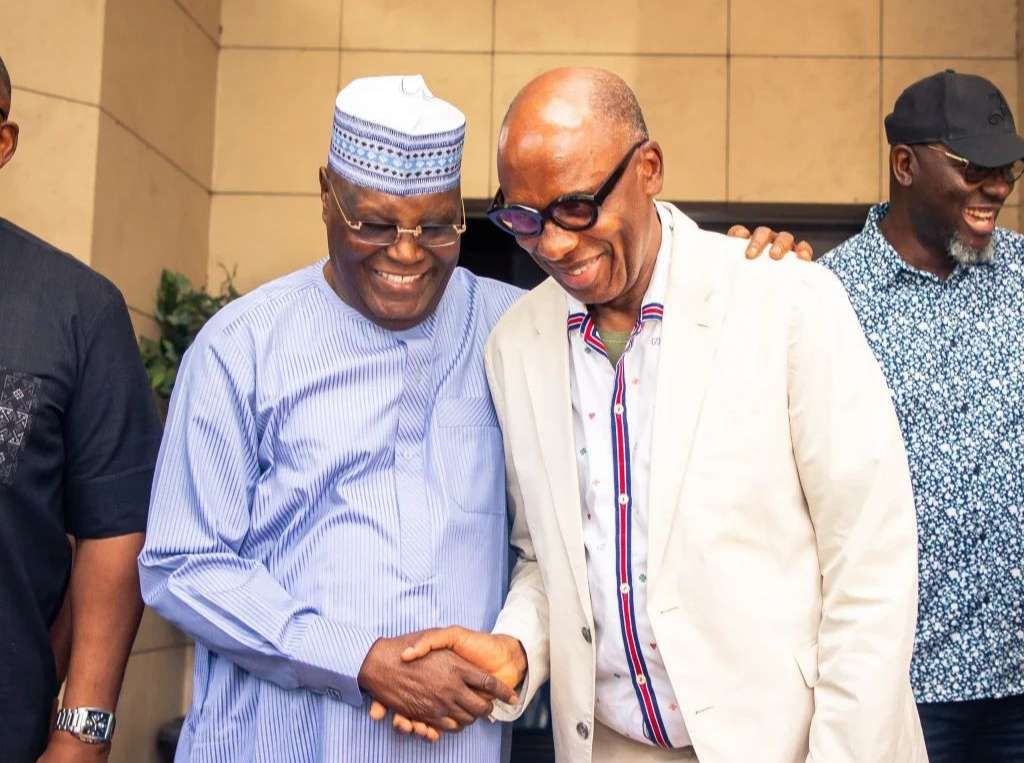
A few days ago, Amaechi paid a visit to Atiku at his Abuja residence. The meeting, which followed an earlier visit by Atiku to Amaechi, was widely interpreted as part of efforts to mend fences after the contentious ADC presidential primary that produced Atiku as the party’s standard bearer.
Amaechi and another aspirant, Mohammed Hayatu-Deen, had initially rejected the outcome of the primary, alleging irregularities in the process.
Although details of the two meetings were not made public, reliable party sources disclosed to Hallmark that discussions centred largely on the possibility of forging a joint ticket for the 2027 presidential election.
The meetings have fuelled speculations that Atiku has finally succeeded in persuading Amaechi to accept the vice-presidential slot after weeks of negotiations involving party leaders, influential stakeholders and political power brokers across the country.
Indeed, reports emerging from the ADC suggest that barring any last-minute change, the party may eventually present an “AA” ticket – Atiku and Amaechi – in what supporters hope could provide a formidable challenge to President Bola Tinubu’s re-election bid.
The decision appears to mark a significant departure from Atiku’s approach ahead of the 2023 elections when he declined to pick former Rivers State governor, Nyesom Wike, as his running mate despite Wike emerging as runner-up in the Peoples Democratic Party (PDP) presidential primary.
Many analysts believe that decision contributed significantly to the internal crisis that eventually fractured the PDP and weakened Atiku’s electoral chances.
This time, the former vice president appears determined not to repeat what many within the opposition still regard as a costly political error.
Why Amaechi?
For weeks, several names had featured prominently in discussions about Atiku’s running mate.
Among them were former Imo State governor Emeka Ihedioha, Director-General of the World Trade Organisation Ngozi Okonjo-Iweala, and publisher and former presidential candidate, Dele Momodu.
Momodu himself openly projected his suitability for the role, arguing that his roots across both the South-West and South-South regions could help bridge Nigeria’s widening political divisions.
In a statement posted on social media, Momodu called for “national reconciliation, re-orientation and reconstruction” and argued that the country needed a fresh political arrangement capable of uniting diverse constituencies.
“The North and the South will reunite in a game of ethnic and religious rivalries,” he wrote, warning that the prevailing tensions in the country could consume everyone if not addressed.
Yet despite the various names floated, Amaechi remained the obvious frontrunner.
His emergence became even more likely after Peter Obi moved to the Nigerian Democratic Congress (NDC), effectively removing from the ADC the one Southern politician with a nationwide grassroots movement and extensive youth support.
Political insiders say Atiku’s preference for Amaechi rests on two major considerations.
The first is financial. Several party sources told Business Hallmark that Atiku’s extensive presidential campaigns over the years have significantly depleted his political resources. In addition, some of his associates allege that businesses linked to the former vice president have faced increased scrutiny under the APC-led federal government.
Amaechi, by contrast, is viewed as one of the wealthiest and most resourceful political figures within the ADC.
The second consideration is political visibility. Among Southern politicians currently in the ADC, Amaechi arguably possesses the highest national profile. Having served as Speaker of the Rivers State House of Assembly, governor, chairman of the Nigeria Governors’ Forum and lately Minister of Transportation, he remains one of the most recognizable political figures in southern Nigeria.
Ihedioha, though respected in political circles, faces limitations that weaken his attractiveness as a running mate. As a South Easterner, he comes from the same region as Obi, whose popularity continues to dominate the political landscape of the zone. Furthermore, he lacks both the national profile and financial capacity that Amaechi brings to the table.
From Critic to Running Mate
What makes the emerging partnership particularly remarkable is that Amaechi was one of Atiku’s harshest critics during the ADC presidential primary campaign.
In an interview with Trust TV, Amaechi questioned Atiku’s electoral viability, arguing that the former vice president had repeatedly failed to convert his political experience into electoral victory.
“He started contesting in 1992,” Amaechi said. “It is his choice. I listened to where the former vice president said he never failed his primary election before. I hope this will be the first time he will fail a primary election.
“But that’s not even the issue. The issue is that all the times he had passed primaries, he didn’t win the election.”
He went further to question Atiku’s ability to defeat Tinubu.
“It is about electability. Can I win this election if you put me before the country? Visa-vis him, will he be able to win the election? And the answer I get is that he may not be able to win the election if he is put forward.
“He has lost against Tinubu before. What new thing are they bringing to the table?”
Those remarks fuelled speculation that Amaechi would reject any offer to become Atiku’s running mate. However, associates of the former minister insist he never ruled out the possibility.
According to them, Amaechi’s position was simply that no formal offer had been made.
Sources now say that offer has finally arrived, accompanied by assurances that he would play a substantial role both during the campaign and in a future administration should the ADC win power.
One close ally disclosed to Business Hallmark that Atiku assured Amaechi that the vice-presidential nominee would have “extensive roles to play in the campaigns and government.”
Such assurances may have been crucial in convincing the former Rivers governor to reconsider.
A Ticket With Serious Challenges
Yet, even if the Atiku-Amaechi pairing is eventually confirmed, formidable challenges remain. The biggest obstacle, for many observers, is geography.
“I don’t see Atiku making any headway in the South,” argued Chidi Anthony, Abuja based lawyer and political analyst. “He squandered his goodwill and portrayed himself as a selfish person. Amaechi won’t help him much because he doesn’t have ground troops.”
While Atiku continues to command significant support across parts of northern Nigeria, his electoral difficulties in the South remain profound. Ironically, Amaechi’s own political influence may not be enough to alter that reality.
In Rivers State, the political structure is largely controlled by Nyesom Wike, now Minister of the Federal Capital Territory, and one of President Tinubu’s most influential allies.
Wike’s extensive political network has become deeply embedded in the state’s governance and electoral machinery. At the grassroots level, however, public sentiment appears aligned with Peter Obi and the NDC.
The same pattern is evident across much of the South South and South East. In virtually all the states, political elites have gravitated towards Tinubu’s administration, while significant portions of the electorate continue to identify with Obi’s message and movement.
Consequently, analysts argue that Amaechi may possess visibility and experience but lacks the kind of grassroots political army capable of delivering votes on a scale that could transform Atiku’s prospects. As one observer put it, the former transportation minister has prominence but not necessarily troops.
Obi Factor Refuses to Disappear
Indeed, Peter Obi’s shadow continues to loom large over opposition calculations. Despite his departure from the ADC coalition, many within the party remain convinced that defeating Tinubu without Obi would be difficult.
This explains why some stakeholders continue to advocate renewed negotiations aimed at bringing Obi back into a broader opposition arrangement.
Usman Okai Austin, an ADC member, recently argued that all opposition forces must unite if they hope to unseat the incumbent president.
“Peter Obi and Kwankwaso should still talk to Atiku about power-sharing,” he said. “It’s now obvious that the NDC is in the race for the 2027 presidency. Collectively, we can chase Tinubu out, though the vice-presidential slot is gone.”
Similarly, Dr. Sam Amadi, Director of the Abuja School of Social and Political Thought, suggested that efforts to court Obi remain active behind the scenes.
“When I read social media insiders with no insider information, I laugh,” Amadi wrote on X.
“The things I know about ADC and search for VP is radically different from what you read here.
“The search is frantically on and they still badly want Mr. Clean. I won’t say more.”
The reference to “Mr Clean” was widely interpreted as a nod to Obi.
The Burden of 2023
Perhaps, the greatest challenge confronting Atiku is not organisational or financial but historical. Many political observers argue that he has yet to recover from the damage caused by his decision to seek the presidency in 2023 despite widespread expectations that power should rotate to the South following Muhammadu Buhari’s eight years in office.
That decision alienated many Southern voters, who had previously viewed him favourably. The irony is not lost on political analysts.
In 2014, Atiku left the PDP and joined the APC partly because of growing Northern dissatisfaction with then President Goodluck Jonathan’s bid for re-election.
Ahead of the 2019 election, Southern aspirants within the PDP largely stepped aside in recognition of the zoning principle, enabling Atiku to emerge as the party’s candidate. Many expected him to reciprocate in 2023 by supporting a Southern candidate, particularly from the South-East, which had never produced a president in the Fourth Republic.
Instead, he contested, and the fallout was immediate. The PDP fractured, Wike rebelled, and millions of Southern voters shifted their support elsewhere.
Prominent elder statesman and former Nigeria Economic Summit Group chief executive, Prof. Anya O. Anya, captured this sentiment during an interview before the 2023 election.
“I advised that he should work to get a pan-Nigerian Igboman to come out of this process, and he will anoint such a person,” Anya recalled.
“If he did that, he’d have become Nigeria’s number one hero; one that rose to help save the country when it was in trouble.”
Anya accused the PDP leadership of violating its own zoning principles and argued that the South-East had a legitimate claim to the presidency.
“Of the three zones in the South, only the South-East has not had it,” he said.
“Are there people in the South-East, who can bring leadership to Nigeria? The answer is yes.”
Those sentiments continue to resonate strongly in many southern communities.
A Difficult Road Ahead
The choice of Amaechi may provide Atiku with a respected political partner, and perhaps, heal divisions generated by the ADC primary contest. It may also reassure Northern and Southern stakeholders seeking balance on the ticket.
However, the deeper question is, if Atiku can rebuild the trust he lost in the South after 2023? The answer may ultimately determine whether the emerging Atiku-Amaechi ticket becomes a genuine threat to Tinubu’s re-election bid, or simply another chapter in the former vice president’s long and complicated quest for Nigeria’s highest office.
For now, the ADC appears convinced that Amaechi offers its best available option. Whether that calculation proves sufficient in a rapidly evolving political environment is a question that only the 2027 electorate and other intervening factors can answer.