Politics
2027: Atiku, Amaechi, Hayatu-Deen battle for ADC presidential ticket today
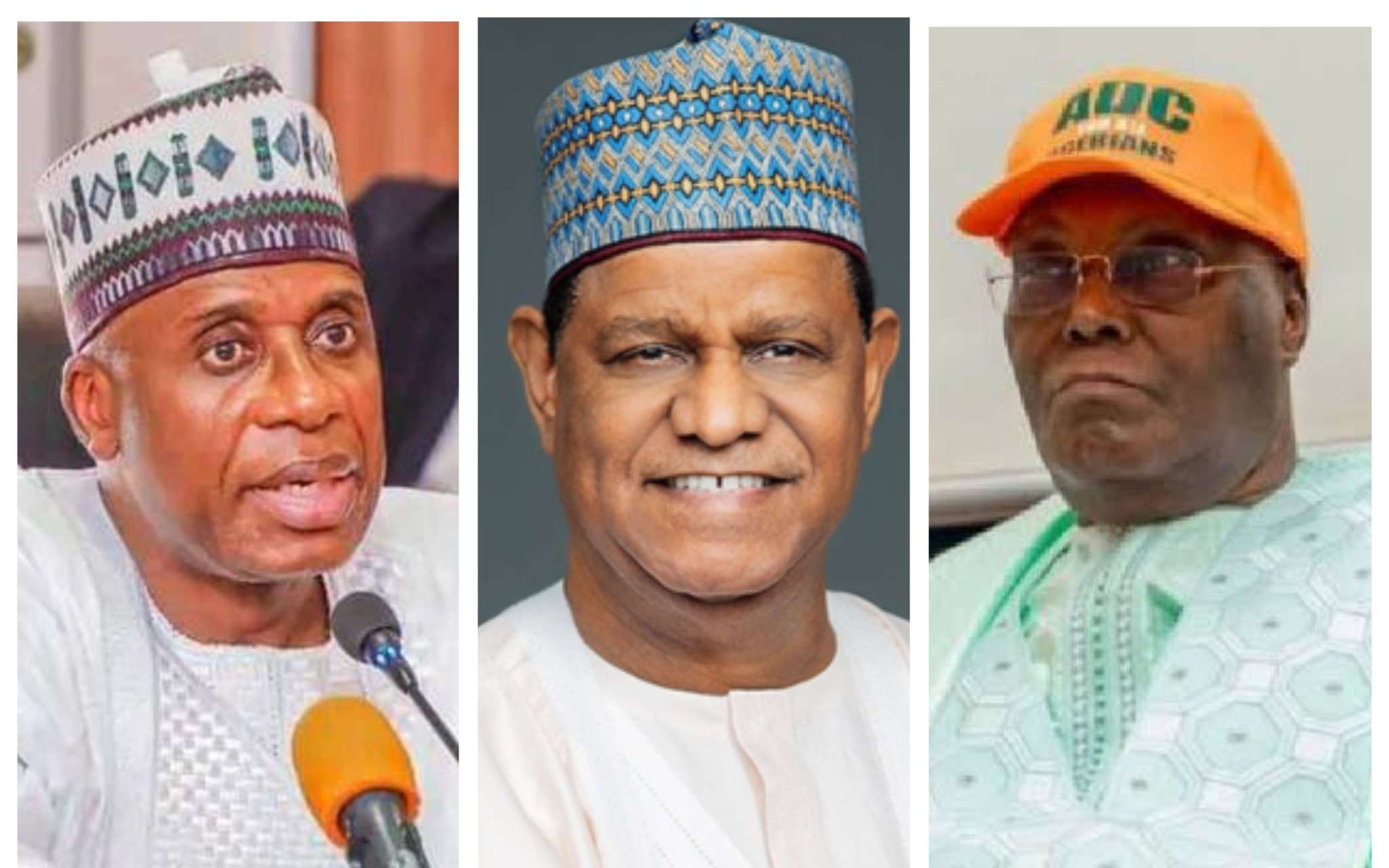
The African Democratic Congress (ADC) faces a crucial moment today as the party begins the process of electing its presidential candidate for the 2027 general election, with former Vice President Atiku Abubakar, former Transportation Minister Rotimi Amaechi and economist Mohammed Hayatu-Deen locked in a high-profile contest for the party’s ticket.
Party members across the 36 states and the Federal Capital Territory are expected to participate in the exercise through the direct primary system after efforts to secure a consensus arrangement reportedly collapsed.

The primary is widely seen as a defining test for the ADC as it attempts to position itself as the leading opposition platform ahead of the 2027 presidential election against President Bola Tinubu and the ruling APC.
Initially, there were discussions within the party over the possibility of adopting an affirmation process similar to that used by the Nigeria Democratic Congress. However, party leaders eventually settled for direct primaries after none of the aspirants agreed to step down for another.
For Atiku, the contest represents another attempt to lead a broad opposition coalition after decades at the centre of Nigerian politics.
The former vice president, who dumped the Peoples Democratic Party in 2025, has since emerged as one of the major architects of the ADC coalition movement alongside former Senate President David Mark and former Osun State governor Rauf Aregbesola.
Political observers believe Atiku’s greatest strengths remain his national political network, experience and financial capacity.
Over the years, he has built strong alliances across different regions of the country, making him one of the most recognisable opposition figures in Nigeria.
Supporters of the former vice president argue that among the three aspirants, he possesses the widest electoral appeal and the strongest political structure capable of mounting a serious challenge against Tinubu in 2027.
Several prominent politicians are also believed to be aligned with his camp, including former Attorney-General of the Federation Abubakar Malami, former Kaduna governor Nasir El-Rufai and former SGF Babachir Lawal.
Yet, Atiku’s long political career has also become a source of criticism among some younger party members who believe the opposition should embrace a new generation of leadership.
Amaechi, on the other hand, is entering the race with a reputation built largely on governance and infrastructure delivery.
The former Rivers State governor and ex-minister remains one of the most influential politicians from the South-South and is expected to draw support from those advocating that the presidency should remain in the South after Tinubu.
His supporters frequently cite the railway projects executed during the administration of former President Muhammadu Buhari as evidence of his performance in office.
They also point to his years as governor of Rivers State, where he implemented education and infrastructure reforms that earned national attention.
Beyond his achievements in office, Amaechi’s camp believes zoning considerations could work in his favour, arguing that the South should complete an eight-year presidential cycle before power returns to the North.
Despite these arguments, questions remain over whether Amaechi can generate enough support across the ADC structure to outmanoeuvre Atiku’s long-established political network.
For Hayatu-Deen, the primary presents an opportunity to market himself as a reform-minded technocrat capable of steering Nigeria away from economic decline.
The former banker has consistently campaigned on issues of economic recovery, institutional reforms, job creation and governance accountability.
Unlike Atiku and Amaechi, Hayatu-Deen has focused less on political alliances and more on policy conversations, insisting that Nigeria needs competence-driven leadership rather than what he describes as “recycled politics.”
Though he may not possess the nationwide political machinery of his rivals, his candidacy has attracted support from professionals, technocrats and sections of the youth population within the party.
His campaign also received a boost after the ADC South-West Professionals Forum endorsed him ahead of the primary, describing him as the candidate best suited to tackle Nigeria’s worsening economic and governance crisis.
Meanwhile, the ADC continues to grapple with internal tensions following the emergence of a rival faction loyal to Dumebi Kachikwu.
The faction, during a parallel convention in Abuja on Sunday, dissolved the party’s National Working Committee and declared Kachikwu its sole presidential candidate.
The development has further exposed divisions within the opposition party at a time it is attempting to build momentum ahead of the 2027 elections.
Nevertheless, political attention remains firmly fixed on today’s primary, which many analysts believe could shape the future direction of the ADC and determine the calibre of opposition Tinubu may face in the next presidential race.