Politics
Tinubu ‘plots’ tenure elongation
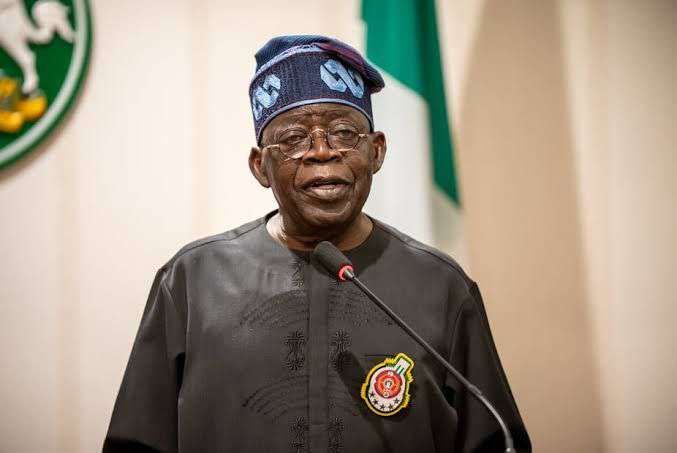
…as Bamidele’s kicks off six-year single term proposal
When Senate Leader, Opeyemi Bamidele, a close ally of President Bola Tinubu, disclosed recently that the National Assembly would consider a constitutional amendment introducing a single six-year term for presidents and governors after the 2027 general election, he presented it as a governance reform aimed at improving performance in public office.
According to him, elected leaders spend too much of their first term worrying about re-election rather than governance, and a single six-year tenure would free them from political distractions and enable them to focus on delivering results.

This had been the position of the Patriots, a group of eminent Nigeria led by late Chief F.R.A. Williams since 2023 when the loopholes in the present governance structure was discovered.
At face value, the proposal appears reasonable. The argument that political office holders lose valuable time preparing for re-election campaigns is not entirely new. Advocates of the idea have long maintained that a single term would reduce election-related tensions, lower campaign costs and allow governments to concentrate on policy implementation.
Yet, in Nigeria’s highly charged political environment, Bamidele’s proposal has triggered a different conversation altogether. For many political observers, the timing of the proposal, the identity of the man advancing it, and the prevailing political circumstances have combined to fuel suspicions that what is being presented as constitutional reform could eventually become a vehicle for tenure elongation.
Those suspicions have become even stronger against the backdrop of recent remarks by influential pro-Tinubu figures, ongoing debates over constitutional interpretation, and concerns that the country’s democratic institutions have become increasingly pliant.
Questions About Bamidele’s proposal
Speaking in Abuja ahead of the National Assembly’s anniversary activities, Bamidele declared that one of the first constitutional amendment bills he intended to pursue after the 2027 elections would be a proposal limiting presidents and governors to a single six-year tenure.
“I now see why one of the first sets of bills that I look forward to moving by God’s grace when we come back for the 11th Senate is for a bill that will only make it possible for anyone, who wants to be President of this country or governor in any state of this country to spend only one tenure of six years,” he said.
According to him, such a system would eliminate the distractions associated with second-term ambitions.
“If you know you are there for six years, only one tenure, you put in your best from day one. You know this is the only chance that you have.”
Ordinarily, the proposal might have generated a purely academic debate about constitutional engineering and governance reforms. However, many observers quickly viewed it through the lens of current politics.
President Bola Tinubu is seeking re-election in 2027. Although his administration continues to defend its economic reforms, the President remains deeply polarizing, with many Nigerians still struggling with the consequences of subsidy removal, currency reforms and rising living costs.
Despite this, Tinubu appears firmly in control of the country’s political machinery. Nearly all of the governors in the country remain loyal to him. The National Assembly leadership is also widely perceived as supportive of the Presidency, while opposition parties continue to battle externally induced internal crises and defections.
Against this backdrop, critics argue that constitutional changes proposed immediately after a Tinubu re-election victory could create pathway for political outcomes that are difficult to foresee today.
Echoes of Jonathan’s failed proposal
Part of the scepticism surrounding Bamidele’s proposal stems from history. During the administration of former President Goodluck Jonathan, discussions around a possible single-term arrangement also surfaced. At the time, many APC leaders including Tinubu, fiercely opposed the idea.
The opposition then argued that Jonathan was seeking to manipulate the constitution for personal political advantage and accused him of pursuing tenure elongation through the back door.
That history has not been forgotten. Political watchers point out that some of the same political actors, who rejected the concept under Jonathan now appear receptive to it. To such critics, the apparent shift raises questions about whether principles are driving the debate, or whether political convenience has become the determining factor.
The third-term whispers
The controversy surrounding the proposal has also intersected with growing speculation about a possible third-term agenda. Officially, no government official has suggested that Tinubu intends to seek more than the constitutionally permitted two terms.
Yet, comments from some prominent supporters have kept the issue alive in public discourse. In March, the Oluwo of Iwo, Oba Abdulrosheed Akanbi, suggested that many Nigerians might eventually demand a constitutional amendment to allow Tinubu remain in office beyond two terms.
The monarch argued that the President’s economic reforms and governance initiatives could generate popular pressure for constitutional changes. Around the same period, Yoruba Nation agitator, Sunday Igboho, went even further.
In a viral video, he declared support for Tinubu not only in 2027 but beyond, vowing that efforts would be made to secure additional years for the President after the expiration of his constitutional tenure.
Although neither statement carried official government endorsement, analysts describe such comments as political “kite-flying” – the practice of testing public reaction to ideas before they become formal policy proposals.
It is within this context that Bamidele’s six-year single-term proposal has attracted heightened scrutiny.
One of the most forceful interventions on the matter came from Professor Chidi Odinkalu, human rights lawyer and former chairman of the National Human Rights Commission.
Speaking in a widely circulated interview, Odinkalu argued that Nigerians were underestimating the implications of the proposal.
“I don’t think people understand where this is headed. There will be a third term, and I’m not the person saying it. Opeyemi Bamidele said something in this regard,” he said.
Odinkalu pointed to Bamidele’s close political relationship with Tinubu and urged Nigerians to take the proposal seriously. According to him, the key question would arise after 2031 if the constitution were amended to introduce a single six-year term.
“The current incumbent will be elected until 2031. In 2031, the question will be, will he be entitled to run on the six-year term or will he not? You will then get the best senior advocates in Nigeria telling you that law is not retrospective.”
Odinkalu suggested that future legal arguments could be built around the principle that constitutional amendments should not be applied retrospectively to limit rights already accrued under a previous constitutional arrangement.
In his view, governors and the President could potentially benefit from such interpretations. Whether that scenario is realistic remains a matter of intense debate among constitutional lawyers. Nevertheless, Odinkalu’s warning has resonated strongly with opposition figures and civil society activists.
Jonathan’s eligibility case and fresh suspicions
Fuel was added to the speculation by a recent Federal High Court judgment affirming former President Goodluck Jonathan’s eligibility to contest future presidential elections. The court held that constitutional provisions limiting presidential tenure could not be applied retrospectively against Jonathan.
Legally, the ruling dealt specifically with Jonathan’s unique circumstances, having completed the tenure of the late President Umaru Musa Yar’Adua before winning election in his own right.
Yet, some analysts believe the judgment may have implications beyond Jonathan himself. For those already suspicious of a hidden tenure-elongation agenda, the ruling appears significant because it reinforces legal arguments about non-retrospective application of constitutional amendments.
That interpretation has strengthened claims among critics that groundwork could be gradually emerging for future constitutional manoeuvres. Government supporters dismiss such concerns as speculative conspiracy theories lacking factual basis. Nevertheless, the coincidence of events has intensified public debate.
A compliant legislature
Another factor driving the controversy is the widespread perception that the current National Assembly lacks the independence displayed during previous administrations. The comparison most frequently made is with former President Olusegun Obasanjo’s failed third-term project.
In 2006, efforts to amend the constitution to allow Obasanjo seek another term ultimately collapsed after strong resistance from lawmakers, civil society groups, and political stakeholders. Many analysts argue that today’s political environment is significantly different.
Bamidele himself recently rejected accusations that the National Assembly functions as a “rubber stamp”, insisting that lawmakers have merely adopted a strategy of constructive engagement with the executive. However, critics remain unconvinced.
They point to the speed with which presidential requests are often approved and argue that legislative oversight has weakened considerably.
The fear among sceptics is that a constitutional amendment backed by the Presidency could face fewer institutional obstacles than similar efforts encountered two decades ago.
Opposition under pressure
The broader political environment has also contributed to concerns. Opposition politicians like Peter Obi, Rabiu Kwankwaso, among others, have repeatedly alleged harassment, intimidation and politically motivated prosecutions.
Several opposition leaders argue that state institutions are increasingly being deployed against political rivals.
Government ministers like Festus Keyamo have been quick to dismiss such allegations.
However, political analysts note that perceptions matter in politics. Where opposition actors believe democratic space is shrinking, suspicions regarding constitutional amendments are likely to multiply. The emergence of a six-year single-term proposal in such circumstances inevitably invites concern.
The northern factor
Among those who take third-term speculation seriously, many doubt it could succeed. Nigeria’s informal power-sharing arrangement remains a powerful force in national politics.
By prevailing political calculations, power is expected to return to the North after Tinubu’s second term ends in 2031. Any attempt to extend Southern occupancy of the presidency beyond that point would likely provoke fierce resistance from Northern political elites.
Historically, questions of zoning and regional balance have played decisive roles in determining political outcomes. Many analysts, therefore, believe that while constitutional amendments may be technically achievable, the political consequences could be destabilising.
A risky political calculation
Abuja-based lawyer, Anthony Chidi, believes the issue should not be dismissed outright, but warns that any attempt at tenure elongation would come at enormous political cost.
“When you observe Tinubu’s mannerisms, and the attitude of those close to him, you will inevitably come away with the idea that these people are not looking like those, who want to step aside anytime soon,” he said.
“But Nigeria is too complex for anyone to railroad in such a manner.
“Yes, it may, indeed, be in their thinking, especially when you hear what looks like an obvious kite in that regard from certain traditional rulers. But he would have to be ready to plunge the country into a huge political turmoil to succeed with that.”
That assessment reflects a broader view among many observers. While some believe the six-year single-term proposal may simply be a governance reform initiative, others see it as part of a sequence of political signals pointing toward a more ambitious constitutional project.
For now, there is no concrete evidence that Tinubu is pursuing a third-term agenda. Neither the Presidency nor the APC has formally proposed such a move.
What exists instead is a convergence of events – public calls for constitutional amendments from influential supporters, judicial rulings raising questions about constitutional interpretation, complaints about shrinking opposition space, and now a proposal for a single six-year tenure coming from one of the President’s closest political allies in the Senate.
Whether these developments are connected remains open to interpretation. What is clear, however, is that Bamidele’s proposal has reopened one of the most sensitive debates in Nigeria’s democratic history.