Business
Trump blasts Supreme Court over tariff setback, unveils plan for new 10% global levy

United States President Donald Trump has sharply criticised the Supreme Court of the United States after it struck down a key pillar of his global tariff policy, escalating tensions between the White House and the judiciary.
It would be recalled that in a 6–3 decision delivered on Friday, the court ruled that the administration overstepped its authority by using the International Emergency Economic Powers Act (IEEPA) to impose sweeping “reciprocal” tariffs on imports from nearly every country. The judgment effectively invalidates a broad set of duties first introduced against Mexico, Canada and China before being expanded globally under what the administration branded “Liberation Day” measures last April.

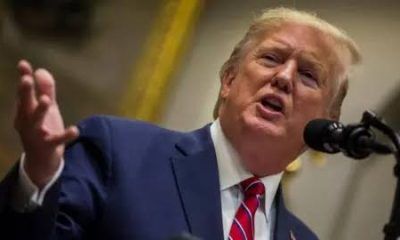
Reacting during a White House press briefing, Trump described the ruling as “deeply disappointing” and accused some justices of failing to uphold what he considers a legitimate exercise of executive power. He said certain members of the bench should be “absolutely ashamed,” alleging without evidence that the decision reflected political correctness and outside influence.
Despite the legal setback, Trump announced plans to sign an executive order introducing a new 10 percent “global tariff” under a separate statutory authority, Section 122. He maintained that the court had only rejected one specific application of IEEPA and had not eliminated his ability to impose tariffs altogether.
“The Supreme Court did not overrule tariffs,” Trump said. “They merely overruled a particular use of IEEPA tariffs.” He pledged to explore alternative legal avenues to safeguard his trade agenda.
Writing for the majority, Chief Justice John Roberts stated that Congress must clearly and explicitly delegate tariff powers to the president. He noted that when lawmakers intend to grant such authority, they do so in unmistakable terms and within defined limits. The court concluded that IEEPA, enacted in 1977 to address national emergencies, does not expressly authorise the imposition of broad-based tariffs.
The administration had defended the levies as necessary to combat drug trafficking and persistent trade imbalances, arguing they would stimulate domestic manufacturing and strengthen the US economy. However, states and small businesses that challenged the measures contended that the law does not mention tariffs and does not permit the executive branch to bypass Congress’ constitutional authority over taxation and trade.
The case was widely viewed as a crucial test of presidential power. The majority included the court’s three liberal justices along with two conservative justices appointed by Trump — Amy Coney Barrett and Neil Gorsuch. In dissent, Justices Clarence Thomas, Brett Kavanaugh and Samuel Alito argued that the president should have been granted broader discretion, with Kavanaugh cautioning that the aftermath of the ruling could create significant legal and administrative complications.
Financial markets responded positively. The Dow Jones Industrial Average rose 230.81 points to close at 49,625.97, while the S&P 500 gained 0.69 percent to 6,909.51. The Nasdaq Composite advanced 0.9 percent to 22,886.07. Communication services and consumer discretionary stocks led gains across most sectors.
Business groups welcomed the judgment cautiously. Nik Holm, chief executive of Terry Precision Cycling, one of the companies involved in the legal challenge, said the decision provided relief to employees at its facilities in Vermont and Washington State. He expressed optimism that improperly collected duties would be refunded, though he acknowledged that supply chain disruptions could persist for months.
According to government data, the US has collected approximately $130 billion in tariffs under IEEPA. Research suggests that much of the burden has ultimately fallen on American importers and consumers through higher costs.
Major corporations including Costco, Alcoa and Bumble Bee have filed lawsuits seeking refunds. While the Supreme Court’s ruling does not directly address the refund mechanism, the issue is expected to be handled by the Court of International Trade.
Meanwhile, fresh figures from the U.S. Bureau of Economic Analysis showed the economy expanded at an annual rate of 1.4 percent in the fourth quarter of 2025, below analysts’ projections of 2.5 percent. The release had been delayed due to a federal government shutdown, which economists estimate trimmed between 0.25 and 1.5 percentage points from quarterly growth.