Business
BREAKING: US Supreme Court strikes down Trump’s global emergency tariffs as unlawful
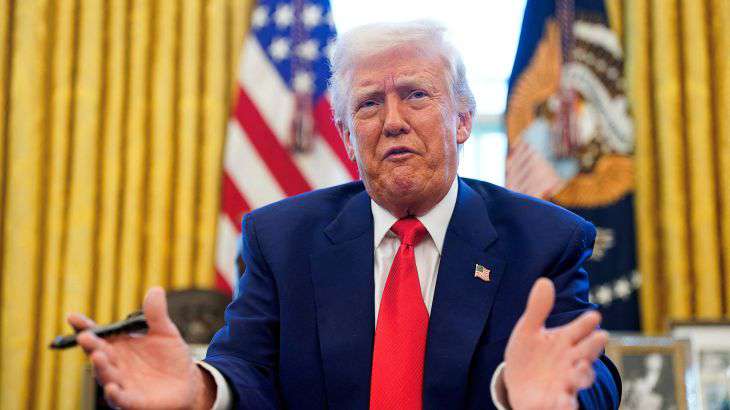
The Supreme Court of the United States has delivered a sweeping rebuke to President Donald Trump, ruling that his far-reaching emergency tariffs violated federal law and exceeded presidential authority.
In a 6–3 decision on Friday, the court held that Trump acted beyond the powers granted to him under the International Emergency Economic Powers Act (IEEPA) when he imposed broad tariffs on imports from multiple countries, including China, Mexico and Canada.

Writing for the majority, Chief Justice John Roberts said the president cannot claim unlimited tariff powers without explicit authorization from Congress.
“The president asserts the extraordinary power to unilaterally impose tariffs of unlimited amount, duration, and scope,” Roberts wrote. “In light of the breadth, history, and constitutional context of that asserted authority, he must identify clear congressional authorization to exercise it.”
The court found that IEEPA – a 1970s-era emergency law that allows presidents to regulate certain economic transactions during national emergencies – does not clearly authorize the imposition of tariffs.
Roberts was joined in the majority by Justices Amy Coney Barrett and Neil Gorsuch, as well as the court’s three liberal members. Justices Clarence Thomas, Samuel Alito and Brett Kavanaugh dissented.
Billions collected, but no clarity on refunds
While the ruling invalidates the legal foundation of the tariffs, the court declined to specify what should happen to the enormous sums already collected.
According to data from United States Customs and Border Protection, the federal government has collected roughly $134 billion in tariff revenue from more than 301,000 importers.
The majority opinion did not address whether those funds must be refunded, leaving the issue to lower courts. In dissent, Kavanaugh underscored the uncertainty, noting that the court “said nothing today about whether, and if so how, the government should go about returning the billions of dollars that it has collected.”
He cautioned that resolving the refund question could prove administratively complex and economically disruptive.
A defining economic showdown
The case marks one of the most consequential economic disputes to reach the high court in recent years. At issue were Trump’s so-called “Liberation Day” tariffs and additional duties imposed as part of his broader trade strategy. Some tariffs reached as high as 50% on certain trading partners and up to 145% on Chinese goods in 2025.
Trump and Justice Department lawyers defended the tariffs as essential tools of economic leverage and national strength, arguing that IEEPA’s language allowing a president to “regulate … importation” during emergencies encompassed the authority to impose duties.
Businesses challenging the tariffs rejected that interpretation, arguing that the statute does not mention “tariffs” or “duties” and that Congress historically grants such powers explicitly and with clear limits.
Roberts agreed with that reasoning, emphasizing that when Congress intends to authorize tariff powers, it does so clearly and with defined constraints. “It did neither here,” he wrote.
The ruling also echoes the court’s recent application of the “major questions doctrine,” under which executive actions involving vast economic or political consequences require unmistakable congressional approval.
Limits on executive power
Trump had argued that tariffs fall within the president’s foreign affairs authority, an area traditionally afforded judicial deference. However, the court concluded that such deference cannot substitute for clear statutory authorization.
While presidents do have other statutory mechanisms to impose tariffs – including limited, time-bound authorities and national security-based provisions – those routes involve procedural requirements and constraints absent from Trump’s sweeping emergency action.
Every lower court that reviewed the tariffs had found them unlawful, though those rulings were temporarily paused pending appeal, allowing collections to continue.
With the Supreme Court’s decision now in place, lower courts must determine the practical consequences, including whether billions of dollars collected from importers must be repaid.