Business
Revenue allocations: New sharing formula boost South’s receipts (with Infographics)
Upstages landmass, population against production, consumption
The 17 Southern states of the federation have upstaged their 19 Northern counterparts in the raging contest for the control of Nigeria’s vast resources as the battle for fiscal federalism between the two contending regions intensifies, Business Hallmark’s findings have revealed.

According to data obtained by Business Hallmark (BH), the South cornered 52.7 percent of federal revenues shared by the Federation Accounts Allocation Committee (FAAC) to states of the federation in 2025.
The development is a major shift in Nigeria’s old political and economic order, where the North cornered the largest chunk of the nation’s vast resources.
For decades, the 19 Northern states, using territorial and population size as advantage, benefitted from the lopsided sharing of both economic and political powers to the detriment of the other parts of the country that contribute more to the commonwealth.
However, the tide had largely turned, with states from the south, though still demanding for more share of distributable earnings, now earn a fair share of the wealth generated from their territories, in a development political observers described as “subtle restructuring.”
✅ Verified Key Insights (2025 FAAC Disbursements)
| Region | % of FAAC Revenue | Total Allocation |
|---|---|---|
| Southern (17 states) | 52.7% | ₦3.15 trillion |
| Northern (19 states) | 47.3% | ₦2.83 trillion |
An FAAC report on disbursements to the 36 states of the federation in the year ended 2025 obtained by BH, showed that top earners of FAAC disbursements in the period under review were major commercial centres and oil-producing states, which benefited from huge statutory allocations from oil and gas proceeds, Value Added Tax (VAT), Electronic Money Transfer Levies (EMTL), Nigeria Customs Service (NCS) duties and tariffs, Company Income Tax (CIT) and others.
Fairer Sharing Formula
An analysis of the report indicates that revenue sharing was largely influenced by factors like digital transactions, 13 percent derivation policy, consumption and population spread.
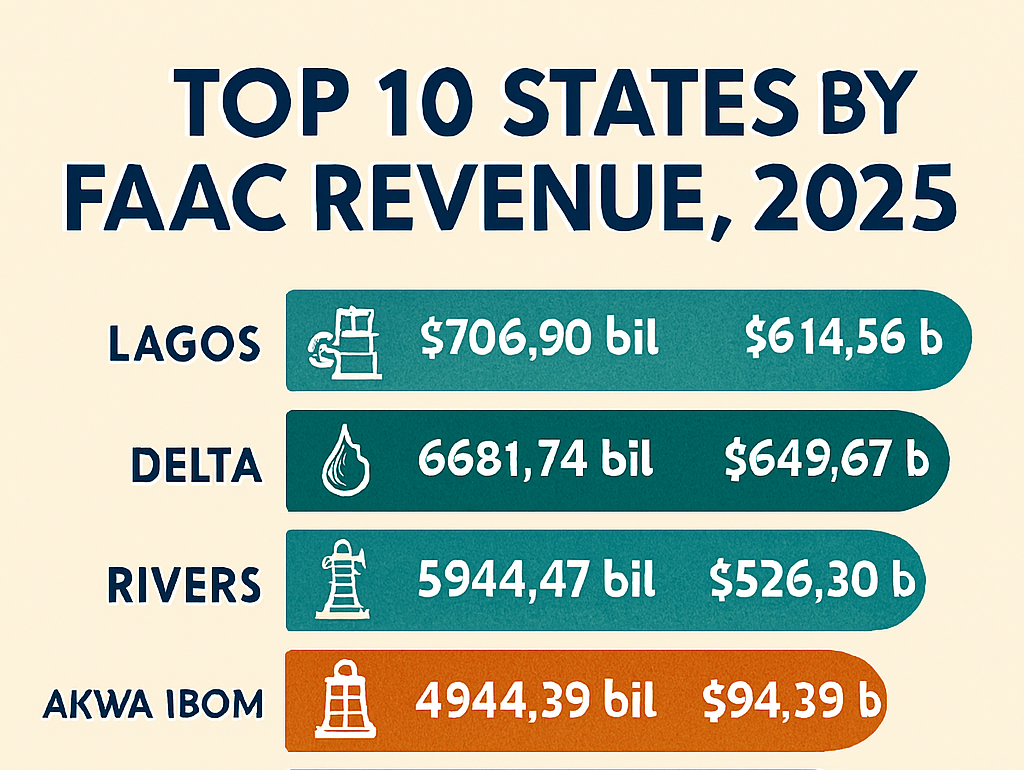
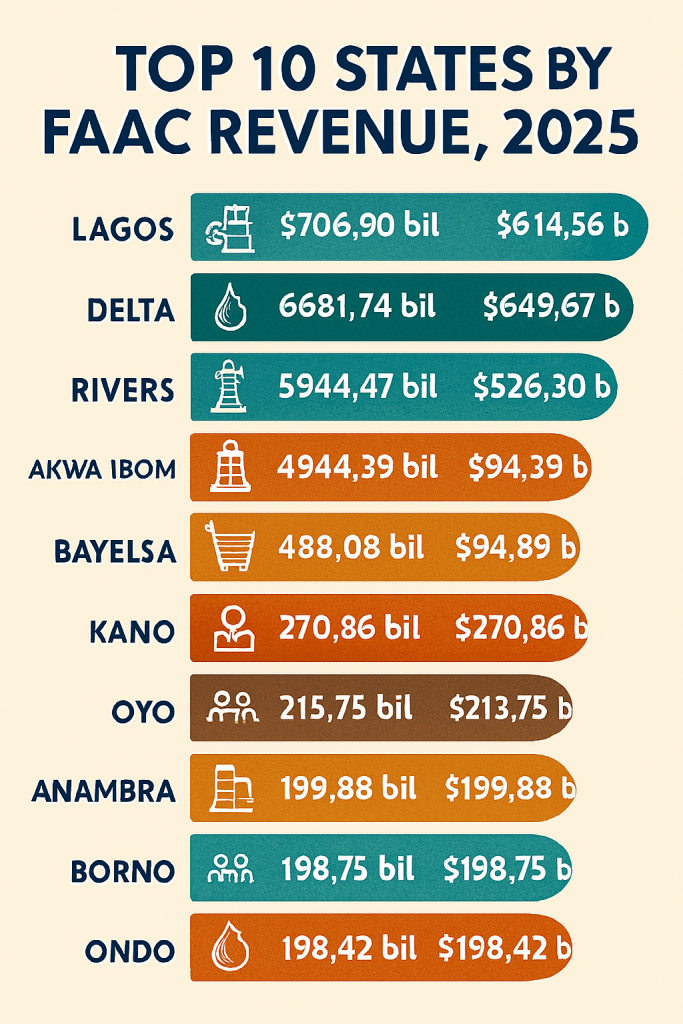
Leading the pack of states with the highest federal revenue in 2025 is Lagos with a total gross FAAC allocation of N706.90 billion and a net payout of N514.56 billion.
Lagos massive allocation was largely driven by strong electronic money transfer levy receipts and a VAT inflow of N459.87 billion.
Closely following on Lagos heels is Delta State, which received a gross allocation of N681.74 billion and a net amount of N649.67 billion after deductions were made.
Delta’s revenue allocation was driven largely by a derivation revenue of N458.65 billion.
In third position is Rivers State. The oil-rich state got N594.47 billion gross and N526.30 billion net from FAAC in 2025. This performance reflects a combination of oil and gas derivation, and VAT inflows from industry players and consumers.
Others are Akwa Ibom in fourth position with a net allocation of N494.39 billion. Breakdown of Akwa Ibom’s FAAC revenue shows that it received a net statutory allocation of N363.35 billion, net VAT allocation of N95.85 billion, and electronic money transfer levy receipt of N4.96 billion.
Bayelsa is the fifth on the ladder, receiving N488.08 billion in FAAC allocations in 2025. Breakdown of the earnings showed that while the state got statutory net allocation of N367.14 billion, net VAT allocation amounts to N87.98 billion and electronic money transfer levy receipt at N3.82 billion.
Kano State, which used to be the highest earner in the country, also crept into the list of top 10 FAAC earners in 6th position with a earning of N270.86 billion in 2025.
While Kano got N100.23 billion in net statutory allocation, its net VAT allocation amounted to N146.81 billion and electronic money transfer levy receipt N7.89 billion
Kano’s performance was driven largely by high population and its position as the economic and commercial capital of the North.
Following Kano in 7th position is another southern state of Oyo, which received N213.75 billion from FAAC in 2025.
Further analysis of Oyo’s FAAC earnings in 2025 indicates that while its net statutory allocation amounted to N49.35 billion, net VAT allocation and EMTL settled at N146.06 billion and N6.75billion. The pacesetter state benefits from its population and economic size.
Anambra in South East Nigeria came 8th on the list of highest FAAC earners in the country with N199.88 billion earnings in 2025.
Breakdown of Anambra’s earnings showed that the state got net statutory allocation of N88.21billion, N94.15 billion net VAT allocation, N5.83 billion EMTL allocation and N20.74 billion in oil derivation.
Like other high performing states, Anambra also benefitted from its position as a trading and industrial hub of the Eastern region, as well as from its status as an oil-producing state.
The second northern state on the list of top FAAC earners is Borno in 9th position. In 2025, Borno earned N198.75 billion.
While the state received N89.11billion as net statutory allocation, it got N92.18 billion and N5.02 billion as net VAT allocation and EMTL.
In 10th position is Ondo with a net allocation of N198.42 billion in 2025. BH analysis of the state’s receipts in the period under review showed that it got N95.20billion, N87.17 billion, N4.85 billion as net statutory allocation, net VAT allocation and electronic money transfer levy receipts respectively.
🎯 Top 10 FAAC Earning States in 2025
| Rank | State | Net Allocation | Economic Driver Icon |
|---|---|---|---|
| 1 | Lagos | ₦514.56bn | 💸 Digital Economy (EMTL, VAT) |
| 2 | Delta | ₦649.67bn | 🛢️ Oil Derivation |
| 3 | Rivers | ₦526.30bn | 🛢️ Oil + VAT |
| 4 | Akwa Ibom | ₦494.39bn | 🛢️ Oil |
| 5 | Bayelsa | ₦488.08bn | 🛢️ Oil |
| 6 | Kano | ₦270.86bn | 🛍️ Commerce + VAT |
| 7 | Oyo | ₦213.75bn | 👥 Population + VAT |
| 8 | Anambra | ₦199.88bn | 🏭 Trade + Oil |
| 9 | Borno | ₦198.75bn | 👥 Statutory + VAT |
| 10 | Ondo | ₦198.42bn | 🛢️ Oil + VAT |
🧠 What This Reveals
- Southern dominance: 8 of the top 10 earners are southern states, driven by oil derivation, VAT, and digital transactions.
- Northern resilience: Kano and Borno still make the list, thanks to population size and statutory allocations.
- Diversified drivers: Lagos thrives on digital levies, Delta and Rivers on oil, Oyo and Kano on VAT and consumption.
……………………………………………
Fears Come True
In the same vein, Northern states led the states with the lowest FAAC allocations in 2025, according to BH checks.
The 10 states with the lowest allocations in the period under review are Yobe in 27th position with N155.20 (net statutory allocation of N63.61 billion, net VAT allocation of N77.56 billion and EMTL of N4.07 billion); Taraba in 28th position with N153.33 billion (net statutory allocation of N64.66 billion, net VAT allocation of N76.06 billion and EMTL of N4.07 billion); Nasarawa in 29th with N149.67 billion allocation in 2025 (net statutory allocation N63.94bn, net VAT allocation N73.27bn and EMTL of N3.97bn).
Others are Kwara in 30th position with N145.93 billion allocation (net statutory of N53.18bn, net VAT allocation of N80.40bn and EMTL of N4.25bn); Osun in 31st N144.94 billion (net statutory allocation: N44.99bn, net VAT allocation and N85.59bn and EMTL of N4.80bn); Ebonyi in 32nd position with N139.10 billion (net statutory allocation N49.69bn, net VAT allocation N76.21bn and EMTL of N4.03bn and Gombe in 33rd position with N136.44 billion allocation (net statutory allocation of N46.67bn, net VAT allocation of N77.24bn and EMTL of N4.08bn).
Last on the list of laggards are Cross River in 34th position with N130.84 billion allocation (net statutory allocation, N37.75bn, but VAT allocation of N79.65bn and EMTL of N4.47bn); Ekiti in 35th position with N130.30 billion allocation (net statutory allocation N38.82bn, net VAT allocation N78.35bn and EMTL and N4.17bn) and Ogun in 36th position with N124.19 billion (net statutory allocation N18.99bn, net VAT allocation of N90.01bn and EMTL of N5.40billion.
BH findings revealed that the financial situation of the North could become worse as President Bola Tinubu’s tax reforms take shape.
Bad To Worse
It would be recalled that the president had submitted a series of tax proposals to the National Assembly, which would among other things, generate more income for the generation and alter the revenue sharing formula among states.
The presidential committee of tax review had proposed a VAT-sharing formula of 20 percent based on equality, 60 percent based on derivation, and 20 percent based on population.
However, the proposals did not go down well with northern leaders, who alleged they will be shortchanged.
Rising from a critical meeting in Abuja, the 19 northern governors, prominent traditional rulers and called on federal lawmakers from the North to reject the bills outright.
A compromise was later reached, where the contentious revenue sharing formula was slightly altered in favour of the North. With the revised formula, which was later passed by the National Assembly, sharing will now be based on 50 percent equality, 30 percent derivation and 20 percent on population.
In spite of that, the adopted formula yields more to states in the southern part of the country with large consumption figures, highly industrialized cities and those generating more revenues to the federal cover.