Politics
Opposition in turmoil as Obi, Kwankwaso dump ADC for NDC
... Deepens Atiku’s isolation ahead of 2027
Nigeria’s opposition politics is once again hurtling towards a familiar precipice, fragmentation, recrimination, and strategic miscalculation, just as the clock begins to tick loudly towards the 2027 general election. What began as a promising coalition under the African Democratic Congress (ADC) has unravelled, exposing deep fissures driven by ambition, distrust, and ideological incoherence.

At the centre of this unfolding drama are three towering figures: Atiku Abubakar, Peter Obi, and Rabiu Musa Kwankwaso. Their uneasy alliance – once touted as the opposition’s best hope of dislodging incumbent Bola Tinubu – has collapsed under the weight of competing presidential ambitions and mutual suspicion.
Now, in a dramatic twist that could redefine the electoral map, Obi and Kwankwaso have concluded plans to defect to the Nigeria Democratic Congress (NDC), effectively splitting the opposition into rival camps and setting the stage for what increasingly looks like a three-horse race in 2027.
A coalition in crisis
The signs of disintegration had been visible for months. The ADC coalition, cobbled together as a broad anti-Tinubu front, was always a fragile construct, less a unified ideological platform than a marriage of convenience among political heavyweights seeking power.
Internal disputes over zoning, leadership structure, and the presidential ticket created persistent tensions. The situation deteriorated further following a controversial ruling by the Supreme Court of Nigeria, which failed to resolve the party’s leadership crisis, and instead returned the matter to a lower court, prolonging uncertainty.
For Obi and Kwankwaso, the legal limbo proved decisive. “With the case back in court, there is uncertainty about how long it will take. That makes it difficult to remain and plan effectively,” said Habibu Mohammed, spokesperson of the Kwankwasiyya Movement, confirming that consultations across Kano’s 44 local government areas had yielded unanimous support for a move away from the ADC.
Kwankwaso himself restated the concerns in a statement at the weekend, noting that he had yet to decide his next steps. But on Sunday, he left no one in doubt.
Behind the official explanations, however, lay a more combustible issue: Atiku’s determination to run. Multiple sources within the coalition describe a growing perception that the ADC’s internal structure had become skewed in favour of the former vice president, effectively foreclosing a fair contest.
“One of the factors cited is the insistence of Atiku Abubakar on contesting,” a source revealed, adding that the party appeared “designed and structured to favour an individual aspirant.”
For Obi, having promised his supporters a place on the ballot in 2027, the former Anambra governor could not afford to gamble on what many saw as a compromised primary process.
The NDC option
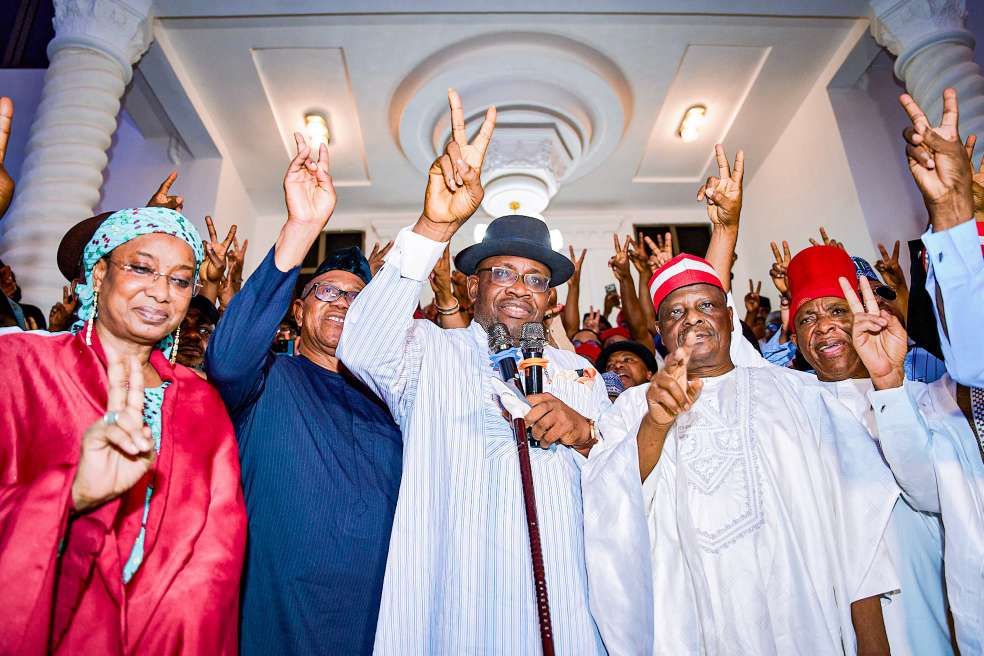
Enter the NDC, a relatively less encumbered platform fronted by Seriake Dickson, former governor of Bayesla State, that has been quietly positioning itself as a refuge for disenchanted opposition figures. Negotiations between Obi, Kwankwaso, and NDC leaders have reached an advanced stage, with party officials openly signalling their willingness to hand over the presidential ticket.
“They are most welcome,” said Abdulmumin Abdulsalam, the party’s deputy publicity secretary. “We are willing to give them the presidential ticket… only Providence, except if Providence decides otherwise.”
Obi and Kwankwaso were on Sunday received into NDC on Sunday by Dickson, although formal declaration is still being expected.
The appeal of the NDC is strategic. Unlike the ADC, it offers clarity, control, and the possibility of a unified ticket without the bruising internal battles that have come to define Nigeria’s opposition politics. Insiders say the deal is effectively sealed: Obi will lead the ticket, with Kwankwaso as his running mate, an arrangement already being marketed through the grassroots “OK Movement.” Obi has promised, and is expected to do four years if elected, and back Kwankwaso in 2031.
Explosion in the opposition camp
The reaction to this realignment has been nothing short of explosive. Within Atiku’s camp, the decision by Obi and Kwankwaso to exit the ADC has been interpreted as both betrayal and political naivety. Loyalists have launched fierce attacks, questioning Obi’s electoral viability, particularly in northern Nigeria, where Atiku’s support base is traditionally strong.
Usman Isyaku, an ADC chieftain and Atiku loyalist, was blunt: “A former governor with zero federal experience thinks he’s bigger than a VP position is unexplainable… I want them out of the ADC!”
Others have echoed the sentiment, arguing that Obi squandered a strategic opportunity to align with a candidate they consider more experienced and nationally entrenched. Media personality Dele Momodu has also weighed in, insisting that Obi would have been better served as Atiku’s running mate, a position he believes offers a more realistic pathway to power.
But Obi’s supporters have responded with equal ferocity.
They accuse Atiku of placing personal ambition above national interest, pointing to what they describe as a pattern of reneging on agreements, including an alleged understanding that the opposition ticket would be zoned to the South.
“The usual suspect agreed before attending the Declaration,” one ally wrote, “but at the venue, he manipulated it again.”
For many within the Obidient movement, the issue is moral. They see Atiku’s persistence as emblematic of a broader failure of Nigeria’s political class to prioritise generational change and national renewal.
Calls for sacrifice ignored
Amid the escalating tensions, several voices within the ADC have called for compromise, urging Atiku to step aside in the interest of unity. Princess Grace Adejoh, a party women leader, framed the moment in stark terms: “Will he choose legacy over ambition?”
Similarly, party stakeholders like Mazi Nnamdi Iroegbu have appealed for “self-denial and unflinching national devotion,” warning that failure to unite could doom the opposition’s chances.
Even outside formal political structures, commentators have joined the chorus. Dr. Charles Apoki, a public affairs analyst, delivered a scathing critique of Atiku’s candidacy, citing concerns ranging from age and health to questions of trust and credibility.
Yet these appeals appear to have had little impact. Atiku’s camp remains resolute, buoyed by confidence in his northern support base and long-standing political machinery. For them, stepping aside is neither necessary nor justified.
Amaechi’s dilemma
Caught in the crosscurrents is Rotimi Amaechi, the former Minister of Transportation and former governor of Rivers State, who has also declared presidential ambitions within the ADC. While Amaechi insists on running, few observers believe he has the political clout to overcome Atiku in a primary contest, or to mount a credible national challenge.
His candidacy, in many ways, underscores the fragmentation within the ADC: multiple aspirants, overlapping ambitions, and no clear path to consensus. Should Atiku secure the ticket – as widely expected – Amaechi may align with the former vice president as his running mate.
Return to a familiar script
As the dust settles, the contours of the 2027 election are beginning to resemble a replay of 2023, albeit with new party alignments. Tinubu is seeking re-election under the ruling All Progressives Congress (APC), leveraging the advantages of incumbency. Opposing him will likely be Atiku, flying the ADC flag, and Obi, leading a revitalised NDC alongside Kwankwaso.
It is a scenario that has prompted both anticipation and concerns. For critics like Farooq Kperogi, the fragmentation is a gift to the incumbent.
“Tinubu is the net beneficiary of their maximalist posturing and internal warfare,” he argued in his Saturday column, describing the opposition leaders as “his most reliable unpaid campaigners.”
Kperogi’s critique cuts to the heart of the opposition’s inability to subordinate personal ambition to collective strategy. “Even before they have had a chance to come together, they are splintered,” he noted. “We are back to the 2023 factionalization of the opposition.”
The politics of mutual suspicion
Perhaps, the most striking feature of the current crisis is the intensity of the hostility between opposition factions. The exchanges between Atiku’s supporters and those of Obi and Kwankwaso have been, by many accounts, more acrimonious than their criticisms of the ruling party.
Each camp accuses the other of indirectly aiding Tinubu. Obi’s supporters argue that backing Atiku would undermine the principle of zoning and perpetuate northern dominance. Atiku’s allies counter that supporting Obi risks disrupting the North’s expected turn in 2031.
The result is a political stalemate in which strategic logic is subordinated to zero-sum calculations. As Kperogi observes, “In fighting each other, the opposition is fighting for Tinubu.”
Fear of a flawed contest
Compounding these challenges is a pervasive scepticism about the integrity of the electoral process. Across the opposition spectrum, there is a lingering belief that institutions, such as the Independent National Electoral Commission (INEC) may not be neutral arbiters.
Allegations suggest that state power could be deployed to shape outcomes in favour of the incumbent. This perception has influenced strategic decisions, including the rush by Obi and Kwankwaso to secure a stable platform in the NDC. As one ADC chieftain put it, “If… the administration manipulates the judiciary against us, that will be too late for us, and it may hand Tinubu a cheap victory.”
A nation watching
Beyond the manoeuvres of political elites, the unfolding drama is being closely watched by a Nigerian public weary of economic hardship, insecurity, and unfulfilled promises. For many voters, the stakes transcend party politics. The question is whether the opposition can offer a credible alternative, or whether it will once again succumb to internal divisions.
The early signs are not encouraging. Instead of presenting a united front, the opposition appears locked in a cycle of fragmentation, with each faction convinced of being indispensable. The very forces driving division – ambition, conviction, and the desire for relevance – are also the engines of political competition. The challenge is to channel them into a coherent strategy.
The emerging configuration has forced political strategists to revisit the regional arithmetic that has long underpinned Nigerian elections. With Obi and Kwankwaso now aligning under the NDC structure, analysts say the opposition may finally be attempting a deliberate fusion of the South-East/South-South enthusiasm that surrounded Obi’s 2023 outing with the formidable Kano-centric political machinery traditionally associated with Kwankwaso.
Within the NDC, insiders describe the arrangement as a “deliberate balancing experiment” designed to neutralise the regional fragmentation that crippled opposition efforts in the past cycle. One party official said the thinking is straightforward: Obi delivers urban middle-class mobilisation and youth-driven digital networks, while Kwankwaso brings disciplined grassroots structures across parts of the North-West.
Yet the question that continues to shadow the coalition is whether these blocs can be harmonised into a coherent national message beyond electoral enthusiasm. Even within Obi’s camp, there are concerns that the ideological distance between both leaders may resurface once the campaign begins in earnest.
In contrast, Atiku’s allies argue that the ADC, despite its current turbulence, still retains the deepest reservoir of elite political experience and national spread. A senior associate within the camp maintained that “structures win elections, not sentiment,” insisting that Atiku’s long-standing presence in nearly every electoral cycle gives him an institutional advantage that new alliances cannot easily replicate.
Meanwhile, Tinubu’s camp has largely maintained public silence – beyond attacks targeted at Obi by the retinue of official and unofficial media aides – but political observers suggest a quiet confidence within the ruling establishment. The fragmentation of opposition forces into at least three competing presidential centres – ADC, NDC, and APC – is widely seen as structurally advantageous to incumbency.