Headlines
North East, Northwest clash over U.S. military deployment in Nigeria
Reopen old differences over Islamic identity
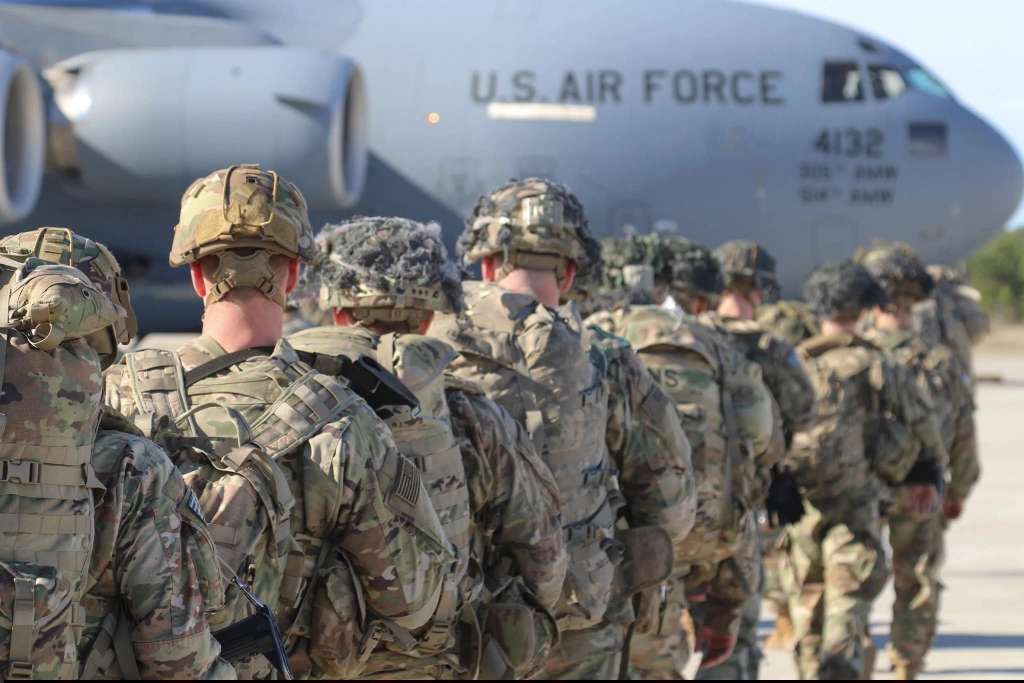
Senator Ali Ndume was recently a guest at Channels Television’s Politics Today , where he endorsed deployment of American troops to Nigeria. Ndume, a ranking senator, represents Borno South in the Senate.

The endorsement has split lawmakers, but perhaps, more telling is that it has reopened the old historical wounds in northern Nigeria ; and highlighted the agelong historical fault lines that date back to the Jihad of Uthman Danfodio in 1804.
For context, two members of the House of Representatives have expressed differing views on Senator Ali Ndume’s recent call for the deployment of United States troops to Nigeria amid worsening insecurity in the North-East.
Speaking penultimate Friday as a guest on Channels Television’s Politics Today, Ndume had endorsed the deployment of U.S soldiers to Borno State to assist in combating insurgency and banditry.
“The fact that the Americans are now helping us fight insurgency is a welcome development. We have been looking for this support for a long time and have made many efforts to get it, but have failed.
“Now that we have this window of opportunity, we must utilize it. I have complained many times that our major setback in this fight is a lack of certain resources; now, America has agreed to provide those resources free of charge,” he said.
Different Strokes
But taking a different stance, Kano lawmaker and House Committee Chairman on Air Force, Alhassan Rurum, said a well-equipped and properly funded Nigerian Armed Forces could defeat terrorism independently. He totally disagreed with Ndume’s perspective.
“I’m not in support of the American Army deployment to Nigeria. Our Armed Forces are capable of handling our security challenges. We only need to properly fund and provide modern equipment for them,” he said.
These two contrasting viewpoints represent two diametrically opposed strands of the Northern question, which speaks to the divide between the Caliphate and the non Caliphate voices in the North, especially the Northeast, which is historically a coagulation of many tribes that are neither Hausa nor Fulani,” professor Alhassan Abubakar, a historian, told Business Hallmark.
“Remember that the Borno empire and the Kwararafa confederate – mainly the Nupe, the Gwari, the Jukun, the Tiv, Idoma, the Angas, Takum, the Angas and many other minority tribes in the Middle Belt were never conquered by the Caliphate. It was the British that handed over the “entire” north to the Caliphate, something they couldn’t achieve through conquest.
The Borno empire under Sefawa dynasty ran for a thousand years under Mai king and they had been practicing Islam long before the Jihad of 1804. The colonial era political formation still reflected the fierce independence of the Kanuri, Shuwa Arabs, the Tangales and other tribes in the North East. You can still remember Borno Youth Movement under Zaid Zungur tended towards anti caliphate. So, there’s has been division in the North. Ndume represents this fierce independence.
Enter the Middle Belt
Penultimate Sunday, the Middle Belt Forum expressed support for Ndume’s proposal, urging U.S troops to act professionally in operations against terrorists, bandits, and insurgents.
The National President of MBF, Dr. Bitrus Pogu, said that while the proposal was positive, the U.S government must carefully consider intelligence and the operational environment.
“One important thing is about intelligence, and I think they are already getting that intel. They also have to study those who have been sent to assess the situation carefully,” Pogu said.
He warned that internal compromise within Nigerian security forces could challenge foreign troop operations.
“A foreign army will find it very difficult to operate. So, if they are going to do it together with the soldiers or the police on the ground, a lot of study and intelligence must first be made available through those who have come earlier,” he said.
Pogu suggested ways U.S troops could assist, such as providing air support while Nigerian forces handle ground operations.
The forum also urged expanded security collaboration, including more troops, enhanced weapons systems, and strengthened intelligence sharing between Nigeria and the U.S.
“At a time when Nigeria has entered into a defence cooperation understanding with the U.S, it is troubling that terrorists appear emboldened, almost as if mocking that partnership,” said Luka Binniyat, the forum’s spokesman.
Beyond the North
Another deployment is taking place in the Borgu area of the Kainji national game reserve, which borders the Oworo and Kaiama communities, which had been theater of mass killings and abductions in the past month with no help coming.
The Arewa Consultative Forum said it had not yet taken a firm position on Ndume’s call, noting that key details of the proposed U.S military involvement remained unclear.
But Professor Abiola Ajala, a political scientist, said ACF will find it difficult to reach a common ground because time has changed and the illusion of one monolithic North has been shattered. It has become “to your tents oh Israel.” They will have to tread cautiously as a group, but as individuals they can take a position.
“ACF is worried that full details of the U.S military involvement are yet to be made public, which is a cause for concern.
“Perhaps, Distinguished Senator Ndume knows more than the ordinary citizens. There are legal and constitutional implications, such as the need for the National Assembly’s approval, because it involves foreign military forces acting in Nigeria’s territory,” said National Publicity Secretary of ACF, Prof. Tukur Muhammad-Baba.
The Forum of Northern Christians and the Federal Capital Territory, led by Chairman Joseph Hayab, expressed support for Ndume’s proposal.
“There is nothing wrong with the U.S backing Nigeria to save the country from terrorist attacks,” he said.
Hayab emphasized that the primary concern was protecting lives and property, adding, “Any partnership that would effectively address insecurity should be embraced.”
The Coalition of Northern Groups, Gombe State Chairman, Mohammed Deba, said his organisation was partially supportive but highlighted concerns over foreign intervention.
“Recently, we supported other African countries in maintaining peace. So, why can’t we solve our security issues?
“Technically, we are in support, and then again we are not in support,” he said.
Reopening Old Wounds
Nothing highlights the division between North West and North East more than the correspondence between Mohammed El-Kanem and Sultan Bello over the inappropriateness of a jihad in a nation that was already Islamic state.
This was further highlighted by the nature of politics in Northern region, which strictly follows the fault lines during the precolonial, the First and Second Republic. NPN which traditionally stood for conservative pro- caliphate tendency never won election in Borno and Gongola states of the Northeast.
The Middle Belt has strong sharing with the Northeast in terms of having a clear cut identity that’s not Islamic but secular. In the First Republic, Bello Ijumu rallied the Okun Yorubas in synergy with other minorities to fight for a different identity, away from Hausa-Fulani domination.
The misconception that the minority tribes of the Middle Belt belong to “the North” was deliberately created by the British colonial government in conspiracy with Northern elites. This was done after the Tiv and other tribes of the Middle Belt united against the Europeans during slavery and also brought an end to the Islamic Jihad.
The Europeans never succeeded in forcefully entering the region now called the Middle Belt (or Central Nigeria). Instead, they wrongly tagged it as “North Central,” against the will of the people who inhabited the area.
Northern Central or Central Nigeria
The people of the Middle Belt also fought together against the Fulani Jihadists, who had conquered the Hausa states in the far North. The advance of the Jihad came to an end in the Middle Belt, where the resistance proved too strong for the invaders.
After Lagos, the Northern Caliphate, and the Benin Kingdom fell into British hands, the colonialists amalgamated Nigeria in 1914—but they had never conquered the Middle Belt, the largest region geographically.
From 1900 to 1960, the tribes of the Middle Belt resisted colonial rule fiercely, just as they had resisted slavery and Jihad. Because of this defiance, the British excluded them from major political structures. Northerners and Southerners were used as interpreters, messengers, and administrators, while the Middle Belt endured punishment under the brutal force of machine guns.
With Nigeria’s independence in 1960, the struggle to capture the Middle Belt intensified. The British feared that if recognized as an independent region—like the East or Niger Delta—the Middle Belt would rise to disrupt Nigeria’s balance of power.
Through Islamic leadership and political manipulation, the Northern elites, mainly North West elites, laid claim to the Middle Belt. The British also fueled divisions among the minority tribes, creating mistrust and disunity where once there had been strong solidarity.
Despite all attempts, the people of the Middle Belt continue to reject the false identity of being called Northerners.
In terms of geography, the Middle Belt is the largest region by landmass, covering Plateau, Taraba, Kogi, Nasarawa, Adamawa, Niger, Benue, Kwara, FCT, Southern Bauchi, and Southern Kaduna.
The Middle Belt, just like minorities of the Northeast, was never part of the Northern Caliphate. It was never conquered by the Jihadists who established the Sokoto Caliphate.