Business
Nigerian equities market defies Iran-Israel war shocks, sustains bullish run

Nigeria’s equities market has demonstrated remarkable resilience in the face of mounting global geopolitical tensions sparked by the escalating Iran-Israel conflict, defying fears of widespread investor panic that have unsettled markets across Europe and the United States.
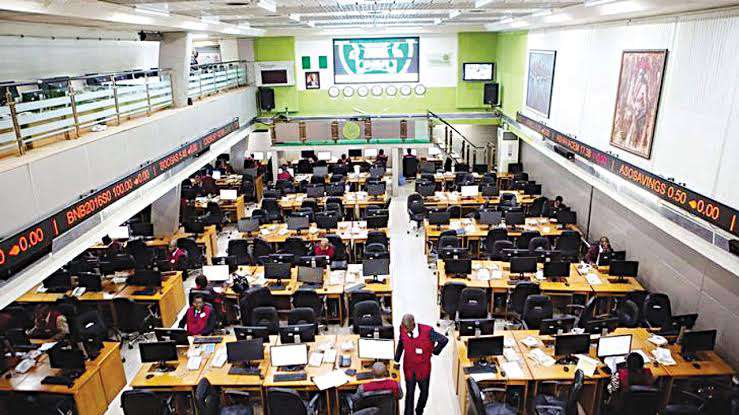
Despite growing concerns about the economic consequences of the war, trading on the Nigerian Exchange Limited (NGX) has remained largely bullish, buoyed by strong corporate earnings, a wave of dividend declarations, and sustained positive investor sentiment.

Market Performance at a Glance
The numbers tell the story. On February 27, the NGX All-Share Index stood at 192,826.78 points, with market capitalisation at N123.76 trillion. By March 2, the index had climbed to 195,514.23 points, pushing capitalisation to N125.49 trillion. The upward momentum continued through the following week, with the index closing on March 13 at 198,407.30 points and total market capitalisation hitting N127.36 trillion, a gain of roughly 2.9 per cent over a fortnight.
That trajectory stands in sharp contrast to the turbulence gripping other markets. The pan-European STOXX 600 index shed more than five per cent in early March, as surging oil and gas prices fanned inflation fears. In the United States, equity markets oscillated between sharp declines and partial recoveries as investors weighed geopolitical developments against domestic economic indicators, with rising crude prices complicating Federal Reserve rate-cut expectations.
Domestic Fundamentals Hold Firm
Analysts attribute Nigeria’s relative stability to the strength of its domestic fundamentals and a robust cycle of corporate earnings.
Mike Ezeh, Managing Director and Chief Executive of Crane Securities Limited, said the difference lies in the nature of the market. “Ours is an emerging market, and such markets have their own characteristics, unlike developed markets that are already feeling the full weight of this conflict,” he said.
He pointed to a string of impressive results from NGX-listed companies stretching back to the first quarter of 2025. “The companies on our market have posted incredibly strong results across all four quarters. Those excellent performances have driven the dividend declarations we are witnessing right now. Most firms are paying good dividends and bonuses simultaneously, that kind of performance naturally supports bullish sentiment.”
Ezeh did, however, caution against complacency. “That is not to say our market is insulated from a meltdown elsewhere. We live in a globalised world, and developments in international markets can eventually reach us,” he warned, adding that foreign portfolio investors, both institutional and high-net-worth individuals, account for a significant share of total market capitalisation.
He drew on history to illustrate Nigeria’s pattern of delayed but eventual exposure. “Cast your mind back to the global market crash of the late 1980s. While other markets were collapsing, Nigeria’s held firm initially because of strong fundamentals. South Africa even sent a delegation through its High Commission here to understand why our market was still standing. The downturn did come for us, but much later.”
Oil Windfall vs. Inflation Risk
The conflict presents Nigeria with a double-edged sword. David Adonri, Executive Vice Chairman of HighCap Securities Limited, noted that oil prices are approaching $100 per barrel,a potential revenue boost for the country’s oil-dependent government finances.
“From the global perspective, the impact on the Nigerian economy and capital market may ultimately be injurious, even though government revenue could benefit from rising crude oil prices,” Adonri said. “Ongoing upward adjustments in domestic petroleum prices, combined with the economy’s heavy dependence on imports, could escalate both inflation and interest rates.”
Rising rates, he warned, could erode the equity market’s relative appeal. “This scenario can slow equities and cause financial assets to migrate to debt instruments,” he said, adding that Nigerian Eurobond yields could also shift as global investors reposition their portfolios.
Risk-Off Clouds on the Horizon
Analysts note that prolonged geopolitical instability typically triggers “risk-off” sentiment globally, with capital flowing from emerging markets into safe-haven assets such as gold and United States Treasury securities. Should the Iran-Israel conflict escalate further, Nigeria could see a reduction in foreign portfolio inflows as international investors seek lower-risk destinations.
For now, however, the NGX continues to chart its own course. The steady rise in both the All-Share Index and market capitalisation signals that domestic investors remain optimistic about the earnings prospects of Nigerian companies, even as uncertainty persists elsewhere.
Whether Nigeria’s resilience will endure as global tensions mount remains an open question. But the current data makes one thing clear: Africa’s largest economy is, for now, standing firm.