Health
Resident doctors to begin another strike over unpaid allowances
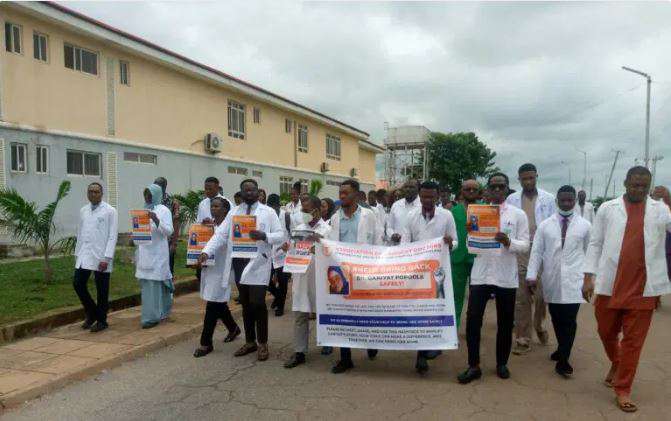
…as radiographers, laboratory scientists, kick against new health bill,
The health sector is under pressure again soon after a long strike by doctors and JEHESU strikes October last year to last month given the stiff opposition to the Medical and Dental Practitioners Act (Repeal and Re-enactment) Bill, 2026 by both radiographers and medical laboratory scientists, and their threat to embark on industrial action should the bill becomes law. This is even as residents doctors have declared another round of industrial action.

The Association of Radiographers of Nigeria has kicked against what it termed a legislative move to erode the profession of radiography and transfer its statutory responsibilities to the Medical and Dental Council of Nigeria.
The President of the association, Dr. Musa Dembele, sounded the warning while addressing a press conference at the Kano NUJ Press Centre two Saturdays ago
He stated, “The Medical and Dental Practitioners Act (Repeal and Re-enactment) Bill, 2026 (HB 2695) is not a reform but a targeted, calculated, and existential assault on the profession of radiography.”
According to him the bill was an attempt to introduce a “jurisdictional override” meant to dismantle the Radiographers Registration Board of Nigeria.
“This is a legislative execution of a profession that has served Nigeria for over 50 years,” he said.
He alluded to Section 8(1) of the bill, which gives the Medical and Dental Council of Nigeria exclusive authority, saying it was “a legislative nuclear weapon” that strips the Radiographers Registration Board of Nigeria of its mandate.
The association also said the bill was nothing but a “conceptual theft” by redefining radiology in a way that erases radiography as an independent scientific discipline.
Legislative Theft
“The bill seeks to legally erase radiography as an independent profession and subjugate radiographers to the disciplinary authority of a council composed of individuals with no expertise in radiographic science,” the association said.
On financial fiduciary issues the association accused the bill of promoting “extortion as regulation,” noting that it mandates that 70 per cent of practising fees be shared with the Nigerian Medical Association.
“This reveals the true motive — financial colonisation,” Dembele said.
The association was also apprehensive of HB 2699, the Radiographers Registration Board of Nigeria Amendment Bill, which it said seeks to weaken the board from within.
According to the association, the inclusion of medical doctors on the board was “a fundamental violation of the doctrine of professional self-regulation,” warning against excessive ministerial control that could politicise regulation.
It emphasized that globally, radiography regulation is profession-led, citing examples from the United Kingdom, Canada, and Australia, and stated that Nigeria cannot afford to adopt a substandard model that contradicts established international norms.
The association, therefore, called on the National Assembly to protect the integrity of the Nigerian healthcare system by rejecting the bill in its entirety.
“The association aligns with the position of the Joint Health Sector Unions, medical laboratory scientists, physiotherapists, and other critical stakeholders, who have also rejected similar legislative attempts,” he added.
A radiographer who craved anonymity told BH that “The bill is a legislative murder of the profession of radiography.
Different Folks, The Same Stroke
Similarly, the medical laboratory professionals in Nigeria have also expressed strong opposition to proposed health reform legislation currently before the National Assembly, saying that the bills has strong potential to weaken the country’s healthcare system and endanger patient safety.
The Association of Medical Laboratory Scientists of Nigeria raised the alarm a fortnight ago saying the proposed amendments were a threat to professional standards and effective healthcare delivery.
At a media briefing in Abuja, AMLSN President, Dr. Casmir Ifeanyi, flayed the Executive Bill HB:2701 and its Senate counterpart, both of which aimed at revising sections of the Medical Laboratory Science Council of Nigeria (MLSCN) Act.
In his view, the proposed amendments—particularly those affecting Sections 3 and 29—could upend the governance structure of laboratory science and blur the professional boundaries that ensure quality healthcare services.
“This is not genuine reform but a step backwards,” Ifeanyi said, warning that the bill fails to align with internationally accepted practices and could negatively impact patient care.
The bone of contention is the suggested restructuring of the Medical Laboratory Science Council of Nigeria, the body responsible for overseeing laboratory science practice in the country.
Under the existing law, professionals dominate the council’s leadership to ensure technical expertise guides decision-making. However, the amendment proposes expanding membership to include non-specialists and increasing political representation.
The AMLSN argues that such changes could undermine the council’s independence and reduce the quality of regulatory oversight.
Ifeanyi also criticised the proposal to remove the requirement that the council chairman must be a Fellow of the profession, describing it as a move that could allow individuals without the necessary expertise to lead critical healthcare institutions.
According to AMLSN, this approach contradicts global standards, where professional regulatory bodies operate independently while collaborating at the clinical level rather than through shared governance.
“What is being proposed goes beyond collaboration—it risks undermining the autonomy of laboratory science as a profession,” Ifeanyi stated.
Role of the Profession
Another critical issue raised relates to Section 29 of the bill, which broadly defines medical laboratory science but appears to limit the role of laboratory scientists in diagnosis.
The AMLSN maintains that this contradicts medical realities, noting that laboratory results form the basis of most clinical decisions.
Experts have warned that altering the current MLSCN Act—already backed by multiple rulings of the National Industrial Court—could lead to legal conflicts and regulatory uncertainty within the healthcare sector.
The AMLSN has called on Bola Ahmed Tinubu and lawmakers to suspend further action on the bills and engage stakeholders in broader consultations.
A medical laboratory scientist, Dr Samson Adebola, told Business Hallmark that “If the National Assembly does not want to be used to throw health sector into crisis it should discontinue with the bill. That’s my honest advice.
Bad To Worse
The growing tension in the sector is now compounded by The Nigerian Association of Resident Doctors'(NARD) announcement last week of an indefinite nationwide strike starting at 12:00 a.m. on Tuesday, April 7, 2026.
According to the association, the strike has become necessary in view of the Federal Government’s decision to halt the implementation of the revised Professional Allowance Table, a key component of agreements reached after NARD’s 2025 industrial action.
The decision, which is expected to disrupt healthcare services across Nigeria once again, was reached at the end of the association’s virtual Extraordinary National Executive Council meeting held on Saturday.
In a statement signed by the association’s National President, Dr. Shuaibu Ibrahim, NARD described the development as “unfortunate,” blaming the Federal Government for pushing doctors toward another industrial action.
According to Dr. Ibrahim, the crisis stems from the implementation of a revised Professional Allowance Table, which was negotiated between NARD and the Federal Government following the prolonged strike in 2025. .
The agreement included improved remuneration packages for resident doctors, covering call duty allowances, shift allowances, rural posting incentives, and non-clinical duty payments.
He noted that although implementation was initially scheduled for January 2026, delays pushed the rollout to February. NARD alleged that the government now plans to discontinue the process by April, a move the association says undermines trust and violates prior agreements
Furthermore, NARD called for the immediate reversal of the government’s decision and the settlement of all outstanding entitlements.