
Business
Wheeling to death: High cost of new tyres fuel road crashes
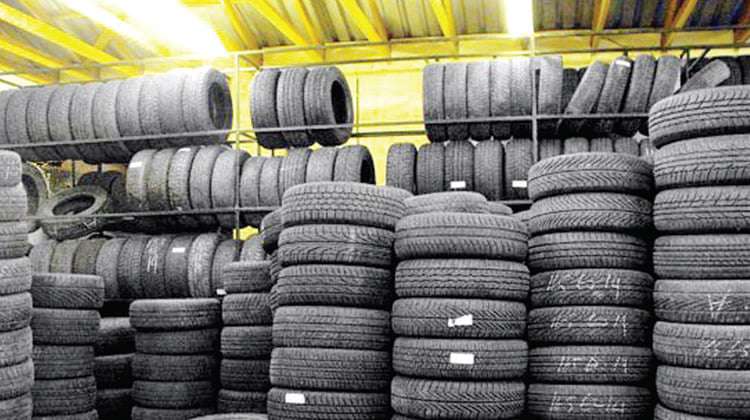
Some apprentice youths were pushing a cart filled with second-hand tyres and retreaded ones last Thursday at the popular Ladipo market, Mushin in Local government area of Lagos. This reporter kept watch as they hurtled towards a customer, who was waiting by the service lane to buy one of them.
The customer needed to select the best out of the lot. So, the boys, who daily scout for buyers on behalf of shop owners at Ladipo market, brought varieties from which the customers could select.
“A lot of people come here to buy Tokunbo spare parts including second-hand tyres said Emeka Harrison, a trader at Ladipo market. He told Business Hallmark that “We have market for both the low budget and the premium,” it depends on your pocket. The low budget are the second hand or retreaded ones.
“Our tyres vary wildly from around ₦45,000 for budget brands to well over ₦800,000 for high-end premium tyres, depending on size (R15, R17, R20, etc.), brand (Michelin, Bridgestone, RoadX, Double King), and type (SUV, Truck, Off-Road). Expect budget to mid-range tyres to start from ₦90k-₦150k, while premium options can easily exceed ₦250k-₦500k,” he said.
He also said that some fairly used popularly called Tokunbo go for as high as N75,000 depending on the brand.
Though the Federal Road Safety Corps (FRSC) has linked the epidemic of road accidents to the use of fake and expired tyres, as well as retreaded ones, it appears the message has fallen on deaf ears as vehicle owners continue to go for expired tyres.
Tyres and accidents
An FRSC official, who claimed anonymity because he was not authorized to speak, said that the challenge is deep. “How many are we in total, it’s not possible to check every vehicle. We have done a lot of training for commercial drivers, we also teach them how to check the expiry date of tyres, but they keep disobeying our instruction.
Another senior official of the corps, who identified as Kayode, echoed the same sentiment. “The few ones we are able to catch, we give them warning, and we talk to them about the danger of fake or retreaded tyres. Our challenge is technology. To succeed in curbing the use of these dangerous tyres that are responsible for over 60 percent of accidents, aside over speeding, we need technology, which currently we don’t have.
According to the FRSC, Nigeria recorded 7,715 road traffic crashes as of September 2025, and these accidents resulted in 3,915 deaths and 24,674 injuries.
At the 2018 National Tyre Conference organized by NADDC, the then FRSC boss Oyeyemi says tyres have been responsible for 5,562 vehicle road crashes from 2012 to 2017.
According to FRSC, the use of fake, retreaded and expired tyres were responsible for more than 3,000 road traffic crashes (RTCs) that occurred in the last five years.
The Corps’ claim has been supported by Standard Organisation Nigeria (SON), the agency charged with the responsibility of ensuring safe products and service in the country.
An official of SON, Mrs. Angela Okisor, said the government has, indeed banned importation of second-hand tyres, but they come in through illegal routes and, at times, with the collusion of some government officials.
SON does not have office at the port to check for expired tyres, she said.
“It is only when they come on the street or in markets, we go after them. If we were at the Port we can just open the container, calculate the date of production (dop), check the expiry date and decide if they should be allowed into the country or not, but we are not so opportuned. SON has left the Port since four year ago.”
A transportation expert, Mr. Chuks Okoro attributed the patronage of bad tyres to lack of education and orientation by necessary agencies.
Wrong Orientation
He noted that a lot of the tyres being shipped into country through the port and porous borders are already prohibited in other part of the world, he noted.
Though the Standard Organisation of Nigeria (SON) is responsible for regulating product standardization in Nigeria, Okoro says that the situation is beyond the agency.
To curb the menace, investigation showed that SON is collaborating with FRSC in the fight against the use of expire or fake tyres. SON is said to have done a lot of sensitizing, collaborated with FRSC and anchored radio programs on the topic of expired tyres.”
In spite of the campaign and mobilization against the use of expired tyres, especially, majority of vehicle owners still prefer to buy second- hand tyres many of which had already expired, said officials of FRSC.
Investigations showed that tyres expire after four years or after travelling about 80,000km, but not many motorists are aware.
Kayode, the FRSC official told Business Hallmark that many vehicle owners in Nigeria, including vulcanizers, do not know how to identify the expiry date of tyres. “We have been trying to expand our sensitization work on this,” he said.
Across Nigeria, roads remain filled with vehicles running on cheap, worn-out, or retreaded tyres, silent time bombs waiting to explode.
Each year, thousands of families lose loved ones to tyre blowouts, many of which are preventable deaths caused by the pursuit of a few thousand naira at the expense of life and property.
Aside bad tyres, over-speeding and tyre burst are frequently being reported as the commonest twin causes of road accidents around the country.
The disgusting situation is firmly blamed on Nigerian motorists for what is observed as their habitual haste on the roads, while cruising on worn-out tyres that are susceptible to burst most times.
Accidents resulting from tyre bursts when vehicles are cruising at top speed have often been ghastly.
Dangerous on Speed
Investigations carried out by the FRSC on the accident that occurred at the Kaduna-Zuba expressway in March 2016, which claimed the life of the Minister of State for Labor, James Ocholi, his wife and son, proved that they had a tyre burst while driving on high speed.
A survey by the FRSC revealed that tyre-related crashes have been responsible for the destruction of 5,288 vehicles between 2011 and 2015. The survey showed that there were more expired than non expired tyres used by motorists on the Nigerian roads, with the expired ones constituting about 61 percent and the non expired tyres, about 39 percent.
The survey also showed that 35 percent of vehicles in that period drove on fairly-used tyres, 15 percent on re-bore tyres while 50 percent had new tyres.
Also, it was discovered that nine percent of tyres used were completely worn out tyres while 91 percent were not completely worn out. Not completely worn-out tyres are termed expired. Also, 58 percent of motorists have knowledge of the expiry dates of their tyres and how to check that on their tyres, while 42 percent have little or no knowledge.
Former Aviation Minister and FRSC Corps Marshal, Mr. Osita Chidoka, recently warned that Nigeria risks tens of thousands of preventable deaths if urgent road safety investments are not made.
“If current trends continue, Nigeria could lose at least 65,000 people to road crashes by 2030. With crashes growing at 10 per cent annually and FRSC still lacking patrol vehicles and fuel for speed enforcement, the situation is dire.”
The Comptroller of the Ogun 1 Area Command of the NCS, Mr. James Ojo, added that second-hand tyres are a major contributor to road crashes.
“These pneumatic tyres, popularly known as tokunbo tyres, are unsuitable for our highways, as many have exceeded their recommended lifespan,” he said.