Business
Western nations court China as US tariff unpredictability rattles trade
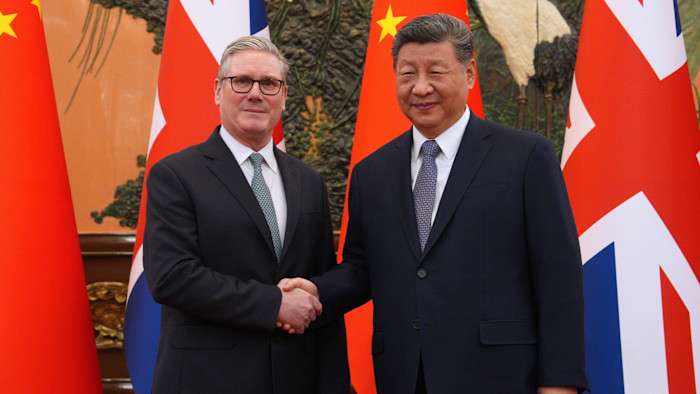
Western leaders are increasingly warming to China, prompted by uncertainty over US tariffs under Donald Trump and a drive to secure investment ahead of upcoming China-US summits.
Britain’s Prime Minister Keir Starmer is the latest to make the move, visiting Beijing this week to promote “pragmatic” economic cooperation. According to AFP report, his trip follows similar visits by leaders from Canada, Ireland, France, and Finland, many of whom had not engaged directly with China in years. Analysts describe the visits as a competitive push to attract Chinese investment and access lucrative markets before Washington’s next trade talks.

“There is a veritable race among European heads of government to meet Xi Jinping,” Hosuk Lee-Makiyama, director of the European Centre for International Political Economy told AFP. “Countries are trying to secure investments and market access ahead of the China-US summits.”
Trade tensions with the US have reinforced the pivot. William Alan Reinsch of the Centre for Strategic and International Studies noted that Trump’s unpredictable tariffs have made the US “a less reliable trading partner,” pushing Western nations to diversify their economic ties.
Starmer told Xi that strengthening UK-China ties is “vital,” while Xi emphasised the need for robust economic cooperation amid global geopolitical challenges. Although relations between the UK and China soured after Beijing imposed a national security law on Hong Kong in 2020, China remains Britain’s third-largest trading partner, making renewed engagement economically strategic.
The European Union has also been pressing for closer engagement, despite a $350 billion trade deficit with China. Irish Prime Minister Micheal Martin advocated for “open trade,” and French President Emmanuel Macron highlighted the imbalance in December.
Outside Europe, Canada signed a preliminary trade deal with China, lowering tariffs on key imports, including canola seed, and agreeing to import 49,000 Chinese electric vehicles under preferential rates. Analysts warn, however, that such partnerships may be perceived as softening stances on China’s national security and economic practices.
Experts say these moves are part of a broader global recalibration. With Europe and emerging markets seeking alternatives to US trade volatility, China increasingly becomes the key economic partner. According to Reinsch, while the agreements follow conventional tariff negotiation practices, the US is now the outlier in global trade policy, with unpredictable tariffs leaving allies seeking more reliable options.