Nation
Makoko residents face uncertain future over Lagos State demolition
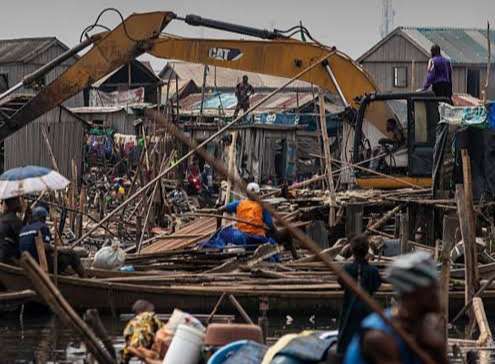
...as govt justified action on safety, urban planning
As Lagosians woke up sluggishly around 5 am to begin preparation for the day’s daily grind on this day, Makoko is already alive. Fishermen’s wooden canoes glide like sharks softly across the lagoon, their paddles waddling through the water with practised ease that signposts experience. Women of different sizes and varying endowments could be seen firmly balancing their goods on the canoes while paddling their boats with two hands.

Suffering-hardened children with sucken eyes, bare-chested and laughing, dived into the water, unfazed by the wreckage that surrounds them. Life continues, stubborn and rhythmic, even as Makoko itself is being pulled apart plank by plank.
Constructed on water and with wood, it is a settlement, where homes rest on stilts driven deep into the lagoon floor—some of those wooden foundations standing firm for more than 20 years, resisting tides.
Today, however, the greatest threat Makoko faces is not the water beneath it, but the bulldozers that have turned the scenic, aquatic environment into rubble, where defeated people are still salvaging what remains of their properties buried deep under collapsed concrete, slabs and thick woods.
For decades, Makoko stood as one of Lagos’ most controversial urban spaces. To some, it is an eyesore, a floating slum that highlights the city’s planning failures. To others, it is a living testament to resilience, culture and survival amid systemic neglect. The recent demolition of the community has reopened a familiar debate: is Lagos State pursuing genuine urban renewal, or is it repeating a familiar pattern of displacing the vulnerable under the guise of “development”?
Hazy Motivation
Makoko’s challenges are undeniable. Estimates place its population between 80,000 and 250,000 residents, many living in stilted wooden homes over the Lagos lagoon, with limited access to sanitation, clean water, electricity and waste management. Residents rely heavily on artisanal fishing and informal trade, making them economically vulnerable.
Government authorities have long labelled Makoko an environmental and security hazard, citing flooding, fire risks and unplanned structures as justification for action. From a regulatory standpoint, these concerns appear valid, but the human and historical dimensions cannot be ignored.
Bade Rouzuo, a man in his 50s, whose father is from Porto Novo in Benin Republic and mother is Ilaje, said “what Lagos government did amounts to crime against humanity. This is where I have known all my life. I’m a fisherman and I use the proceeds to feed and cater for my family. This place, Makoko, is not just an ordinary settlement, it is one of Lagos’ oldest settlements, with roots tracing back over a century to Egun fishing communities. This demolition threatens to erase not only homes but also history and identity.
Housou Kerekou, another fisherman with two wives and 10 children, said he has lived in Makoko since 1981. “Where do this government expect us to go. My few belongings are still across there, where my house used to be. I’m attached to the place, the spirit of my ancestors followed me to this place from Benin, now it’s left stranded. Government did not provide alternative place for us. We are fishermen, all over the world fishermen live around the coast.
Though an eyesore to the government, Makoko, which before the demolition, used to be an international attraction, drawing tourists, researchers, architects and filmmakers intrigued by its floating architecture and unique urban design. The settlement has been celebrated globally as an example of informal urban resilience, a feature that the city risks losing entirely.
Residents like Kerekou doubts government’s intention, as many, who spoke to Business Hallmark, recalled Maroko incident, chorusing government’s ruthless land grab. They may be right to some extent as history provides a cautionary tale.
Lessons from History
The demolition of Maroko in the 1990s, justified similarly on safety grounds, resulted in the conversion of prime waterfront land into high-value real estate, inaccessible to former residents. The question for Makoko is whether the current government is genuinely prioritizing urban renewal or merely pursuing land acquisition under the veneer of “development”.
Professor Ajibola Eniola- Obietan, an environmentalist, told Business Hallmark that “The core of this debate is three competing priorities: urban renewal, historical preservation, and social welfare. These are not mutually exclusive, yet the social dimension must take precedence. Renewal that displaces communities without consultation, resettlement, or livelihood protection cannot be called development but dispossession.
The demolition, according to Obietan, has significant environmental impacts. “While government authorities have referenced the removal of “illegal structures” as an environmental cleanup to reduce pollution and “improve” the waterfront, the forced eviction of the community has led to severe, often detrimental, environmental consequences,” he said..
“There’s destabilization of the lagoon ecosystem, often involving the destruction of wooden stilts, along with ongoing, parallel dredging and sand-filling of the Lagos lagoon. This destabilizes the natural aquatic ecosystem. Don’t forget that the reclamation of wetland areas to create land for development removes natural sponges that retain water. It must be noted that filling these areas exacerbates flooding in surrounding low-lying areas, including Ikorodu, by forcing water to find new, often destructive, paths.
“The demolition included structures like the Makoko Floating School, which was designed to be a sustainable, climate-resilient structure that adapted to rising sea levels, rather than fighting them.
The abrupt, often violent, nature of the demolitions leaves behind substantial debris in the lagoon, contributing to pollution.
Though the government has tagged the community an “environmental nuisance,” the demolition has caused a humanitarian crisis, forcing residents to live on boats or in, even more, makeshift shelters on the water, thus intensifying their, and the environment’s, struggle.
Government Defense
But the Lagos State Government did not see anything wrong with the demolition, despite welter of condemnation. Penultimate Tuesday, the government defended the ongoing demolition exercises, even as a planned protest against the action recorded a low turnout in the waterfront community.
According to reports, only a handful of youths gathered at the waterfront penultimate Tuesday to protest the demolition.
Speaking on the development, the Permanent Secretary, Office of Urban Development, Mr. Gbolahan Oki, said those opposing the exercise were residents, who refused to vacate areas marked for demolition.
“There is no problem with Makoko,” Oki said. “The Makoko people have been one. We have been on this for the last five years. There have been a series of engagements. We begged them, held meetings with them, and they agreed.
“The people making noise now are those stubborn boys, who do not want to leave the place. What the law says is 100 metres from the power line.”
He said the government had acted in the interest of public safety, warning that residents would hold the state responsible if a power line fell into the water.
Meanwhile, The Housing Development Advocacy Network (HDAN) has severally expressed concern over the ongoing demolition of homes, which has left more than 9,000 residents displaced, their homes destroyed, and their futures uncertain.
Speaking on the development, the Executive Director of the Housing Development Advocacy Network, Festus Adebayo, acknowledged the Lagos State government’s position that some of the demolished structures were built under high-tension power lines, posing serious safety risks.
However, Adebayo insisted that safety concerns should not be addressed in a manner that violates the rights and dignity of vulnerable citizens.
The Housing Development Advocacy Network, therefore, called on the Lagos State Government to urgently suspend further demolitions pending engagement with affected communities; provide clear, affordable and accessible alternative settlement options for displaced residents; ensure compensation and resettlement plans that align with national and international housing and human rights standards; and adopt participatory urban planning approaches that include community voices in decision-making.