Nation
Future leaders losing hope in their future: Rising cost of desperation for Nigerian youths
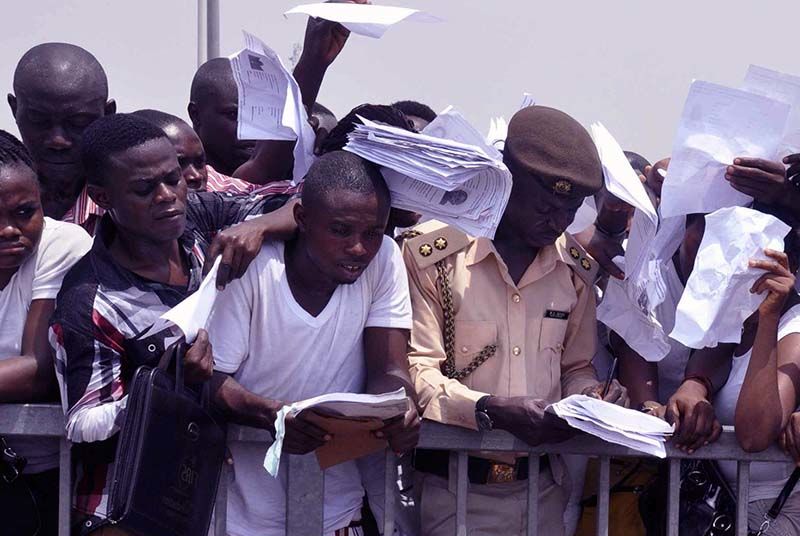
In the bustling streets of Lagos and the crowded markets of Kano, a generation searches for opportunity and finds only mirages. Armed with degrees, skills, and ambition, many young Nigerians are instead trapped in a grinding cycle of underemployment and economic stagnation.
What should be the prime of their productive lives has become a season of waiting , waiting for jobs that never come, wages that never rise, and a system that never quite works.

Now, that quiet desperation has taken a darker turn. Dozens of young Nigerians have reportedly been drawn into Russia’s war against Ukraine — not as ideological combatants, but as economic refugees. They left home expecting factory work or security contracts. They arrived to boot camps and battlefields. Their journey from hardhats to rifles is not merely personal tragedy; it is evidence of systemic failure with profound business and national security consequences.
Reports indicate that at least 36 Nigerian men have been recruited into the Russian military since mid-2024, with several confirmed dead in the trenches of eastern Ukraine. Others were identified months after signing contracts they barely understood. Most were between 25 and 35 years old ,the very demographic that should power Nigeria’s economic engine.
They were promised monthly wages ranging from $1,000 to $2,000 — sums that dwarf Nigeria’s minimum wage of 70,000 naira (roughly $45 per month). For young men navigating a domestic economy where average monthly earnings hover near subsistence and youth unemployment lingers around 40 percent, such offers can feel life-changing.
But the promises quickly dissolved. Survivors recount language barriers, confiscated documents, coercion, and deployment to frontlines with little preparation. Some who were captured described believing they were traveling for construction or security jobs. Instead, they became expendable foot soldiers in a foreign conflict.
Behind each statistic is a family in Ogun, Enugu, or Abuja waiting for remittances that will never arrive.
The Economics of Despair
This phenomenon is not reckless adventurism. It is rational calculation in a distorted market.
Nigeria produces hundreds of thousands of graduates annually, yet job creation lags far behind. Inflation erodes savings. Power shortages stifle startups. Small businesses struggle under import pressures and inconsistent policy environments. The result is a generation forced into survival mode.
When local opportunity collapses, risk tolerance rises.
From a business standpoint, this is economic self-sabotage. Every skilled worker lost to migration , legal or illicit, represents foregone productivity, consumption, innovation, and tax revenue. If even 36 young professionals are removed from the domestic economy, the lifetime fiscal loss runs into billions of naira in unrealized income taxes, VAT contributions, and multiplier effects. Scale that across thousands of outward migrants annually, and the macroeconomic cost becomes staggering.
Nigeria’s tech ecosystem alone is projected to generate billions in value over the coming years. But ecosystems require talent density. When ambition exits the country , or worse, is extinguished abroad, growth projections become fragile abstractions.
Recruitment networks exploiting this vulnerability operate through shell companies and false job offers, masking military pipelines as civilian employment opportunities. Diplomatic protests alone will not dismantle these systems. Economic vulnerability is the recruiters’ most reliable ally.
A Security Time Bomb
The implications extend beyond economics.
Desperation lowers the barrier to militarization. If a young Nigerian can be enticed into a foreign war for $1,500 per month, local extremist groups offering far less may still appear viable alternatives in regions plagued by unemployment and weak state presence.
Groups like Boko Haram and ISWAP have long leveraged economic grievances to recruit. When legitimate pathways to prosperity narrow, illegitimate ones widen.
Meanwhile, morale within Nigeria’s own security forces suffers when compensation inconsistencies and delayed allowances undermine trust. Economic fragility at home does not just export manpower abroad; it corrodes resilience within.
The normalization of violence as employment, whether abroad or domestically, reshapes social expectations. Communities accustomed to seeing military service as a desperate income strategy risk long-term instability. Returnees, if any survive, may carry trauma and militarized worldviews back into already fragile environments.
The Human Cost
Beyond strategy and statistics lies grief.
Families borrow money to process travel documents. Parents celebrate what they believe is overseas employment. A first remittance arrives ,200,000 naira perhaps ,offering proof of hope. Then silence.
For many households, the loss is not only emotional but economic. Breadwinners vanish. School fees go unpaid. Small family investments collapse. A nation already strained by inequality absorbs another layer of preventable suffering.
This is not migration in pursuit of opportunity. It is commodification of vulnerability.
From Palliatives to Prevention
Nigeria cannot respond with temporary relief schemes while ignoring structural reform. A credible response requires:
Aggressive job creation strategy focused on labor-intensive sectors and digital services.
Targeted youth enterprise financing, providing low-interest startup capital tied to mentorship and performance metrics.
Stronger anti-trafficking enforcement, in coordination with international policing agencies, to dismantle fraudulent overseas recruitment pipelines.
Security sector wage transparency, ensuring allowances align with risk exposure and are consistently paid.
Data-driven labor market reforms that align education outputs with industry demand.
The cost of proactive investment is marginal compared to the billions lost annually to conflict, brain drain, and insecurity.
A Generation at the Crossroads
The 36 confirmed cases are not anomalies. They are warning signals.
Nigeria’s demographic dividend , often celebrated as its greatest asset , can just as easily become a liability if underemployment persists. A youthful population without opportunity becomes a reservoir of frustration that external actors and internal insurgents alike can exploit.
Nigeria’s young people do not lack ambition. They lack infrastructure for ambition to flourish.
They deserve factories, not foxholes. Code, not combat. Investment, not exploitation.
If the nation fails to convert youthful energy into productive growth, others will weaponize it. The door to decline stands open , but it is not yet irreversible.
The choice is stark: finance hope at home, or continue exporting despair abroad.