
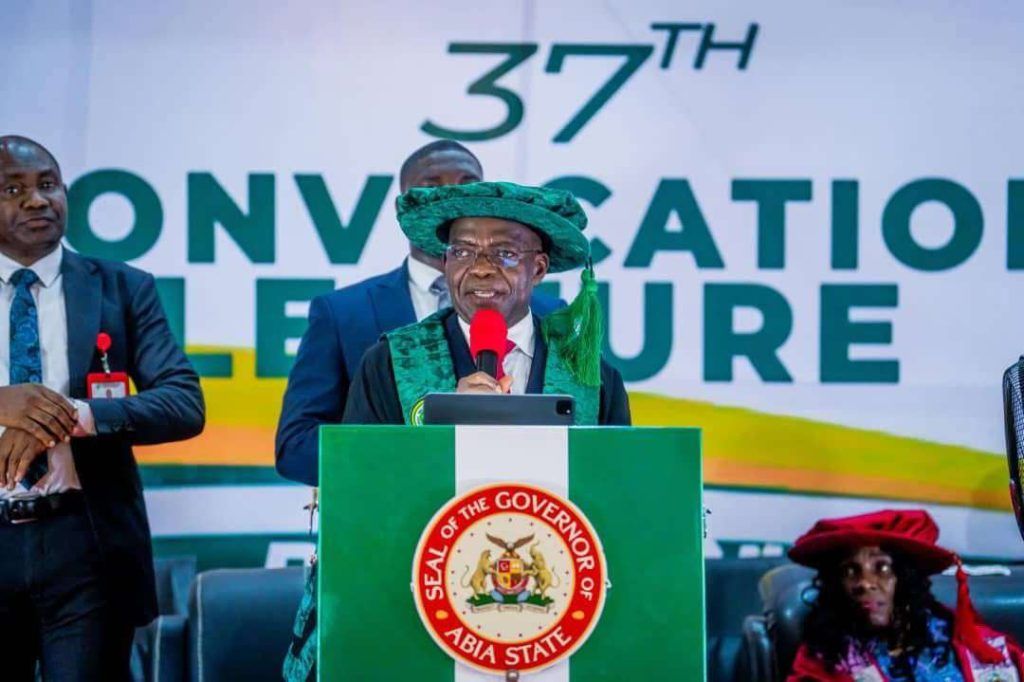
ECONOMIC DEVELOPMENT AND SUSTAINABILITY: BEYOND OIL, EXPLORING ALTERNATIVE REVENUE POTENTIAL FOR ECONOMIC GROWTH AND SUSTAINABLE DEVELOPMENT IN NIGERIA
Being the Text of the 37th Convocation Lecture of the Federal University of Technology Owerri Delivered by Governor Alex C. Otti, OFR, at the Prof. C. O. E. Onwuliri Conference Hall on Thursday, December 4, 2025
Protocols
1.I would like to begin by expressing my profound gratitude to Management of the Federal University of Technology Owerri (FUTO) for the privilege of standing on this podium to present the 37th convocation lecture of this great citadel of learning — an institution that has not only distinguished itself by the quality of its alumni but has remained faithful to its founding mission of serving humanity through technological innovation, excellence in research and duty to community. Thank you for the honour of inviting me and for the opportunity to address important matters of national development as they connect to the theme of this year’s convocation:
Economic Development and Sustainability: Beyond Oil, Exploring Alternative Revenue Potential for Economic Growth and Sustainable Development in Nigeria. Before I dive straight into it, may I take a moment to thank this University for being an integral part of the New Abia story. The events of March 18 to 22, 2023 in Umuahia and then Abuja and back to Umuahia, point us to how the decisions we make, especially when under intense pressure, can affect the destiny of millions of people. All of us will at different points in our lifetimes be presented with situations that will challenge our assumptions, test our resolve and compel us to either `take a definite stand for the truth or bend slightly in response to fear of the unknown, self-preservation or personal benefit. Whatever our encounter becomes, may we learn from the courage of Prof Nnenna Oti, the Vice Chancellor of this University and through our judgment, inspire generations unborn to think beyond self when making decisions that are tied to the destiny of our communities.
Part of my mission here today is to bring to the FUTO community, the sincere gratitude of Ndi Abia and to encourage you to keep alive and active, the production pipeline that gave us moral giants like your Vice-Chancellor and so many others like her. I have heard a few people demur that the praises heaped on the good professor are undeserving since she merely did her job but I am always quick to retort: how often do we do our own job with the same patriotic vigour as she did hers in Umuahia in March 2023? Again, the gratitude of our people to this institution is infinite, if for no other reason, for producing men and women who do their job well. Thank you.
2. Nigeria, on the strength of its population, the enormous deposit of mineral resources it holds and the creative energy and intellect of its people, is a potentially great country. However, we may also have to appreciate that potential and reality are not the same. It is an established lesson of history that large population size, enormous deposit of mineral resources and isolated human intellect on their own have not been known to independently influence the economic realities of any nation. China and India had a combined population of about 1.1 billion people in the 1960s and yet, the vast majority of their population lived in extreme poverty, some estimates put the poverty rates in the 2 countries at the time in the region of 40% to 55%. Population alone never brought them prosperity. Nigeria’s other natural advantage — speaking specifically of huge deposits of crude oil and natural gas — has also not translated to improved living conditions for the general population. So also in a country like Venezuela. The South American country actually holds the world’s largest crude oil reserve estimated at over 300 billion barrels. In the same vein, large deposits of solid mineral resources, including cobalt, copper and diamond, with a projected market value of around $24 trillion have also not radically improved the social and economic experiences of the population in the Democratic Republic of Congo. The paradox of endemic poverty in the midst of abundant mineral resources is also unsettling economic assumptions in countries like Angola, Afghanistan and South Sudan. The third puzzle in the Nigeria development dilemma is the persistent struggle to lift ourselves from the nadir of economic uncertainties even with a large population of brilliant, hardworking and resilient individuals. It beggars belief that this mass of extraordinary people who have made their marks in complex scientific and engineering fields are seemingly unable to find answers to decades-old development questions with respect to the supply of basic infrastructure, social order and a path to self-fulfilment within the country. On this stretch, I would also argue that while the brilliance of our people has never been in question, it is also true that achieving long term social prosperity requires more than the brilliance of individuals acting in pursuit of narrow interests. My position in this regard can be buttressed by a careful study of some of the empires that once ruled the world before suffering collapse.
3.On the evidence of our lived reality in more than 65 years of independence, the current development struggles we face in the country are not peculiar. We are only one of the many nations with huge potentials for growth but are still removed from the actualisation of what could have been and the reasons are not far-fetched. Development is the outcome of sequence of processes and events that transform potential, whatever it is, to social benefits for the entire population. To many, development is understood as an abstract idea — a fancy word that politicians and scholars bandy about to impress their audience. For others, development is restricted to the provision of basic infrastructure. For others still, development is about the individual acquisitions — high-speed cars, mansions and the things that separate one household or a community from others — the achievements that give us bragging rights over our peers and the communities around us.
4.While it is true that development means different things to different folks, economics scholars and experts have taken a deep dive into the subject over the last 50 years and had reached some consensus on what should constitute the key metrics for measuring a society’s progress on the ladder of development. For Seer (1969) , development is about the human population and the occurrences around it. Seer’s idea of development revolves around a society’s response to social anxieties arising from events like poverty, unemployment and inequality. In his estimation, while growth in gross domestic product (GDP) tells an important story about the health of an economy in the short to medium term, economic development is a lot more than just an increase in the volume of output from a country or perhaps its per capita income. A 1991 publication by World Bank dug deeper into the subject to establish an equally robust perspective on the structure and scope of development. For the Bank, perhaps borrowing from Seer’s pioneering work, development is about measurable improvements in the quality of life of the population. It pointed out that development is indicated by rising average income levels, wider access to education and health services, even distribution of opportunities, healthy environment, personal freedom and exposure to uplifting cultural experiences. Sen (1999) leaned into the new awareness and emerging orientation of the structure and content of development when making his intervention on the subject. He argued that development is best understood as “freedom” and the “capability to function.” For him, development is the series of focused initiatives and designs aimed at expanding the range of choices available to the average individual within a community. The Nobel laureate held that the rate and frequency of overcoming deprivations arising from poverty and its manifestations with particular emphasis on hunger, illiteracy, poor health and insecurity, are the more critical measures to consider when accessing the development position of a society. For Todaro and Smith (2003) , the three most important demands of development revolve around the capacity to provide for the basic needs of the population, regard for the self-esteem of the individual and the power to choose from a rich variety of goods and services. The central idea of their postulation is that development goes beyond the economics of production but functions on a multidimensional plane where economic policies interconnect with social structures and cultural contexts to define
the daily experiences of the individual.
5.It is beyond argument that different scholars interpret the subject of development differently but then, the variations in philosophy and context do not diminish the significance of the common themes especially as it relates to the living condition of the masses, access to opportunities and the importance of self-fulfilment for the average person. It ultimately follows that every effort at development would necessarily involve a resolute commitment at wealth creation within the community, production of goods and services that meet the daily needs of the people and the effective adoption of policy measures that set the community free from the limitations of ignorance, early mortality, starvation and diseases. Development is therefore not an abstract term but the lived experiences of the people. It is ultimately about the human community and the measure of freedom individuals are allowed. These insights are very well represented in Goulet (1971) where development is captured from the lenses of sustenance, self-esteem and freedom from servitude.
6.Development is a dynamic idea and has continued to expand in scope and meaning over the past 50 years. Following the adoption of the sustainable development framework at the Rio Conference in 1992, the attention of development experts is now focused on a whole-of-society approach to tackling the challenges of poverty, hunger, inequality and the conditions that assault the dignity of man . On account of new ideas and superior understanding of the structure and nuances of development with respect to building the capacity of the human person and their self-esteem, experts now rank education and healthcare needs, the right and freedom to participate in shaping public sector decisions and fair distribution of opportunities for social ascent to everyone — irrespective of gender, religious and political biases — as critical pillars in measuring a society’s position on the development ladder. The United Nations Sustainable Development Goals (SDGs) initiative which became operational in January 2016 further widened the development frontlines to capture elements that may not have received sufficient attention in previous frameworks. The SDGs paradigm encapsulates important human and environmental needs as they impact the welfare of the present generation and the capacity of the earth to support the generations coming after. In the new model, important metrics like clean water and sanitation, clean and affordable energy provisions, the resilience of the communities and responsible approaches to production and consumption, amongst other important indicators, have been added to the bucket of development demands that key stakeholders are required to pay attention to . The new emphasis on environmental consciousness and considerations for the future point us to the dynamic nature of development and the rationale for placing the human community at the centre of it. What has, however, changed in the SDGs context is that the future has been added as an element of the grand equation. Even then, the enduring objectives, and criteria for measuring progress still revolve around the welfare of the human person, the freedom to live in dignity and enjoy the experience of being human, the opportunity to contribute to meaningful social, economic and political outcomes and a general understanding of how the events of today shape the expectations of the future.
7.The evolution of development theory over the past 5 decades and the consistency of elements of human progress in all the paradigms reflect the necessity of making generous investments in social infrastructure and services as the population expands. The post-1960s development frameworks also provide clarity on the importance of structured planning, commitment to institution building, integration of technology into production streams and the widespread adoption of policies that encourage investments from local and foreign investors to the attainment of development targets . An effective reading of the patterns that attended the rise of China, India and others within the Southeast Asia economic block in the last 50 years would indicate that development does not happen overnight. Moving from one rung to the next on the ladder requires visionary leadership, policy consistency and the capacity to leverage advantages to expand the streams of opportunities for job creation and entrepreneurship, poverty reduction, the strengthening of social service delivery architecture and as earlier mentioned, the capacity to consistently attract the inflow of foreign capital . Development, as Todaro and Smith (2003) noted, is a multifaceted process that combines elements of politics, planning and strategic partnerships to transform the economic outlook of the community over the medium to long term. Quality infrastructure, higher output levels and rising wage rates may signal development but the bar is raised higher with each passing day, effectively reminding us that the world is never static. At any rate, the general architecture of development, although dynamic, also has clear benchmarks that enables the tracking of progress. It is also important to take note of the peculiar realities of each community when scoring its progress. In present day Nigeria, one has to attentively evaluate the data that speak to security of lives and property in different communities when discussing matters of development in the country. This is in addition to measuring the spread of physical infrastructure, the availability of jobs and how earnings from regular jobs support the livelihood of individuals and families. One may also include access to health services, quality schools, the reliability of service institutions like emergency responses and the body of guardrails that preserve the social order. Scoring development markers in Nigeria would also involve assessing intangibles like confidence in the justice system, speed of redress for individual and institutional injuries and effectiveness of the apparatus of state power like the law enforcement and postal services.
8.To economists and others in the policymaking fields, development is a science — the outcome of conscious planning, investments in factor-inputs and the commitment to building robust economic and social institutions . To the average member of the community, however, development is about their daily experiences. It is about being able to find a decent job, the basket of goods and services their pay checks can afford and the support they get in moments of turbulence. Development is about what happens in good times as it is also about what happens when the storms arrive. The new element here demands that development must also take cognisance of measures set up to protect the population from living below a certain minimum level of comfort — the point where human dignity is eroded .
9.On account of the complexities associated with measuring development and the differences in cultural outlook across societies, the push to find a universally acceptable body of metrics in that regard continues to evolve as human appetites and the path to the top change. Consequently, the Human Development Index (HDI) was adopted in 1990 by the United Nations as a “quintessential measure for assessing the overall well-being and progress of nations .” It offers a balanced summary of a country’s development status based on certain universally-applicable scopes such as health, education, and general standard of living. The HDI metrics, anchored on 3 dimensions — life expectancy at birth for health, mean years of schooling and expected years of schooling for knowledge, and gross national income (GNI) per capita for the standard of living — offer a much broader framework for appreciating the undercurrents of development across societies. The HDI methodology is hinged on the idea that people and their capabilities should be the ultimate criteria for assessing the development of a country rather than relying on metrics that are exclusively of economic origin. What the HDI metrics highlight, like the ideas captured by Seer , Sen , Todaro and Smith , are the need to prioritise health service delivery and all the components related thereto, education and the initiatives aimed at building and upskilling human capital for higher output values . It also speaks to the prudence of committedly investing in the infrastructure backbone that would drive the most critical sectors of the economy to enable job creation and the production of wider spectrum of goods and services. The HDI, although runs on the same thread as the train of development thoughts that emerged from mid-1960s, differs slightly by creating a widely-acceptable template for measuring a country’s development trajectory. It also provides critical guidelines for policymaking and public investment decisions . Furthermore, its human-centric outlook and particular focus on welfare-related concerns make it unique and widely applicable. More fundamentally, the HDI gives the clearest indication that although cultural and social realities may differ, humans, in whatever clime they live, have common basic needs. The framework teaches that a community’s progress can only be objectively assessed by looking at where it ranks in meeting these universal human needs of its people.
10.In view of its abundant human and material resources, Nigeria has not lived up to the promise of its early days as an independent nation. With tens of millions of our compatriots living in multidimensional poverty , struggling with acute infrastructure deficiencies , security challenges , limited access to health services , multi-pronged challenges in the education sector and growing levels of social and economic uncertainties , it is difficult to be impressed with our place in the development firmament. Yes, we have more kilometres of motorable roads today than we did in 1960, more health facilities have been built and more households are now connected to the electricity grid so it would also be dishonest to suggest that we have not made some progress. My position, and the views of many, is that we have the capacity for a lot more so why get comfortable with less? It is an indictment on all of us that millions of our compatriots live in abject poverty. Part of the reason for Nigeria’s lingering development crisis , , is the propensity to trade blames; not many of us are willing to accept responsibility for the challenges we face so everyone assumes that someone else is responsible for the failure of our institutions, the collapse of moral values in our communities and other unsavoury events that point to the poor state of affairs in the polity. My position, as flawed as it may be, is that our failure is a collective one. In the same vein, I am also of the conviction that our development would require the collective commitment of all of us.
11. May I begin the discourse on sustainability and sustainable development by providing some contextual clarity to guide our outlook. Sustainability acquired a new meaning in the post-2015 world follow