
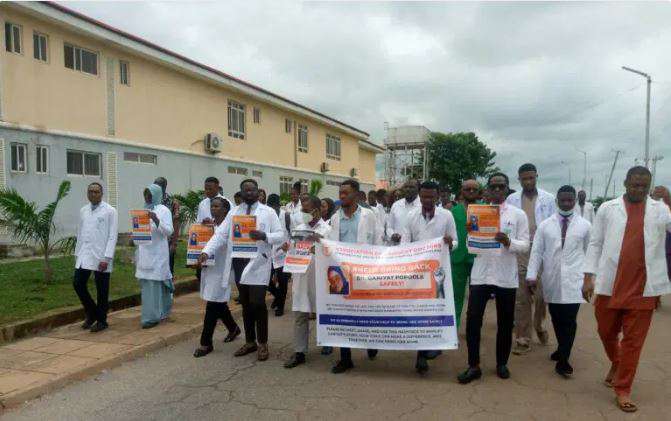
As the indefinite strike embarked by the Nigeria Association of Resident Doctors, NARD, entered the fourth week, the corridors of government owned hospitals are now nearly empty, and filled with frustration, pain, death and uncertainty. About 91 federal and state healthcare facilities are affected with about 11000 members of the medical association involved in the ongoing strike.
A Lagos State University Teaching Hospital, LASUTH, patient, Mr. Joseph Okon, who couldn’t hide his anger as he was turned back on his appointment, said that the government and Consultants are using them for their selfish purposes, adding that, while government ignored the striking doctors, who are the backbone of tertiary health sector delivery, consultants, who keep skeletal emergency services exploit patients by referring them to their hospitals, with consultation fee of N50000 and outrageous diagnostic tests because of the desperation of patients.
“Today is my appointment for an important test, and next week is another appointment for consultation, but both are now off, and the consultant directed me to his clinic where I will pay N50000 for consultation, even though he is suppose to handle my case officially here. This is exploitation and gambling with the life of people.”
From the Lagos State University Teaching Hospital, LASUTH, to the Lagos University Teaching Hospital, LUTH, National Orthopaedic Hospital, Igbobi, NOHIL, and the Federal Neuropsychiatric Hospital, Yaba, patients and their families now endure an endless wait not for doctors on call but for the strike to end.
The doctors whose grouse is that they are fighting for an unjust refusal of the Federal government to pay allowances amounting to N48 billion and erratic salary payments had declared an indefinite strike on October 27th.
As it’s when two gigantic elephants slug it out in an open field, the grass suffers. Four weeks into the strike, hundreds of patients are lamenting woes. Several years and months of appointments being cancelled due to strikes including life saving surgeries, have taken huge toll on Nigerians from avoidable deaths recorded.
Sentenced to Suffer
A pathetic case was that of a parent, who had patiently waited with a sense of anxiety for her son’s corrective surgery at the Lagos State University Teaching Hospital, LASUTH, Ikeja for three years. For this parent, each appointment brought new hope and then another postponement. Finally, a date was set for November 3 according to him but just when the parent thought the long journey to healing was over, the procedure was cancelled making it another casualty of the nationwide doctors’ strike.
“My son was booked after three years of back and forth. We finally got November 3rd for his surgery, now it’s been cancelled because of the strike. I don’t even know what to tell him anymore,” the parent lamented.
Another patient, who also craved anonymity, scheduled to see a doctor for an eye condition, also shared his pain with Business Hallmark. The patient, identified as Peter Adebayo, said he had been turned back two weeks ago after the doctor on duty said he was tired. When he returned on November 3, he was informed that the doctors were now on strike. Asked why he came back now given that the strike was ongoing, he told Business Hallmark that “the pain is so severe, and someone advised that there might be skeletal attendance to critical cases.
“Why are we being treated like this in this country?” he lamented. The experience mirrors the agony of countless patients and families stranded nationwide as the indefinite strike declared by NARD is ongoing .
A visit to General Hospital Ifako, Ijaye over the weekend revealed near-deserted wards and clinics. Only nurses were on duty, attending to patients in the absence of doctors. At the children’s ward, parents could be seen pacing the corridors, some whispering prayers, others making frantic calls for updates.
“I was at LASUTH on Saturday to see a neighbor’s daughter, who has been on admission,” a concerned observer told Business Hallmark.
“There were no doctors, not even senior consultants, I went back yesterday, it was the same thing, only nurses were around. Normally, when junior doctors are on strike, consultants hold the fort, but this time, it’s empty. I am hoping that the Federal government will answer them soonest,” he stated.
A patient who identified as Sayo said he was scheduled to go for surgery for hepatitis shortly before the commencement of the strike but the strike has scuttled it.
A senior doctor, who craved anonymity told Business Hallmark at General Hospital, Ifako, Ijaye that “We have resolved to continue the strike until all our demands are met. We believe the only language the government understand is force, so this ongoing strike is our own force, we hope this government will be sensible enough to accede to our demands otherwise the entire health sector will be paralysed.”
The situation was similar at General Hospital, Oke Odo, in Alimosho. Only nurses were present as the place wore a demure atmosphere. A nurse, who pleaded for anonymity, told this medium that “Government is only concerned with reelection, they are playing with people’s lives. This government has no regards for the lives of Nigerians. How can a responsible government allow heath workers to go on strike for one month?”
The same experience played out when this medium visited General Hospital, Sango Ota as only nurses were available. The place looked like abandoned gothic environment. An administrative officer, who did not want to be identified, told Business Hallmark that since the strike began, they have lost some patients, “And the situation is scary considering the intransigence, justified intransigence of the doctors. Politicians are wicked, but we the people condone their bad behavior. In a saner clime, this strike is enough to bring down the government, they will be forced to resign.
Disputed Claims
NARD dismissed claims by the Federal Ministry of Labour that the government has met a significant portion of the doctors’ demands, describing the claim as misleading and inconsistent with the realities of the ongoing nationwide strike.
The association insisted that the indefinite strike, which commenced on 1 November, will continue until the government meets its minimum conditions.
NARD also refuted comments by the Minister of State for Health and Social Welfare, Dr. Adekunle Salako, that it refused to sign a Memorandum of Understanding. The association clarified that it declined to endorse the document because it contained no binding timelines, verifiable actions, or guarantees of implementation.
According to NARD, signing such an agreement would amount to legitimizing promises that have repeatedly gone unfulfilled.
“On the refusal to sign the MoU, the Minister’s insinuation that NARD outrightly refused to sign the MoU is a misrepresentation of fact.
“We refuse to sign any Memorandum of Understanding that is built on a foundation of unfulfilled promises and lacks clear, binding, and time-bound deliverables.
“We will not be party to an agreement that merely papers over cracks while our members continue to suffer. A MoU that does not guarantee immediate and verifiable action is not worth the paper it is written on”.
The association’s position was contained in a rebuttal issued last Thursday and jointly signed by Dr Mohammad Usman Suleiman, President; Dr Shuaibu Ibrahim, Secretary General; and Dr Abdulmajid Yahya Ibrahim, Publicity and Social Secretary, where the association said none of its 19 core demands has been fully or verifiably met.
NARD said its Extra-Ordinary National Executive Council meeting of 17 November reviewed the government’s position and found that what the ministry presented as progress amounted to unfulfilled promises, unimplemented decisions, and newly formed committees.
The doctors dismissed the ministry’s claims on the commencement of the 25 percent and 35 percent CONMESS review payments and the 2024 accoutrement allowance.
They argued that no member of the association has received the payments and that ongoing attempts to reconcile omissions and failed transfers only confirm the lack of implementation.