
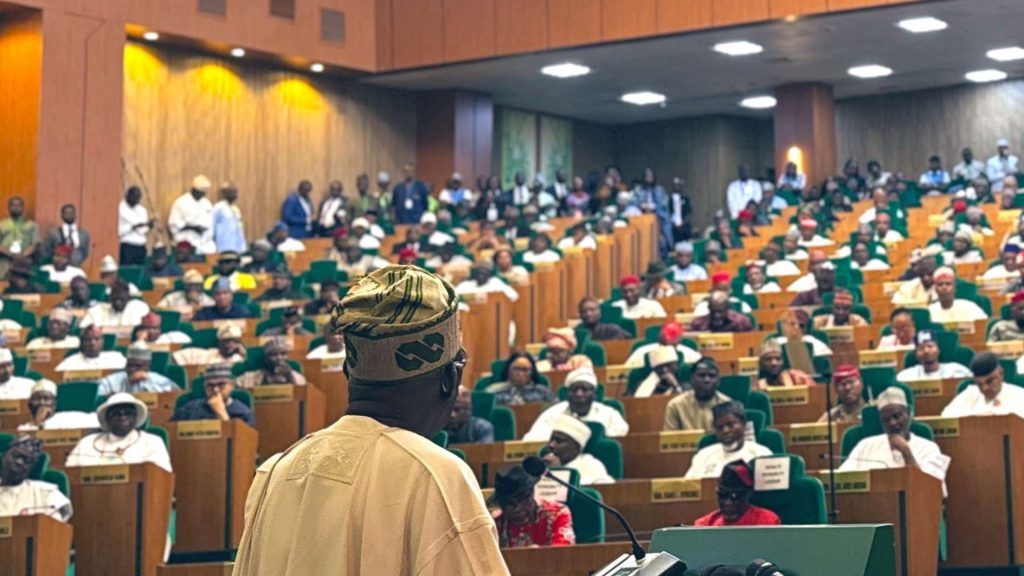
President Bola Tinubu has formally asked the National Assembly to approve a fresh N43.56 trillion Appropriation (Repeal and Re-enactment Bill–2) for the 2024–2025 fiscal period, a move the presidency says is designed to end the practice of operating multiple budgets within a single fiscal cycle and to tighten fiscal accountability.
In a letter transmitted on Wednesday to both chambers, the president said the proposed legislation would recalibrate the federal budgeting framework, legally consolidate emergency expenditures already undertaken, and support what he described as “unprecedentedly high” capital execution across the 2024 and 2025 fiscal years.
Under the proposal, Tinubu is seeking authorisation to withdraw N43.56 trillion from the Consolidated Revenue Fund of the Federation. The allocation includes N1.74 trillion for statutory transfers, N8.27 trillion for debt servicing, N11.27 trillion for recurrent (non-debt) expenditure, and N22.28 trillion for capital expenditure and development fund contributions.
The scale of capital allocation, according to the presidency, reflects the administration’s push to use infrastructure and productivity-enhancing investments to stabilise the economy and drive recovery.
Tinubu said the revised framework would create a constitutionally sound process for absorbing critical and time-sensitive expenditures already incurred in response to emergencies, including those related to national security and social welfare. He argued that the proposal balances urgent government intervention with fiscal discipline, while closing gaps that have previously weakened budget implementation.
The bill also introduces safeguards aimed at tightening expenditure controls and improving transparency. These include strict limits on the use of released funds to approved budget lines, restrictions on virement without the consent of the National Assembly, and clearly defined procedures for corrigenda where genuine errors could impede implementation.
In addition, the proposal mandates separate accounting for excess revenue, with spending allowed only upon legislative approval. It also strengthens due-process requirements and calls for regular reporting on fund releases, internally generated revenue and external assistance.
According to the president, the measures are intended to reinforce legislative oversight, improve transparency and rebuild public confidence in the budget process, which has long been criticised for weak execution and limited accountability.
The proposal has already begun to receive legislative attention. In the Senate, Tinubu’s letter was read at plenary and the bill was passed for second reading before being referred to the Senate Committee on Appropriations, with instructions to report back promptly.
The upper chamber also directed key economic officials, including the Minister of Finance and Coordinating Minister of the Economy, Wale Edun; the Minister of Budget and National Planning, Senator Atiku Bagudu; and the Chairman of the Federal Inland Revenue Service, Dr Zacch Adedeji, to appear before the committee to provide further details on the spending plan.
Leading debate on the bill, Senate Leader Opeyemi Bamidele described it as a structural reform rather than a routine procedural amendment. He said the legislation seeks to repeal and re-enact the existing appropriation framework to end the long-standing practice of running parallel budget cycles, which he said had eroded fiscal discipline and blurred accountability across government agencies.
Bamidele added that the bill provides a lawful mechanism to regularise unavoidable emergency spending while preserving legislative control over public finances, noting that virement would only be allowed with prior parliamentary approval.
In the House of Representatives, the president’s letter was read at plenary, after which Deputy Speaker Benjamin Kalu ruled that it should be treated as first reading and moved towards second reading. The decision triggered objections from some lawmakers, who insisted that members should first be furnished with copies of the letter. The bill was later referred to the House Committee on Appropriations for further consideration.
Meanwhile, Tinubu is expected to present the 2026 Appropriation Bill to a joint session of the National Assembly on Friday. A statement from the Clerk to the National Assembly, Kamoru Ogunlana, said the presentation would take place at 2pm, with strict security arrangements in place.
Separately, the House witnessed controversy after a lawmaker, Abdussamad Dasuki, raised concerns over alleged alterations to tax bills passed by the National Assembly. Speaking on a matter of privilege, Dasuki claimed that the gazetted versions of the laws differed from the harmonised texts approved by both chambers.
He described the discrepancy as a constitutional violation and urged the House leadership to review the documents. Speaker Tajudeen Abbas said the matter would be examined in the interest of the country.