
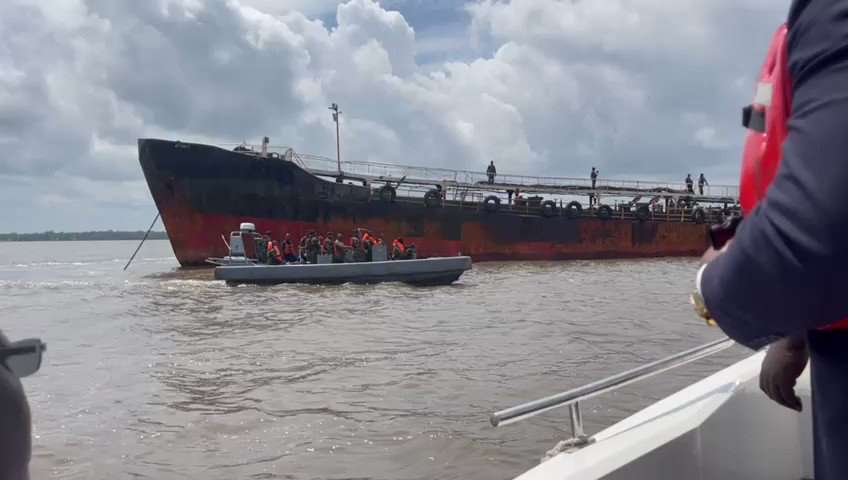
The interception of vessels laden with suspected stolen crude oil worth an estimated $300 million by a joint military task force has renewed scrutiny of security arrangements in Nigeria’s oil-rich Niger Delta, even as fresh details emerged of multiple arrests and seizures by the Nigerian Navy.
The operation, carried out on April 11, 2026, by Operation Delta Safe, is being described by officials as one of the most significant maritime recoveries in recent years, highlighting both the scale of crude oil theft and persistent gaps in surveillance across the region.
Operation Delta Safe, a multi-agency security outfit comprising the Nigerian Army, Navy and Air Force, is mandated to protect oil infrastructure and combat illegal bunkering activities in the Niger Delta.
Preliminary findings indicate that the intercepted vessels were apprehended along strategic waterways long associated with pipeline vandalism and crude theft. Military sources said the cargo, believed to be illegally refined crude, was likely destined for illicit international markets.
At current global oil prices, the value of the seized consignment is estimated at about $300 million, a figure that underscores the magnitude of losses Nigeria continues to face from oil theft.
Authorities said investigations are ongoing to determine the origin of the crude, identify the perpetrators, and dismantle the logistics network that enabled the movement of such a large shipment.
The development comes amid intensified enforcement under Operation Delta Sentinel, a maritime security initiative launched earlier in January 2026 to bolster surveillance and disrupt oil theft syndicates.
Data from the first quarter of the year shows that naval forces conducted 183 anti-oil theft operations between January and March, recovering more than 531,500 litres of illegally refined petroleum products and arresting at least 18 suspects.
In a related operation on March 21, troops intercepted about 44,000 litres of diesel at Ogbologo, leading to the arrest of eight individuals. Security operatives also dismantled at least 12 illegal refining sites and several storage facilities during the period.
Despite these efforts, the scale of the latest seizure has reignited debate over the effectiveness of existing surveillance systems, particularly in areas monitored under private security arrangements.
Industry stakeholders have raised concerns over how vessels carrying crude worth hundreds of millions of dollars could navigate the region’s waterways undetected, suggesting possible lapses in coordination or monitoring.
Security experts warn that crude oil theft remains a major threat to Nigeria’s economy, draining government revenues, weakening the naira, and worsening environmental degradation in host communities. They also note that proceeds from illegal crude sales are often channelled through informal networks, making recovery difficult.
Meanwhile, the Nigerian Navy has confirmed the arrest of additional vessels and crew members in separate but related operations, underscoring the scale of ongoing enforcement efforts.
Commander of the Joint Task Force South-South, Operation Delta Safe, Rear Admiral Olugbenga Oladipo, disclosed that two vessels — MT Mkpodu and MT Westaf AF — were arrested while carrying over 939 metric tonnes of suspected stolen crude oil valued at more than N4 billion.
He said 26 crew members were apprehended during the operation, which was executed based on credible intelligence received on April 8.
According to Oladipo, the vessels were intercepted at a wellhead within the Calabar/Akwa Ibom Joint Operations Area, where they were allegedly siphoning crude oil.
“MT Mkpodu was caught actively siphoning crude at the time of arrest,” he said, noting that the operation was conducted in collaboration with the Office of the National Security Adviser and the Office of the Chief of Defence Staff.
He added that naval assets, including Nigerian Navy Ship SHERE and a Navy helicopter, were deployed to the scene, with the aircraft providing real-time aerial surveillance while the ship secured the vessels offshore.
Subsequently, Nigerian Navy Ship OSE and personnel from the Forward Operating Base IBAKA facilitated the transfer of the vessels and suspects to the Navy jetty in Calabar.
Oladipo further revealed that another vessel, MT Steliosk, was intercepted on April 10 in a similar operation, highlighting sustained pressure on oil theft networks.
Also speaking, the Flag Officer Commanding, Eastern Naval Command, Rear Admiral Chidozie Okehie, commended the operation and reaffirmed the Navy’s commitment to intensifying efforts against economic sabotage in the region.
Despite the string of successes, stakeholders continue to call for stronger collaboration among security agencies, private surveillance contractors, and host communities, as well as improved transparency in monitoring operations.
They argue that without a comprehensive and coordinated approach, large-scale crude theft operations may continue to evade detection, undermining gains made by security forces.
The military, however, has reiterated its resolve to sustain operations aimed at dismantling criminal networks and restoring integrity to Nigeria’s oil sector.