
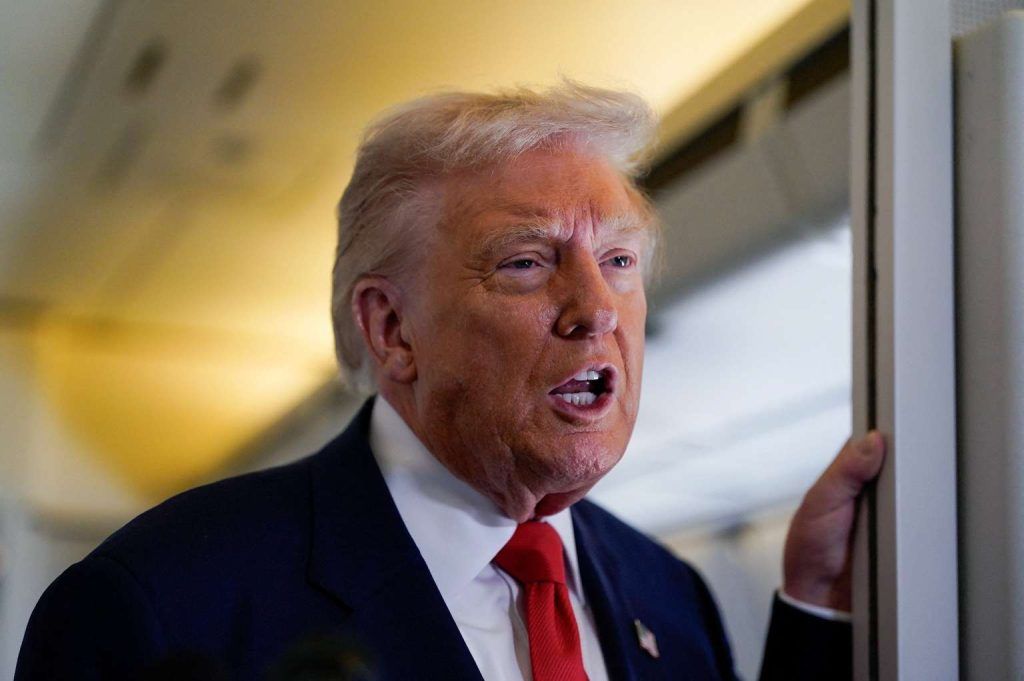
United States President Donald Trump has announced a two-week suspension of planned military strikes against Iran after Tehran agreed to reopen the strategic Strait of Hormuz, easing fears of an imminent escalation in the ongoing conflict.
Trump made the announcement on Tuesday evening via his Truth Social platform, just hours before a deadline he had earlier set for a potential bombing campaign against Iran.
The US leader said the decision followed appeals from Pakistan’s Prime Minister Shehbaz Sharif and the country’s army chief, Field Marshal Asim Munir, who intervened to mediate between Washington and Tehran.
“Based on conversations with Prime Minister Shehbaz Sharif and Field Marshal Asim Munir of Pakistan, and wherein they requested that I hold off the destructive force being sent tonight to Iran, and subject to the Islamic Republic of Iran agreeing to the COMPLETE, IMMEDIATE, and SAFE OPENING of the Strait of Hormuz, I agree to suspend the bombing and attack of Iran for a period of two weeks,” Trump wrote.
The message was posted at 6:32pm US Eastern Time, less than two hours before the 8pm deadline he had earlier set for the strike.
Iran’s Foreign Minister Abbas Araghchi soon confirmed that a tentative arrangement had been reached.
“If attacks against Iran are halted, our Powerful Armed Forces will cease their defensive operations,” Araghchi said in a statement.
He added that safe navigation through the Strait of Hormuz would be allowed for the two-week period through coordination with Iran’s armed forces.
“For a period of two weeks, safe passage through the Strait of Hormuz will be possible via coordination with Iran’s Armed Forces and with due consideration of technical limitations,” he said, while also thanking Pakistan for facilitating the last-minute diplomatic effort.
Iran’s Supreme National Security Council indicated in a separate statement that the ceasefire could be extended if negotiations progress positively.
Further diplomatic talks are expected to take place in Islamabad in the coming weeks.
The announcement followed a day of heightened tensions after Trump earlier issued a stark warning on social media, suggesting catastrophic consequences if Iran failed to comply with his demands.
“A whole civilization will die tonight, never to be brought back again,” Trump had posted earlier on Tuesday, adding that the looming deadline could mark “one of the most important moments in the long and complex history of the world”.
The US president had previously threatened to target Iran’s power plants, bridges and other critical infrastructure, actions that legal experts warned could violate international law if carried out.
In his latest message, Trump said the ceasefire was the result of progress already made toward a broader peace agreement with Tehran.
“This will be a double sided CEASEFIRE,” he wrote, adding that Washington had already met its military objectives and received a “10-point proposal” from Iran that could form the basis for a longer-term settlement.
He said the two-week window would be used to finalise negotiations aimed at achieving a more durable peace agreement in the Middle East.
The conflict began more than five weeks ago after Israel and the United States launched a joint military offensive against Iran on February 28, arguing that the operation was necessary to curb Tehran’s regional influence and prevent it from developing nuclear weapons.
However, legal experts and international observers have criticised the campaign as an unprovoked attack that could violate international law.
The war has already resulted in significant casualties. Nearly 2,076 people have been killed in Iran since the conflict began, while 28 others have died in neighbouring Gulf states.
The United States has lost 13 military personnel, and Israel has recorded 26 civilian fatalities.
One of the central flashpoints of the conflict has been the Strait of Hormuz, a crucial maritime corridor through which roughly 20 per cent of the world’s oil and natural gas supply passes.
Iran moved to restrict traffic through the strait shortly after the war began, triggering sharp increases in global energy prices and mounting pressure on the Trump administration at home.
Washington had urged allies, including NATO members as well as Japan and South Korea, to support efforts to reopen the waterway, though no major coalition deployment has materialised beyond defensive operations.
Analysts say the latest two-week ceasefire could provide a critical window for diplomacy, though questions remain over whether Israel will also adhere to the pause in hostilities.