
Concerns over the future of Nigeria’s democracy intensified on Thursday as prominent political actors, civil society leaders and opposition figures warned that the country could drift towards a one-party state ahead of the 2027 general elections.
The alarm was raised at the fifth Comrade Yinka Odumakin Memorial Lecture held at the Airport Hotel in Ikeja, Lagos, where human rights lawyer Femi Falana (SAN), the Aare Ona Kakanfo of Yorubaland, Gani Adams, and other activists criticised recent political developments, particularly the handling of the leadership crisis within the African Democratic Congress (ADC).
The event, organised by the Oluyinka Odumakin Foundation and hosted by its President, Dr Joe Odumakin, was attended by several notable figures including the President of the Nigeria Labour Congress (NLC), Joe Ajaero; activist and publisher of Sahara Reporters, Omoyele Sowore; Senior Advocate of Nigeria, Olumide Fusika; and the Executive Director of the International Press Centre, Lanre Arogundade.
Falana warns of possible single presidential candidate
Delivering a lecture titled “Can Nigeria’s Democracy Work without Restructuring?”, Falana warned that continued judicial interference in the internal affairs of political parties could create a situation where only one presidential candidate contests the 2027 election.
According to him, conflicting court orders and the manipulation of legal processes were increasingly being used to destabilise political parties.
“Through the manipulation of Nigerian courts and senior lawyers, you may have only one candidate contesting the presidential election in this country,” Falana said.
“If that happens, Nigeria may not even need to spend money on a presidential election.”
He cautioned that such developments could provoke unrest if citizens felt they had been deprived of genuine electoral choices.
Falana urged civil society organisations, labour unions and political activists to mobilise in defence of democratic values, warning that poorly organised protests could degenerate into chaos.
“We must stop agonising and start organising in the interest of our people and democracy,” he said.
Adams warns of drift toward one-party system
Echoing similar concerns, Gani Adams warned that Nigeria was gradually drifting toward a one-party system.
He accused those in power of using the judiciary as a tool to weaken opposition parties and suppress the will of voters.
“We are moving towards a one-party system. Those in power are using the judiciary to suppress the will of the people,” Adams said.
“We may end up having only one presidential candidate in Nigeria if care is not taken.”
He urged Nigerians to speak out against injustice regardless of ethnic or political affiliations, stressing that silence in the face of injustice could eventually harm those who benefit from political power today.
Debate over restructuring and federalism
Falana also used the occasion to revisit the longstanding debate on restructuring Nigeria’s federal system, arguing that the country currently operates more like a unitary state.
He noted that during the First Republic, regions controlled key institutions such as the police, courts and local governments, but the 1999 Constitution centralised authority in Abuja.
“In 1963 there were about 45 items on the Exclusive List, but today we have about 68 items. Practically everything is controlled by Abuja,” he said.
According to him, although some powers have been devolved to states through court rulings and constitutional amendments—particularly in areas such as electricity, railways and prisons—many state governments have failed to utilise those powers effectively.
Falana also cautioned against the potential abuse of state police, recalling how regional governments allegedly used police forces to harass political opponents during the First Republic.
Activists warn of democratic erosion
Other speakers at the memorial lecture raised concerns about Nigeria’s political trajectory.
Senior Advocate of Nigeria, Olumide Fusika, warned that the country was approaching a dangerous point amid widespread insecurity.
Human rights activist Richard Akinola criticised what he described as an “incestuous relationship” between the executive and the judiciary.
“Politicians have hijacked the judiciary, and it is dangerous,” he said.
NLC President Joe Ajaero argued that Nigeria’s centralised governance structure had allowed a small elite to capture the country’s resources.
He called for restructuring, devolution of powers and local control of resources, alongside the creation of state police.
On the prospect of revolutionary change, Sowore said worsening hardship and insecurity under President Bola Tinubu could push Nigerians toward mass resistance.
“These are revolutionary times if we take advantage of them,” he said, adding that the current administration could inadvertently trigger widespread demands for systemic change.
ADC crisis fuels political tensions
The growing concerns come amid a deepening leadership crisis within the African Democratic Congress, which has drawn the Independent National Electoral Commission (INEC) into controversy.
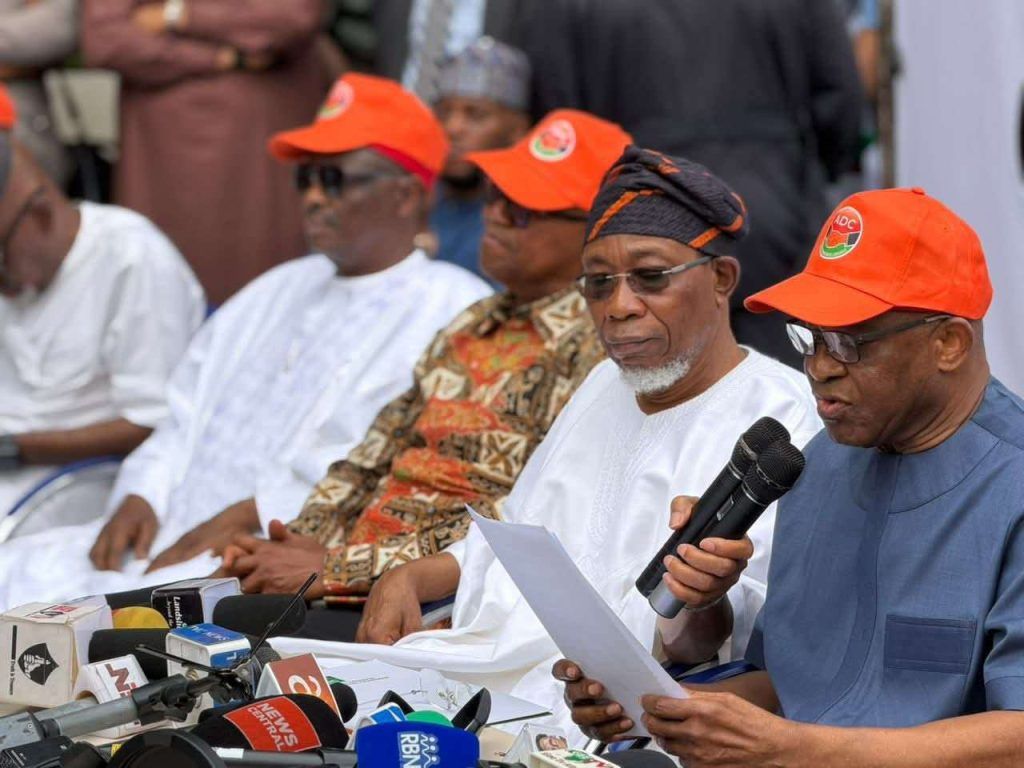
On Wednesday, INEC announced that it would no longer recognise key leaders of the party, including National Chairman David Mark and National Secretary Rauf Aregbesola, citing a Court of Appeal judgment directing the commission to maintain the status quo pending the resolution of an ongoing court case.
The decision has triggered backlash from opposition figures, who accuse the electoral body of acting under the influence of the ruling All Progressives Congress.
At a press conference in Abuja on Thursday, Mark called for the resignation or removal of INEC Chairman Prof. Joash Amupitan and other national commissioners.
“We no longer have confidence in them. We are convinced that they are incapable of conducting any credible election,” Mark said.
He argued that the commission’s interpretation of the court order was flawed and accused it of attempting to undermine the ADC’s leadership structure.
According to him, the party’s new National Working Committee was duly constituted following a National Executive Committee meeting on July 29, 2025, which was monitored by INEC officials.
He insisted that the party would continue its activities, including scheduled congresses and a national convention, regardless of INEC’s position.
INEC defends its actions
INEC, however, rejected the accusations, maintaining that it was merely complying with the Court of Appeal’s directive.
In a statement issued by the Chief Press Secretary to the INEC Chairman, Adedayo Oketola, the commission said its leadership and operations are protected by the Constitution.
“The appointment, tenure and removal of the Chairman and National Commissioners are strictly governed by Section 157 of the 1999 Constitution,” the statement said.
The electoral body also dismissed allegations that its actions were part of a plot to impose a one-party state.
INEC noted that the recent registration of three new political parties—the Democratic Leadership Alliance, Nigeria Democratic Congress and National Democratic Party—had increased the number of recognised parties to 22.
According to the commission, this demonstrates its commitment to a multi-party system.
INEC added that it would not allow itself to be drawn into internal disputes within political parties and warned against politicising its planned nationwide voter revalidation exercise.
Political climate heats up ahead of elections
The Inter-Party Advisory Council also urged INEC to exercise caution in handling the ADC dispute, warning that missteps could erode public confidence in Nigeria’s electoral process.
With off-cycle governorship elections scheduled for Ekiti in June 2026 and Osun in August 2026, political tensions appear to be rising as parties position themselves ahead of the 2027 presidential race.
For many observers, the ADC crisis, combined with growing concerns about judicial intervention in party affairs, has become a focal point in the broader debate over the health of Nigeria’s democracy.
As Falana and other activists warned in Lagos, the coming months could prove decisive in determining whether Nigeria’s multi-party system remains intact or faces deeper political strain.