
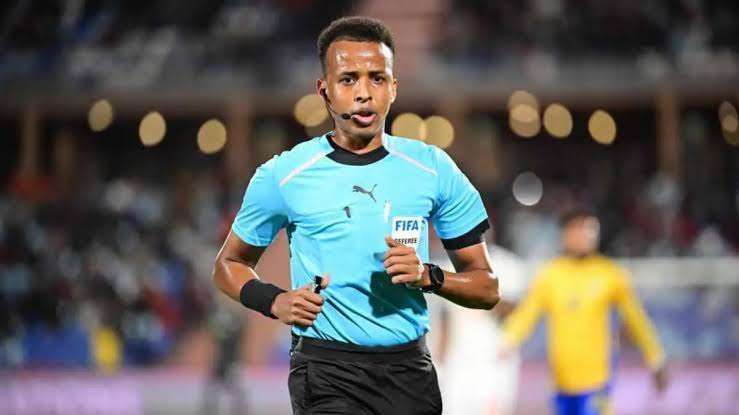
Award-winning Somali referee Omar Abdulkadir Artan has expressed frustration and disappointment after being denied entry into the United States, a development that has cost him the opportunity to officiate at the 2026 FIFA World Cup.
Artan, who was poised to become the first Somali referee to officiate at a FIFA World Cup finals, was removed from FIFA’s list of match officials after US immigration authorities denied him entry upon arrival at Miami International Airport and subsequently returned him to Turkey.
Speaking in an interview with The New York Times, the Confederation of African Football (CAF) Men’s Referee of the Year for 2025 said he was devastated by the decision, insisting that he had complied with all travel requirements.
“I am very, very disappointed. I’m just simply a referee who’s trying to live his dream, the biggest dream of my life, to come to the World Cup,” Artan said.
The Somali official disclosed that he underwent an extensive immigration interview lasting approximately 11 hours before authorities informed him that he would not be allowed into the country.
“I had the right papers and everything. I had the right visa,” he maintained.
According to Artan, he was later placed in a holding facility before being flown back to Istanbul.
US immigration authorities have not publicly disclosed the reason for the decision. However, the incident comes amid travel restrictions affecting several countries, including Somalia.
Following consultations with US authorities, FIFA confirmed that Artan would not be able to participate in the World Cup as either a referee or match official.
“FIFA can confirm that match official Omar Abdulkadir Artan will be unable to train and officiate at the FIFA World Cup 2026 after he was denied entry into the United States,” the football governing body said in a statement.
The organisation added that immigration and visa decisions fall within the authority of host nations and not FIFA.
“FIFA is not involved in host country immigration processes, including visa adjudications, and has been informed by authorities that Mr Artan’s status will not be changed at present,” the statement added.
Officials from Somalia have also questioned the decision.
A senior adviser at Somalia’s Ministry of Youth and Sports told the BBC that Artan possessed all the required travel documentation, while a Somali embassy official in Nairobi said he had been issued a diplomatic passport specifically to facilitate his journey after previous visa-related challenges.
The decision effectively ends Artan’s World Cup participation despite the tournament being jointly hosted by the United States, Canada and Mexico.
Under FIFA regulations, all selected referees and assistant referees are required to train and operate from a central preparation base in Miami before and during the competition, making US entry mandatory for tournament officials.
Responding to the controversy, Andrew Giuliani, head of the White House Task Force on the World Cup, defended the action taken by immigration authorities.
“While I can’t go into the derogatory information on that, I can tell you it was the right decision by Customs and Border Protection, and I support that decision,” Giuliani told the BBC World Service.
Artan, however, believes his nationality may have influenced the outcome.
“I think that they have a problem with my country,” he said.
The incident has generated widespread discussion within the football community and renewed concerns about visa and travel restrictions ahead of the World Cup, scheduled to run from June 11 to July 19.
For Artan, whose rise through the ranks of African football officiating earned him continental recognition and a place among the world’s elite referees, the decision represents the abrupt end of a lifelong ambition to officiate on football’s biggest stage.