
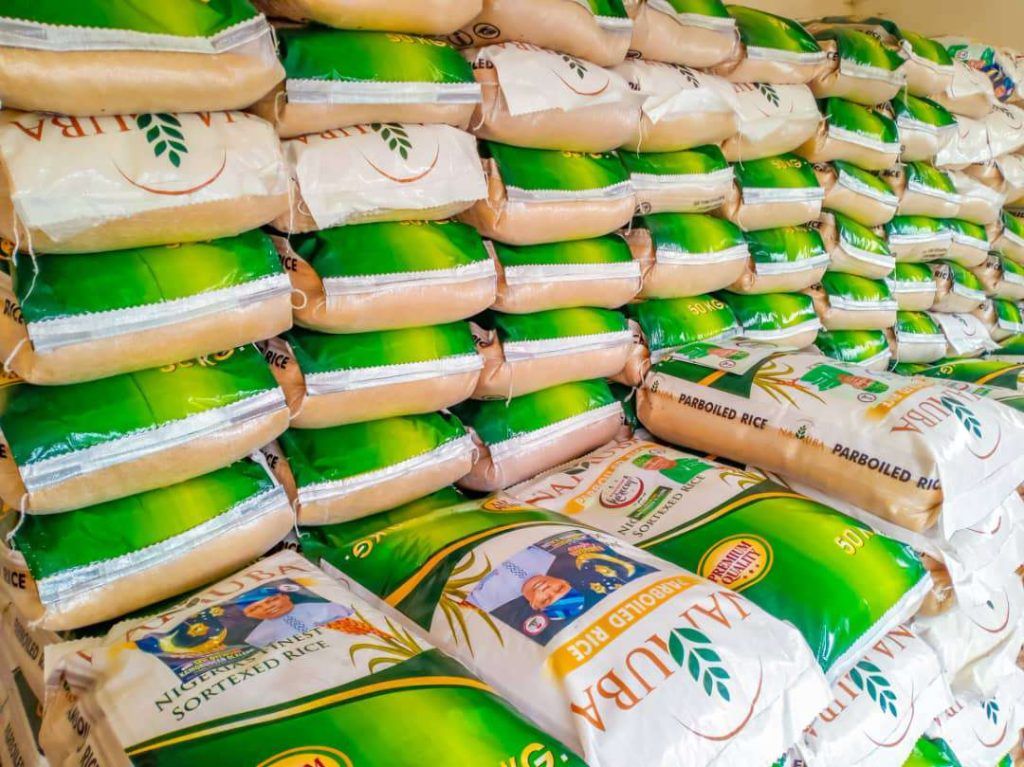
Rice prices across Nigeria may come under renewed pressure in the coming months following a recommendation by a Federal Government-backed agribusiness policy committee to formally shut existing rice import windows, a move that could significantly reduce supply in the local market.
The recommendation was made by the National Agribusiness Policy Mechanism (NAPM), a presidentially coordinated framework for food and agriculture policy, amid concerns that Nigeria’s current rice surplus is being sustained largely by heavy imports rather than strong domestic production.
If adopted by the Federal Government, the proposal could reverse the recent decline in rice prices witnessed across major markets, where a 50kg bag dropped from about N76,000 to N55,000 following import-led interventions aimed at easing food inflation.
Nigeria is estimated to have spent over N1tn importing about 2.4 million metric tonnes of rice in 2025. Based on global benchmark prices published by S&P Global Platts, the volume of imports represents a major foreign exchange outflow, even though the figures are indicative and do not reflect actual transaction costs.
At Thailand’s benchmark price of about $370 per tonne for five per cent broken white rice, the estimated import bill for 2.4 million metric tonnes would be roughly $888m, translating to about N1.26tn at the Central Bank of Nigeria’s Nigerian Foreign Exchange Market (NFEM) rate of N1,418.95 to the dollar as of January 26. Indian rice, assessed at about $347 per tonne, would still amount to an estimated N1.18tn at the same exchange rate.
According to the communiqué issued after the Second Cycle Meeting of the NAPM, held in Abuja in December 2025, the committee advised the government to close rice import windows “given that food inflation has fallen below 14 per cent.”
Data from the National Bureau of Statistics show that food inflation declined sharply from 26.08 per cent in January 2025 to 10.84 per cent in December 2025, a moderation officials say altered the policy environment that initially justified emergency import waivers.
The committee noted that Nigeria recorded a technically positive food balance across major staple crops by the end of 2025. However, it warned that rice and wheat supply security remained heavily dependent on imports, exposing structural weaknesses in domestic production.
According to the indicative national food balance sheet, Nigeria produced about 6.07 million metric tonnes of rice in 2025, while imports stood at 2.4 million metric tonnes. With no reserves or exports recorded, total rice availability reached 8.66 million metric tonnes, exceeding demand by about 1.1 million metric tonnes.
However, the committee stressed that the surplus was “largely sustained by historically high import levels rather than domestic production capacity,” distinguishing rice from other staples that still face supply gaps due to production constraints.
Despite the surplus, participants cautioned that shutting import windows without adequate safeguards could trigger fresh supply pressures, especially if domestic output continues to decline. Field surveys presented at the meeting showed that rice production fell by 7.9 per cent during the 2025 wet season, driven by rising input costs and falling farm-gate prices.
The surveys, conducted across 13 pilot states and covering over 33,000 farmers, revealed that rice and maize producers suffered negative gross margins after import windows were opened. While fertiliser, energy and irrigation costs remained high, output prices dropped sharply, squeezing farmers’ profitability.
The committee observed that the import policy was implemented without a corresponding price stabilisation mechanism, such as a Guaranteed Minimum Price, leaving farmers exposed when market prices fell below production costs.
Weak extension services were also highlighted as a major constraint, with Nigeria’s extension agent-to-farmer ratio estimated at about one to 6,466, limiting the adoption of improved seeds and modern agronomic practices.
As a result, many farmers are shifting away from rice. A dry-season farmer intention survey showed that 10.6 per cent of rice farmers plan to scale back production in the 2025/2026 cycle, opting instead for vegetables, wheat and export-oriented crops with more predictable margins.
The committee warned that these trends could translate into future supply risks, meaning that shutting import windows too abruptly could push rice prices upward again, undermining recent gains made by consumers.
The Presidential Food Systems Coordinating Unit has been mandated to prepare a technical memo recommending the cessation of rice imports to the National Council on Agriculture and Food Security, with onward transmission to the National Economic Council and the Federal Executive Council.
Meanwhile, the Tinubu administration remains under pressure from private sector operators and rice millers to end food import waivers introduced in July 2024. Industry players argue that continued imports have led to mill closures, job losses and declining investment.
Chairman of the Competitive African Rice Forum Nigeria, Peter Dama, recently lamented the shutdown of local mills, blaming cheap imports, insecurity and lack of government support. He warned that unless farmers are protected through subsidies and pricing mechanisms, many will abandon rice production altogether.
Analysts say the government now faces a delicate balancing act: protecting local producers and conserving foreign exchange, while avoiding another surge in rice prices that could worsen the cost-of-living crisis for millions of Nigerians.