
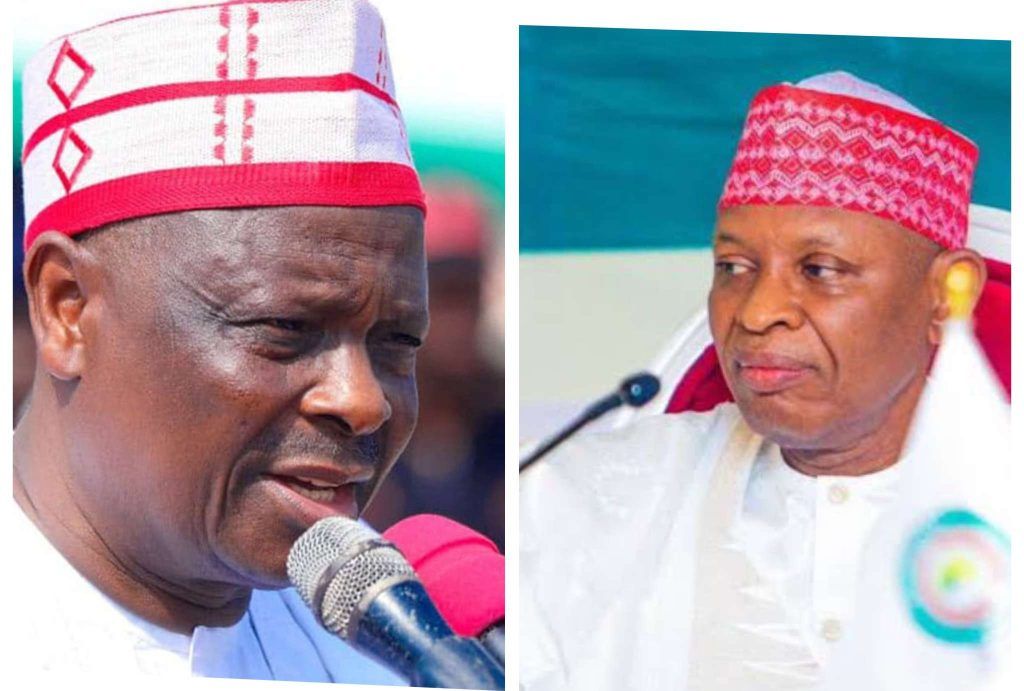
… Kwankwaso holding discussions, will make his move soon – NNPP spokesperson
Security has been beefed around Kano State government house as the North West state, long regarded as one of Nigeria’s most politically sophisticated and combustible arenas, has again become the epicentre of a dramatic power shift. Governor Abba Kabir Yusuf’s decision to dump his longtime political mentor, Senator Rabiu Musa Kwankwaso, and defect from the New Nigeria Peoples Party (NNPP) to the ruling All Progressives Congress (APC) has triggered shockwaves across the state and beyond, reopening old wounds about godfatherism, loyalty, ambition and survival in Nigerian politics.
Kwankwaso, has meanwhile, said he would only consider an alternative political party if offered presidential or vice presidential ticket in 2027, while advising Governor Yusuf to vacate his governorship seat and go to the APC, even as his party’s spokesperson told Business Hallmark that he is in advanced talks and will soon make his move.
Yusuf’s planned defection, initially scheduled for today, Monday in Abuja, marks one of the most consequential realignments in Kano politics since the bitter fallout between Kwankwaso and his former deputy, Abdullahi Ganduje, nearly a decade ago. Yusuf, the only sitting NNPP governor in the country, is expected to be received by Vice President Kashim Shettima, APC national chairman Yitwalda Nentawe and Kano APC strongman Ganduje, in what party insiders describe as a carefully choreographed ceremony aimed at consolidating APC dominance ahead of the 2027 general elections.
Already, the machinery has been set in motion. Ganduje was recalled from a trip to Dubai, while the APC state chairman, Abdullahi Abbas, reportedly cut short his lesser hajj in Saudi Arabia to prepare the ground for Yusuf’s formal admission into the party at his Diso Ward in Gwale Local Government Area. The symbolism is unmistakable: Kano, a traditional opposition stronghold under the red banner of the Kwankwasiyya Movement, is slipping decisively into the APC’s orbit.
Yet beyond the spectacle lies a far deeper political rupture, the collapse of a relationship that has defined Kano politics for over four decades.
A mentor and his protege
Until recently, Abba Kabir Yusuf was widely seen as Kwankwaso’s political alter ego. Their relationship predates partisan politics, stretching back to the 1980s when both men worked as civil engineers at the Water Resources and Engineering Construction Agency (WRECA). Kwankwaso, the senior engineer, took Yusuf – then a young graduate – under his wing, a mentorship that evolved into a lifelong political alliance and was later cemented by family ties through marriage.
When Kwankwaso ventured into politics, Yusuf followed. He served as personal assistant during Kwankwaso’s first tenure as governor between 1999 and 2003, remained close when Kwankwaso became Minister of Defence, and later rose to Principal Private Secretary and Commissioner for Works during Kwankwaso’s second stint as governor from 2011 to 2015. For years, Yusuf was not just a loyal aide; he was the embodiment of Kwankwaso’s political project.
That loyalty was rewarded. After narrowly losing the governorship election in 2019, Yusuf was again handpicked by Kwankwaso as the Kwankwasiyya Movement’s flagbearer in 2023. This time, victory followed, albeit after a bruising legal battle that ended at the Supreme Court. To many within the movement, Yusuf’s ascent was proof of Kwankwaso’s enduring influence and strategic acumen. Observers say it is precisely this history that has made the current rupture so jarring.
Defection without blessing
The rift burst into the open when aides to the governor confirmed his intention to defect to the APC – a move that, according to NNPP leaders, was neither discussed with nor sanctioned by Kwankwaso. Ladipo Johnson, the NNPP’s National Publicity Secretary, confirmed that the party leadership was blindsided.
“The NNPP is not officially aware of the governor’s decision to move to the APC,” Johnson told Business Hallmark. “We also heard about it as everyone else, and as such the national leader of NNPP (Kwankwaso) did not sanction such move.”
Johnson confirmed that while the rumours of Yusuf’s defection appeared credible, Kwankwaso himself was not considering a move to the APC. Instead, he hinted at ongoing consultations, noting that the former governor was “meeting with different people” and that discussions had reached “advanced stages”, without committing to any particular platform.
Behind the scenes, however, the politics has been anything but ambiguous. Sources say President Bola Tinubu was initially reluctant to accept Yusuf into the APC without Kwankwaso, wary of importing a divided political structure into the ruling party. It reportedly took the intervention of Imo State Governor Hope Uzodinma to convince the president that absorbing Yusuf, even at the cost of alienating Kwankwaso, was worth the gamble.
That calculation appears rooted in numbers. Insiders say Yusuf currently enjoys the backing of about 40 of Kano’s 44 local government chairmen and a commanding majority in the State House of Assembly. Among Kano’s federal lawmakers, he is also said to control the larger bloc. In cold political terms, Yusuf brings more immediate electoral value than a Kwankwaso who, while influential, no longer commands executive power in the state.
Godfatherism and growing independence
At the heart of the crisis is a familiar Nigerian political dynamic: the tension between a godfather accustomed to unquestioned loyalty and a godson determined to assert autonomy.
Sources close to both camps say Kwankwaso became increasingly uneasy with Yusuf’s growing independence in governance. While the former governor reportedly exerted enormous influence in the early months of the administration, from the appointment of commissioners to heads of agencies, that grip began to loosen over time. Disagreements emerged, including over the leadership of the Kano State Public Complaints and Anti-Corruption Commission, where Yusuf reportedly resisted Kwankwaso’s preferences.
For Yusuf, allies argue, the reality of governing a complex and politically diverse state demanded flexibility beyond the rigid discipline of the Kwankwasiyya Movement. For Kwankwaso, that same flexibility was interpreted as ingratitude and rebellion.
A senior NNPP official in Kano described the rift as “differences in leadership style and priorities”, insisting it was not personal. Yet the political consequences quickly became personal, translating into manoeuvres over party control, succession and survival.
Fears of isolation and political extinction
From Yusuf’s camp, the decision to defect is framed as pre-emptive self-preservation. A senior aide to the governor said lingering internal crises within the NNPP – including multiple litigations and factional disputes – posed a serious threat to Yusuf’s chances of securing a second term.
“The NNPP is no longer a viable platform,” the aide said. “Even if the governor stays, Kwankwaso’s inner circle has decided he will not get the ticket. Their plan is to give the deputy governor the chance.”
According to this account, Yusuf’s visible projects and rising profile had begun to unsettle his mentor’s loyalists, who feared he might eclipse Kwankwaso’s towering legacy in Kano politics. Defection to the APC, therefore, offered not just protection from internal sabotage but access to federal power and resources ahead of 2027.
It also neutralised a more immediate threat of impeachment. Kwankwaso was believed to have initially banked on his supposed control of 27 lawmakers, the constitutional minimum required to remove a governor. That assumption reportedly collapsed once it became clear that most legislators were prepared to follow Yusuf into the APC, rendering impeachment mathematically impossible. By the time the dust settled, the balance of power had visibly shifted.
NNPP in free fall
Even before Yusuf’s planned exit, the NNPP in Kano was already in disarray. Factional battles over leadership, legitimacy and control of party structures had weakened the party’s foundations. The governor’s defection has now pushed the NNPP to the brink of collapse in the state.
In Kano, the party is effectively split into three factions: one loyal to Kwankwaso; another aligned with Yusuf; and a third linked to the Agbo Major-led national leadership. With Yusuf’s camp openly plotting to migrate its entire structure into the APC, the NNPP risks losing not just its only sitting governor but also its grassroots machinery in Nigeria’s second most populous state.
The crisis has taken on a legal dimension. A Kano State High Court recently affirmed Abdullahi Zubairu Abiya as the acting NNPP state chairman, upheld the suspension of Hashimu Sulaiman Dungurawa, a Kwankwaso loyalist, and restrained him from parading himself as chairman pending the determination of a substantive suit. The National Working Committee of the Kwankwaso-aligned faction responded by dissolving party executives at state, local government and ward levels, announcing plans to install caretaker committees.
Rather than restore order, the moves have deepened uncertainty, reinforcing perceptions that the NNPP has become a battlefield for rival ambitions rather than a viable platform for electoral competition.
Kwankwaso at a crossroads
For Senator Kwankwaso, the defection represents not just the loss of a governor but a profound strategic dilemma. Publicly, his associates insist there is no personal rift and that external forces are exaggerating the fallout. Privately, however, the former governor is said to be weighing his options carefully.
According to NNPP spokesperson Ladipo Johnson, Kwankwaso is not considering joining the APC. Instead, he is holding consultations with various political actors, with talks reportedly reaching “advanced stages”. Multiple sources suggest that the African Democratic Congress (ADC) has emerged as a serious option, especially as it attracts heavyweights such as Atiku Abubakar and Peter Obi in an evolving opposition coalition ahead of 2027.
If realised, such an alliance could dramatically alter the national opposition landscape, but it would also mark a significant departure for Kwankwaso, whose political identity has long been rooted in Kano-centric mobilisation rather than broad-based coalitions.
The irony is that while Yusuf moves closer to the centre of federal power through the APC, Kwankwaso, once one of the most influential figures in the ruling party’s northern bloc, now finds himself repositioning as an opposition tactician once again.
Few voices have been as scathing about Yusuf’s move as Senator Rufa’i Sani Hanga, the NNPP’s Deputy Minority Whip and a longtime Kwankwaso ally. In a wide-ranging interview, Hanga framed the crisis as part of a tragic historical pattern in Kano politics, but argued that Yusuf’s actions were unprecedented in scale and ingratitude.
“What Abba is trying to do is worse than what Rimi did to Malam Aminu Kano, and much worse than what Ganduje did to Kwankwaso,” Hanga said, invoking two of Kano’s most infamous political betrayals.
He traced the origins of the current crisis to what he described as Yusuf’s political naivety and susceptibility to external pressure, drawing parallels with Abubakar Rimi’s rebellion against Mallam Aminu Kano during the Second Republic.
Hanga also hinted at more sinister undercurrents, alleging that investigations involving individuals close to the governor may have created vulnerabilities that were exploited by powerful interests seeking to force Yusuf’s hand.
“I believe Abba may be under serious threat,” he said. “Otherwise, a rational person would never think of leaving his party, his people and those who have worked for him for years.”
Whether or not such claims are substantiated, they reflect the depth of suspicion and bitterness now permeating the Kwankwasiyya camp, sentiments that make reconciliation increasingly unlikely.
Impeachment plots and counter-plots
At the height of the crisis, both camps engaged in high-stakes political chess. Kwankwaso was alleged to have explored the possibility of impeaching Yusuf through the State House of Assembly, banking on what he believed was his control of the constitutional minimum number of lawmakers.
That plan reportedly collapsed once it became clear that the majority of legislators had thrown their weight behind the governor and were prepared to defect with him to the APC. With Yusuf commanding the loyalty of about 33 lawmakers, combining his supporters and existing APC members, impeachment became a non-starter.
Attention then shifted to the deputy governor, Aminu Abdussalam Gwarzo, who was perceived as sympathetic to Kwankwaso. Sources said Yusuf’s allies began considering the possibility of impeaching Gwarzo after the defection, a move that would consolidate the governor’s grip on power.
Gwarzo’s sudden trip to Saudi Arabia for the lesser hajj was widely interpreted through a political lens, though his camp insists he remains neutral. In a carefully worded New Year message, the deputy governor praised both Yusuf’s “visionary leadership” and Kwankwaso’s “enduring mentorship”, signalling an attempt to straddle a rapidly widening divide.
A familiar Kano script
To seasoned observers, the unfolding drama fits neatly into Kano’s long tradition of political fallouts. From Aminu Kano and Abubakar Rimi, to Kwankwaso and Ganduje, the state’s history is littered with alliances that began in trust and ended in acrimony.
A veteran journalist and political analyst argues that Kano’s politics is uniquely driven by strong personalities whose ambitions inevitably clash.
“What we are seeing now fits squarely into Kano’s political DNA,” he said. “The structures are strong, the followership is passionate, and when disagreements happen, they tend to be dramatic and consequential.”
What distinguishes the current crisis, however, is its timing and national significance. With the 2027 elections on the horizon, Yusuf’s defection hands the APC a strategic advantage in a state that has often resisted federal incumbency. For the opposition, it raises urgent questions about cohesion, leadership and the viability of smaller parties in the face of relentless political consolidation.
Beyond Kano
The parallels with Rivers and Benue States are instructive. In Rivers, the breakdown between Governor Siminalayi Fubara and his godfather, Nyesom Wike, culminated in a state of emergency and the suspension of elected officials. In Benue, Governor Hyacinth Alia’s feud with Senator George Akume fractured the APC and paralysed governance.
Kano has not yet reached such extremes, but the warning signs are evident. Godfatherism, when unchecked, often produces instability, while attempts by godsons to assert independence can provoke fierce resistance.
For Yusuf, the gamble is evidently to align with the APC, secure federal backing and seek a second term from a position of strength. For Kwankwaso, the challenge is existential: reinvent his political relevance beyond the structures he once controlled and decide whether to anchor his future in a national opposition coalition or rebuild from the ruins of the NNPP.
An uncertain endgame
As Kano awaits the formal defection ceremony, it is obvious that the old certainties have collapsed. The Kwankwasiyya Movement, once famed for its iron discipline and mass appeal, is fractured. The NNPP, barely three years old, teeters on the edge of irrelevance in its strongest state. And the APC, ever pragmatic, is poised to capitalise on the spoils.
Whether history will judge Abba Kabir Yusuf as a political survivor who read the signs early or as a betrayer who underestimated the long memory of Kano’s electorate remains to be seen. Likewise, whether Rabiu Musa Kwankwaso can once again reinvent himself, as he has done before, will shape not just Kano’s future but the broader trajectory of opposition politics in Nigeria.