
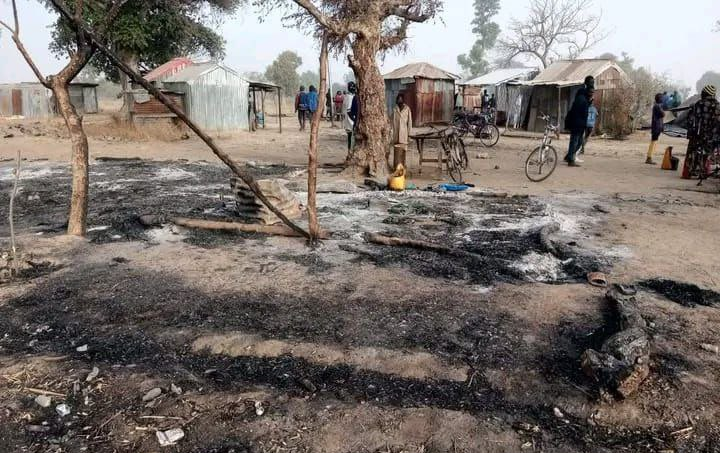
Suspected fighters of Boko Haram and the Islamic State West Africa Province have abducted more than 100 women and children during a violent raid on Ngoshe community in Gwoza Local Government Area, triggering fresh concerns over the resurgence of insurgent attacks in Nigeria’s northeast.
The attackers also killed several soldiers, the chief imam of the town and a number of community elders during the assault, which took place shortly after Muslims broke their fast on Wednesday during Ramadan, according to a report by Daily Trust Newspaper.
In a related development, Business Hallmark gathered from BSN that terrorists on March 4, burnt St Mary’s Catholic Cathedral in Wukari, Taraba State. It was gathered that flames raged through roof and windows at night as bystanders watched. The Priest Fr James Oliver rescued the Blessed Sacrament.
Meanwhile, in Borno, local residents and security sources told Daily Trust that the terrorists began the operation by launching an attack on a military base belonging to the 82 Division Task Force Battalion stationed in the area.
According to a security source, the insurgents overwhelmed the troops due to their large numbers before moving into the community and an Internally Displaced Persons (IDPs) camp where many residents had sought refuge.
“The militants first attacked the military base and engaged the soldiers in a fierce battle. Because of their numbers, they managed to overpower the troops before advancing into the community,” the source said.
After forcing the soldiers to retreat, the gunmen reportedly pursued them into surrounding areas before storming homes and abducting women and children.
Although the exact number of casualties has yet to be officially confirmed, security sources disclosed that at least nine soldiers’ bodies had been recovered following the attack.
The insurgents also destroyed military assets during the raid, setting armoured vehicles and operational equipment ablaze before fleeing with a large quantity of ammunition.
Residents said the attack left the community in chaos as frightened families fled in different directions to escape the violence.
Many survivors have since taken refuge in the nearby town of Pulka.
One resident described the attack as devastating, noting that many families had only recently begun returning to Ngoshe after years of displacement in neighbouring Cameroon.
“This is a huge setback for us. Some people had just started rebuilding their lives here after returning from Cameroon. Now they have been forced to run again,” the resident said.
Community members also suggested that local informants might have assisted the attackers by providing information that enabled them to strike both the military base and civilian areas.
“The attack was well coordinated. It would have been difficult for them to execute it without inside information,” another source said.
According to residents, the chief imam of the town and several elders were killed during the assault while many women and children were taken away by the attackers.
Military retaliates with airstrikes
Following the attack, the Nigerian military reportedly launched a counteroffensive against the fleeing insurgents.
Security sources said fighter aircraft from the Nigerian Air Force tracked the militants as they retreated along known escape routes.
According to reports, the insurgents had attacked troops’ positions at about 7:30 pm before withdrawing from the area.
Surveillance aircraft subsequently located their movements and carried out precision airstrikes that killed more than 50 of the attackers.
Military sources said the operation disrupted the terrorists’ escape and inflicted heavy casualties on the group.
Security analysts attribute the renewed wave of insurgent attacks on military locations to ongoing military offensives targeting militant hideouts in areas such as Sambisa Forest, the Mandara Mountains, and the Lake Chad basin.
Survivors recount trauma
Residents who fled Ngoshe said the humanitarian situation in Pulka remains dire, with many families still searching for missing relatives.
One survivor, Malam Umar, described heartbreaking scenes as displaced residents tried to locate loved ones.
“You will see mothers crying while searching for their children and children looking for their parents. Many families were separated during the attack,” he said.
“The pain of losing homes and loved ones at the same time is very difficult for people to bear.”
Ndume condemns attack
Reacting to the development, Senator Ali Ndume condemned the attack and called for intensified military operations against insurgents in the region.
He confirmed that soldiers, the chief imam of Ngoshe and several elders were among those killed during the assault.
Ndume also disclosed that the military base in the area was dislodged, with equipment destroyed and houses worth millions of naira burnt.
The senator said senior military officials, including the General Officer Commanding the Nigerian Army 7 Division, Brigadier-General Ugochukwu Unachukwu, had visited the community to restore order.
He added that authorities were working with the Borno State Emergency Management Agency and the Gwoza local government council to provide relief materials for displaced residents now sheltering in Pulka.
However, Ndume noted that the absence of permanently stationed attack helicopters and fighter jets in the northeast remained a major operational challenge for troops battling insurgents.
Appeal for humanitarian support
Meanwhile, youth groups in Gwoza have appealed for urgent humanitarian assistance for victims displaced by the attack.
They said many families currently taking refuge in Pulka lack food, clothing, bedding and other essential household items.
The group urged government agencies, humanitarian organisations and members of the public to support the affected residents as they struggle to rebuild their lives after the devastating assault.