
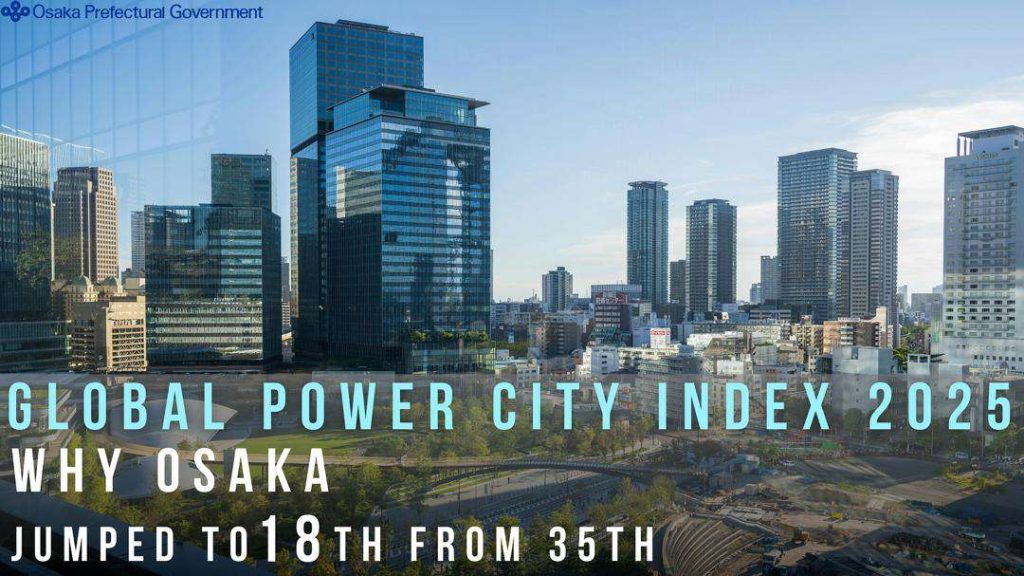
Osaka, Japan, has recorded its strongest-ever performance in the Global Power City Index (GPCI) 2025, climbing 17 places from 35th to 18th and emerging as the fastest-rising city among the 48 global cities assessed in the latest ranking.
The annual index, published by the Mori Memorial Foundation’s Institute for Urban Strategies, measures the comprehensive strength of major cities across six indicators: economy, research and development, cultural interaction, livability, environment and accessibility.
Osaka’s sharp rise reflects its accelerating transformation into a more competitive and globally connected city, buoyed by post-Expo international engagement, a rebound in tourism and steady improvements in livability and economic performance.
In the 2025 edition, Osaka improved its ranking across all six categories, underscoring what analysts describe as growing international momentum and urban attractiveness.
The most notable leap came in the Cultural Interaction category, where Osaka surged from 23rd to 13th, the largest improvement recorded by any city in the ranking. The gain was driven by strong growth in foreign visitor arrivals, an increase in international conferences and a higher volume of cultural and global exchange events hosted by the city.
The cultural upswing was closely linked to the Osaka–Kansai Expo, which welcomed an estimated 29 million visitors and featured participation from 158 countries and regions. The Expo has been widely credited with repositioning Osaka as a global meeting point for culture, business and innovation.
Inbound tourism also hit a record high in 2025, with an estimated 17.6 million foreign visitors travelling to Osaka, according to figures from the Osaka Convention & Tourism Bureau. The surge marked the city’s strongest tourism performance on record and reinforced its growing international profile.
Osaka also recorded gains on the economic front, improving its ranking from 38th to 33rd – one of the largest jumps globally, tied with Dubai. The prefecture’s nominal GDP reached ¥44.5 trillion, reflecting annual growth of 4.3 per cent and extending a three-year streak of positive expansion.
Building on this momentum, the Osaka Prefectural Government is developing a long-term strategy titled “Beyond EXPO 2025: Toward Osaka’s Post-Expo Future”, which aims to lift nominal GDP to ¥80 trillion by the 2040s. The final version of the strategy is expected to be completed by March 2026.
Livability also emerged as a key strength. From the perspective of residents, Osaka climbed from 15th to 8th in the livability ranking, supported by its high concentration of retail outlets and restaurants, compact urban layout and comparatively short commuting times. These factors have increasingly positioned Osaka as an attractive city for both domestic and international talent.
Accessibility further reinforced the city’s standing as a strategic hub. Osaka offers rapid rail connections to Kyoto and Kobe within 30 minutes, while Tokyo can be reached in as little as 2.5 hours via the Shinkansen. Kansai and Itami airports together handle around 240 domestic flights daily, alongside more than 1,550 international flights weekly, linking Osaka to 82 cities worldwide.
With its expanding global reach, improving urban quality and growing economic scale, Osaka is increasingly being viewed as a rising destination for startups and international entrepreneurs seeking access to Asian markets.