
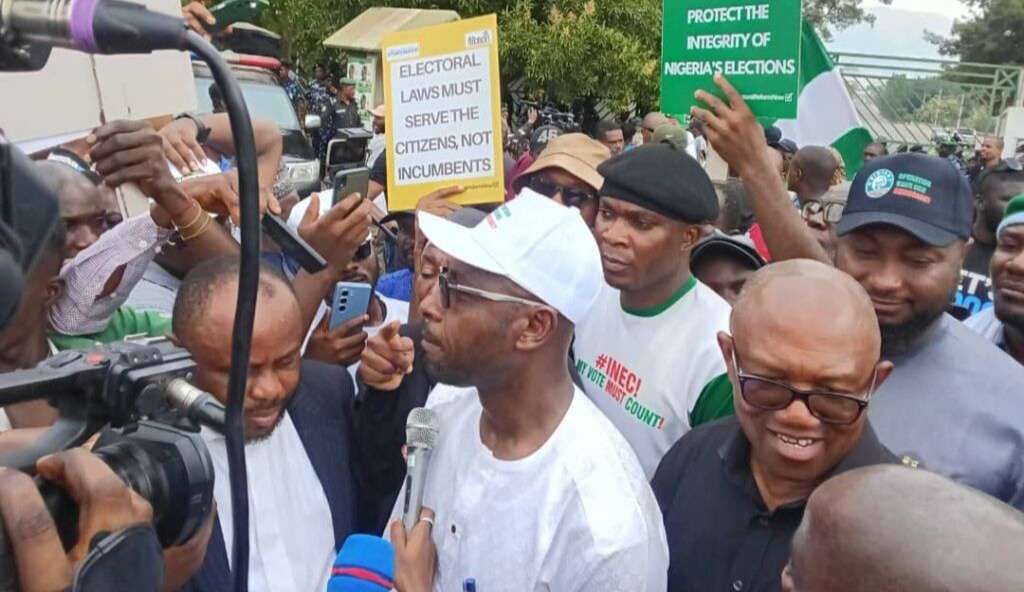
Former Labour Party presidential candidate, Peter Obi, on Monday joined hundreds of demonstrators at the gates of the National Assembly in Abuja, calling for the immediate reinstatement of “real-time” electronic transmission of election results in the amended Electoral Act.
The protest, tagged “Occupy the National Assembly,” was organised by members of the Obidient Movement, civil society organisations, women’s groups and supporters of the African Democratic Congress (ADC). The protesters accused lawmakers of diluting electoral safeguards ahead of the 2027 general elections by removing the phrase “real-time” from provisions on electronic transmission of results.
Last week, the Senate passed the Electoral Act 2022 (Repeal and Reenactment) Amendment Bill, 2026, through third reading. A major source of controversy was the deletion of the words “real-time” from clauses relating to electronic transmission of election results — a move critics say could open the door to manipulation during result collation.
Although the Senate later clarified that it had not rejected electronic transmission outright, protesters insisted that the absence of explicit “real-time electronic transmission” language leaves significant loopholes.
Chanting solidarity songs and displaying placards reading “Our votes must count,” “No to electoral robbery,” and “Protect democracy now,” the demonstrators marched from the Federal Secretariat to the National Assembly complex.
They were stopped at the entrance by a heavy security presence comprising personnel of the Nigeria Police Force, the Nigerian Army and the Nigeria Security and Civil Defence Corps. Security operatives barricaded the main gate, forcing the protesters to hold their rally outside the premises.
Some civil society leaders clarified that the group had no intention of breaching the complex but chose the gate as a symbolic location for their protest.
Speaking to journalists, Obi warned that Nigeria risked undermining hard-won democratic gains if the credibility of elections was compromised.
“We must dismantle this criminality and prove that we are now a nation that shows light in Africa,” he said.
He urged the National Assembly to enact provisions that would make real-time electronic transmission of results mandatory, recalling the controversy surrounding the 2023 elections when the Independent National Electoral Commission (INEC) cited technical glitches in uploading results.
“The danger was clear. We have suffered the danger before. We don’t want any glitch again. This is finished. We want things to come back to normal. No more glitch,” Obi said.
His presence energised the crowd, many of whom regard him as a symbol of the youth-driven political awakening that challenged Nigeria’s political establishment in 2023.
The National Coordinator of the Obidient Movement Worldwide, Dr Yunusa Tanko, said the agitation would persist until lawmakers explicitly reinstate real-time electronic transmission in the law.
“If there is no electronic transmission of results, there will be no election. Our elections must be credible,” Tanko said.
He noted that past elections had been tainted by manual interference during result collation — a problem electronic transmission was intended to address following reforms after the 2011 and 2015 elections.
Electoral reforms gained momentum after the widely criticised 2007 general elections. The introduction of card readers in 2015 and the Bimodal Voter Accreditation System (BVAS) in 2022 were seen as major transparency measures, despite challenges in implementation.
Civil society organisations had strongly advocated for electronic transmission provisions during debates leading to the 2022 Electoral Act, arguing that technology would reduce human interference and rebuild public trust.
Activist Randy Peters, who also addressed the protesters, accused the political class of betraying democratic ideals and pledged sustained demonstrations.
“Tomorrow, we will be back here until the Senate does the right thing. The current administration supported the June 12 campaign. It was about free and fair elections,” he said.
Invoking the legacy of the June 12, 1993 election – widely regarded as Nigeria’s freest and fairest – Peters questioned why elected leaders would resist reforms aimed at guaranteeing credible outcomes.
“In 2027, our votes must count. The most important thing is that our votes must count,” he added.
Despite the barricades and tight security, the protesters remained peaceful, insisting their mission was to send a clear message to lawmakers: Nigerians do not want a repeat of past “glitches” and demand firm legal guarantees for transparent, real-time transmission of election results.