
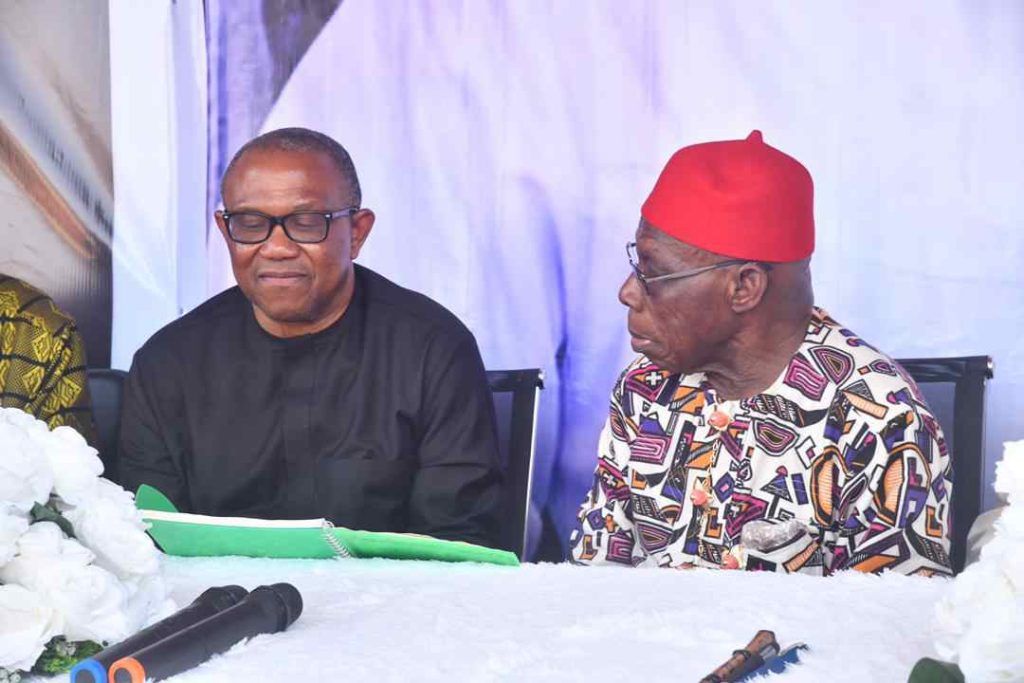
It is a risky task writing about former president, head of state, army general, Gen. (Chief) Olusegun Obasanjo for several reasons. Today, he is the greatest black leader in the world, and unarguably one of the greatest leaders in the world. There are few men alive, who have attained his pedigree; he is well respected as the first military leader in Africa to willingly relinquish power to civil leadership.
He was appointed by the Commonwealth as one of the Eminent Persons Group on the decolonization of Southern Africa, based on his record as head of state, when he took punitive actions to nationalized British companies, such as BP, (AP), Standard Bank (First Bank), and Barclays Bank (Union Bank), which made Nigeria a member of the Southern Africa Frontline states.
Although, he tried unsuccessfully to become UN secretary General losing to Bhutros Ghali of Egypt, because our government didn’t support him, he was not diminished in any way by it, rising from it over a decade later to become civilian president after escaping firing squad under Gen. Abacha for false allegation of a coup plot. He has experienced everything: the highest level of accomplishments, and the deepest pit of despair.
A Dangerous Agenda
However, his present self-assignment of pushing the Mr. Peter Obi’s presidency agenda may be his euthanasia for the Igbo. For a man, who had been known as a friend of the Igbo, his current role will negate all the good he may have done in the past. His ambition for an Igbo president in his lifetime may seem good and patriotic on the surface, but beneath are landmines. Beyond self-glorification, what benefit would it accord them?
I won’t join former presidency spokesman, Mr. Laolu Akande, to accused him of being responsible for all the political issues confronting Nigeria today because of his monumental failures in government as president between 1999 and 2007; however, I daresay that he bears considerable responsibility for some of them, if not most.
For instance, the issue of insecurity today started under him, when the Northern governors introduced Sharia contrary to the constitution. He looked the other way because he wanted a third term; now see where it landed us. Again, he was instrumental to the Nigeria’s betrayal of former president Jonathan, which paved the way for the APC to assume power. Again , he was responsible for introducing political corruption, such as Constituency Projects, and monetizing party primaries. So, Mr. Akande was not far from the truth, although he may have over-generalized.
Obasanjo’s advocacy for Obi’s presidency is best read not as sentiment or nostalgia, but as deliberate disruption. At this stage of his life, which he said is the “departure lounge,” his interventions increasingly resemble stress tests designed to expose what he sees as a brittle, extractive political order. But this one departs from the norm and leaves a question mark over his motive.
Doomed To Fail
From all indications, he is the drummer in the Obi dance for the presidency in 2027, even though the consequences may far outlive him. The issue here is neither the suitability nor otherwise of Obi, which all agree is not in doubt, nor the righteous act of having an Igbo president. No, the challenge is what will be the outcome or fallout of such move whether successful or not on the Igbo?
First, it is highly doubtful if Obi can beat President Tinubu in an election, especially with Northern scepticism about the fidelity of the Igbo to Nigeria, as well as Obi’s readiness to do a term. On both counts, they’re probably justified. Obasanjo seems to have grown out of touch with current reality. Second, even if Obi wins, Tinubu will still be in power for three months before transition and may not be willing to intervene in any backlash, which should be expected.
From Obasanjo’s vantage point, Obi represents less a man than a corrective idea, discipline over largesse, prudence over populism. This framing explains why Obasanjo appears largely untroubled by the social turbulence Obi’s candidacy generates, particularly in the South-West. He seems to judge Nigeria’s macro-dysfunction as a greater threat than the localized unrest electoral competition may provoke.
Lessons Of History
This is where elite logic collides with lived reality. The 2023 elections demonstrated how quickly political competition in Lagos can assume ethnic form. Obi’s defeat of Tinubu in the state punctured a long-standing assumption: that Lagos is politically immune and ethnically guarded from electoral incursions.
For Igbo residents in Lagos, the danger is structural. They are economically visible, yet politically marginal. An Obi presidency, even if secured through broad national support, risks intensifying this vulnerability if defeat in Lagos is framed not as a democratic change, but as demographic encroachment.
Obasanjo is unlikely to be unaware of this risk. His posture suggests prioritization, rather than miscalculation. In his reading, Nigeria is already in a prolonged crisis; avoiding discomfort today merely defers collapse tomorrow. It is part of his nationalistic posturing for a united country, which has always stood him in good stead with Northern leaders. For him, saving Nigeria is an urgent task that deserves every risk
Vindictive Against Tinubu
There is also a strategic weakness in the Obasanjo-Obi alignment. By presenting Obi as a moral corrective to a decadent political class, supporters inadvertently sharpen the perception that an Obi presidency would represent not reform within the system, but replacement of its custodians, which conditions the arrogant attitude of the Obidients. A misplaced expectation, if you asked me.
In regions, where political power is tightly interwoven with ethnic identity, this perception is incendiary. It allows opponents to recast competence as conquest, and fiscal restraint as hostility. Even in the event of electoral success, the aftermath could prove paradoxical. He may be bothered by the slide in national cohesion and ethos, however, he’s also incensed, more especially by a vindictive response to a Tinubu ascendancy as president.
What Obasanjo ultimately offers is a familiar Nigerian reform model: change driven from above that may change little given the expected brevity of tenure, and an acclamation of the categoric imperative of his dominance, and victory over Tinubu. It’s a proxy contest between two Yoruba ‘gods’ with the Igbo as pawns. He will still fail and the Igbo will be the worst for it.