
…as Tinubu continues silent fiscal restructuring
The silent constitutional reforms being implemented by President Bola Tinubu have continued to alter the dynamics of power and control of Nigeria’s resources with the North losing grounds to the South in the scheme of things, Business Hallmark can report.
According to BH findings, the remaining public institution that sustained the North for several decades, the Nigerian National Petroleum Company Limited (NNPCL), has been taken away from the firm control of the region with an executive order. But it is not enough unless backed by Acts of Parliament.
With the new reform effected in the NNPCL, the South’s future earnings from the federation account is expected be disproportionately higher than what goes to its northern counterpart as distribution is now largely based on production and consumption.
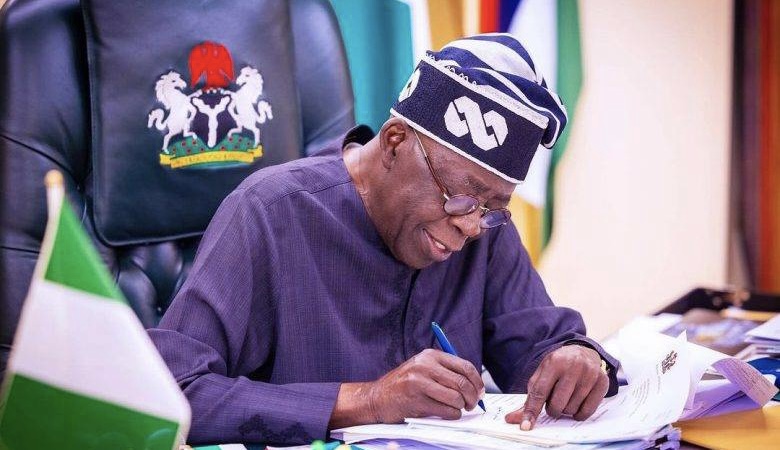
The president, it would be recalled, had on February 18th, 2026, signed an Executive Order that ended the retention of oil and gas revenues by the NNPCL. Instead, revenues from oil oil gas sales, as well as fees and royalties paid by oil companies will now flow directly into the federation account.
According to the president, the Executive Order, which is anchored on Section 44(3) of the Constitution, which vests ownership, control, and derivative rights in all minerals, mineral oils, and natural gas in, under, and upon any land in Nigeria, including its territorial waters and Exclusive Economic Zone, in the Government of the Federation, seeks to restore the constitutional revenue entitlements of the federal, state and local governments, which were removed in 2021 by the Petroleum Industry Act (PIA).
Between Executive Order and PIA
“Under the current PIA framework, NNPC Limited retains 30 per cent of the Federation’s oil revenues as a management fee on Profit Oil and Profit Gas derived from Production Sharing Contracts, Profit Sharing Contracts, and Risk Service Contracts.
“In addition, the company retains 20 per cent of its profits to cover working capital and future investments.
“Given the existing 20% retention, the additional 30% management fee is considered unjustified by the Federal Government, as the retained earnings are already sufficient to support the functions NNPCL performs under these contracts.
“NNPC Limited also retains another 30% of its profit oil and profit gas under the production sharing, profit sharing, and risk service contracts, as the Frontier Exploration Fund under sections 9(4) and (5) of the PIA.
“A fund of this size, being devoted to speculative exploration, risks accumulating large idle cash balances, which would encourage inefficient exploration spending, at a time when government resources are urgently needed for core national priorities, including security, education, healthcare, and energy transition investments.
“There is also the Midstream and Downstream Gas Infrastructure Fund (MDGIF) under Section 52(7)(d) PIA, funded by the collection of gas flaring penalties provided under Section 104. The fund is to be used for supporting environmental remediation and relief for host communities impacted by gas flaring.
“However, section 103 of the PIA has already established a dedicated Environmental Remediation Fund, administered by NUPRC, specifically designed to fund the rehabilitation of communities negatively impacted by upstream petroleum operations, including gas flaring.
Furthermore, Section 103 already imposes a fee on lessees to contribute to this fund for precisely this purpose.
“All these deductions far exceed global norms and effectively divert more than two-thirds of potential remittances to the Federation Account.
“The continuing decline in net oil revenue inflows is largely attributable to these deductions and fragmented oversight under the current PIA architecture.
PIA Robbed the Federation
“The objective is to eliminate unjustified multiple layers of deductions that erode revenues that ought to accrue to the Federation Account, enabling the three tiers of government to pursue critical national priorities”, the president explained in the order.
While many Nigerians, especially state governors from the North have continued to welcome the move, BH findings showed that the order is going to be more far reaching. One of the implications of the order, which sources in government told our correspondent, which would soon be sent to the National Assembly to be made a parliamentary act, is that revenues redirected from the NNPCL will be made available to the three tiers of government for sharing.
However, with the ongoing fiscal restructuring being implemented by the president, especially the three tax laws he recently signed into law, which largely favors the South, the region will end up receiving a larger chunk of the NNPCL largesse, as the major producer of oil.
A financial expert, who spoke on the matter to our correspondent at the weekend, Jude Igbrude, said the election of President Tinubu as president in 2023 is a blessing to the country, especially the South.
“It is now that I believe one can achieve much without making much noise. Tinubu, contrary to the expectations of many that he’s going to be a weak president, is getting his way with everything he wants.
“He wanted an ambitious tax Act, he got it. He gave important positions in government to trusted people and he got away with it. He wanted approval of the National Assembly to secure huge loans to fund his budgets, lawmakers gave it to him.
“He said he wanted to build a coastal road in the South, he got it despite objections from many quarters. In spite of protests from the opposition, he got his own Electoral Act. Now he wants state police and he is going to get it.
Silent Revolution
“A silent revolution is going on in the country. The president is silently redrawing the socio-political and economic map of Nigeria without many of his adversaries, especially those from the northern part of the country, fully realizing what he’s really up to.
“He has continued from where former President Olusegun Obasanjo stopped. They (North) will be shell-shocked by the time he is over with them”, Igbrude noted.
It would be recalled that former President Olusegun Obasanjo had embarked on a major constitutional reforms that gave more economic powers to the South during his second coming as president from 1999 to 2007.
Through his privatisation exercise, the former president had liquidated or transfered ownership of several state-owned assets in which Northern political elites largely exclusively feasted on, including the Nigerian Airways, NITEL, NICON NUGA Hotel (now Transcorp Hilton Hotel), Apapa Port Complex, NEPA, Aluminium Smelter Company of Nigeria (ALSCON), the Port Harcourt Refinery, which was later reversed by his successor and many others to the private investors.
The exercise to a very large extent ended the North’s dominance and control of many of the now private- public companies used to amass vast wealth and to dispense political favors.
The sale of the companies irked many northern leaders, who made fruitless efforts to reverse them by putting pressure on successive northern presidents. He actually succeeded with the privatization program because it was started by military president Ibrahim Babangida, which strengthened his hand against opposition.
However, Obasanjo’s many reforms could not be undone as they were done through parliamentary Acts, which required stringent conditions before they can be reversed.
Focus on Economy
President Bola Tinubu had picked up from where former Presidents Obasanjo and Goodluck Jonathan stopped by abandoning the more difficult and acrimonious political power restructuring for the less contentious fiscal federalism.
“However, what the North failed to realise is that whoever controls the money controls the government. Why do you think South South governors are so powerful in Nigeria of today?
“It is because of the favourable revenue sharing formulas that they got over the years, especially the 3% host communities and 13% revenue derivation sharing formulas.
In August 2021, a former group managing director of the NNPCL, Mele Kyari, lamented that the allocation of 3% oil companies operating expense to host communities is higher than the 30 percent of oil and gas profit set aside for frontier exploration.
“When people say three percent profit oil and gas from NNPC shares or from PSC, it looks like a very small number. The percentages appear very outrageous, but 30 percent of what? Nobody has sat down to look at it. When you say profit oil 30% percent, it probably comes down to less than $400 million per annum.
“But when you come to the host communities, you have three percent of our operating expense. We spent about $16 billion in 2020 in our operating expense across the industry. So, when you take three percent of that number, it is above $500 million, far above the budget of NDDC,” Kyari had explained back in 2021.
Production, Consumption Pursued
With the provisions of the new Tax Acts mid-wifed by the president, which favors production and consumption, the South is expected to further upend the North in the sharing of national resources.
Business Hallmark had in a story published on February 16th, 2026, titled: ‘Revenue allocations: New revenue formula boost South’s receipt’, reported how the 17 Southern states of the federation have upstaged their 19 Northern counterparts in the control of Nigeria’s vast resources.
According to the report, the South led in the federal revenues shared month by the Federation Accounts Allocation Committee (FAAC) in 2025, earning about 52.7 percent of generated income.
The development is a major shift in Nigeria’s old political and economic order where the North cornered the largest chunk of the nation’s vast resources.
For decades, the 19 Northern states, using landmass and population size as advantage, benefitted from the lopsided sharing of both economic and political powers to the detriment of the other parts of the country that contribute more to the commonwealth.
However, the tide had largely turned, with states from the South, though still demanding more share of distributable earnings, now earn a fair share of the wealth generated from their territories, in a development political observers described as “subtle restructuring”.
A FAAC report on disbursements to the 36 states of the federation in the year ended 2025 obtained by BH, showed that top earners of FAAC disbursements in the period under review were major commercial centres and oil-producing states who benefited from huge statutory allocations from oil and gas proceeds, Value Added Tax (VAT), Electronic Money Transfer Levis (EMTL), Nigeria Customs Service (NCS) duties and tariffs, Company Income Tax (CIT) and others.
An analysis of the report indicates that revenue sharing was largely influenced by factors like digital transactions, 13 percent derivation policy, consumption and population spread.
Leading the pack of states with the highest federal revenue in 2025 is Lagos with a total gross FAAC allocation of N706.90 billion and a net payout of N514.56 billion.
Lagos massive allocation was largely driven by strong electronic money transfer levy receipts and a VAT inflow of N459.87 billion.
Closely following on Lagos heels is Delta State which received a gross allocation of N681.74 billion and a net amount of N649.67 billion after deductions were made.
Delta’s revenue allocation was driven largely by a derivation revenue of N458.65 billion.
In third position is Rivers State. The oil-rich state got N594.47 billion gross and N526.30 billion net from FAAC in 2025. This performance reflects a combination of oil and gas derivation and VAT inflows from industry players and consumers.
Others are Akwa Ibom in fourth position with a net allocation of N494.39 billion. Breakdown of Akwa Ibom’s FAAC revenue shows that it received a net statutory allocation of N363.35 billion, net VAT allocation of N95.85 billion and electronic money transfer levy receipt of N4.96 billion.
Bayelsa is the fifth on the ladder, receiving N488.08 billion in FAAC allocations in 2025. Breakdown of the earnings showed that while the state got statutory net allocation of N367.14 billion, net VAT allocation amounts to N87.98 billion and electronic money transfer levy receipt at N3.82 billion.
Kano State, which used to be the highest earner in the country, also crept into the list of top 10 FAAC earners in 6th position with a earning of N270.86 billion in 2025.
While Kano got N100.23 billion in net statutory allocation, its net VAT allocation amounted to N146.81 billion and electronic money transfer levy receipt N7.89 billion.
Kano’s performance was driven largely by high population and it’s position as the economic and commercial capital of the North.
Following Kano in 7th position is another southern state of Oyo, which received N213.75 billion from FAAC in 2025.
Further analysis of Oyo’s FAAC earnings in 2025 indicates that while its net statutory allocation amounted to N49.35 billion, net VAT allocation and EMTL settled at N146.06 billion and N6.75billion. The pacesetter state benefits from its population and economic size.
Anambra in South East Nigeria came 8th on the list of highest FAAC earners in the country with N199.88 billion earnings in 2025.
Breakdown of Anambra’s earnings showed that the state got net statutory allocation of N88.21billion, N94.15 billion net VAT allocation, N5.83 billion EMTL allocation and N20.74 billion in oil derivation.
Like other high performing states, Anambra also benefitted from its position as a trading and industrial hub of the Eastern region, as well as from its status as an oil-producing state.
The second northern state on the list of top FAAC earners is Borno in 9th position. In 2025, Borno earned N198.75 billion.
While the state received N89.11billion as net statutory allocation, it got N92.18 billion and N5.02 billion as net VAT allocation and EMTL.
In 10th position is Ondo with a net allocation of N198.42 billion in 2025. BH analysis of the state’s receipts in the period under review showed that it got N95.20billion, N87.17 billion, N4.85 billion as net statutory allocation, net VAT allocation and electronic money transfer levy receipts respectively.
In the same vein, Northern states led the states with the lowest FAAC allocations in 2025, according to BH checks.
The 10 states with the lowest allocations in the period under review are Yobe in 27th position with N155.20 (net statutory allocation of N63.61 billion, net VAT allocation of N77.56 billion and EMTL of N4.07 billion); Taraba in 28th position with N153.33 billion (net statutory allocation of N64.66 billion, net VAT allocation of N76.06 billion and EMTL of N4.07 billion); Nasarawa in 29th with N149.67 billion allocation in 2025 (net statutory allocation N63.94bn, net VAT allocation N73.27bn and EMTL of N3.97bn).
Others are Kwara in 30th position with N145.93 billion allocation (net statutory of N53.18bn, net VAT allocation of N80.40bn and EMTL of N4.25bn); Osun in 31st N144.94 billion (net statutory allocation: N44.99bn, net VAT allocation and N85.59bn and EMTL of N4.80bn); Ebonyi in 32nd position with N139.10 billion (net statutory allocation N49.69bn, net VAT allocation N76.21bn and EMTL of N4.03bn and Gombe in 33rd position with N136.44 billion allocation (net statutory allocation of N46.67bn, net VAT allocation of N77.24bn and EMTL of N4.08bn).
Last on the list of laggards are Cross River in 34th position with N130.84 billion allocation (net statutory allocation, N37.75bn, bet VAT allocation of N79.65bn and EMTL of N4.47bn); Ekiti in 35th position with N130.30 billion allocation (net statutory allocation N38.82bn, net VAT allocation N78.35bn and EMTL and N4.17bn) and Ogun in 36th position with N124.19 billion (net statutory allocation N18.99bn, net VAT allocation of N90.01bn and EMTL of N5.40billion.
Baking the Cake
BH findings revealed that the financial situation of the North could become worse as President Bola Tinubu’s tax reforms take shape. The tax law had hit stout opposition from the north, which threatened its abortion.
However, the proposals did not go down well with northern leaders who alleged they will be shortchanged.
Rising from a critical meeting in Abuja, the 19 northern governors, prominent traditional rulers and called on federal lawmakers from the North to reject the bills outright.
A compromise was later reached where the contentious revenue sharing formula was slightly altered in favour of the North. With the revised formula which was later passed by the National Assembly, sharing will now be based on 50 percent equality, 30 percent derivation and 20 percent on population.
In spite of that, the adopted formula yields more to states in the southern part of the country with large consumption figures, highly industrialized cities and those generating more revenues to the federal cover.