
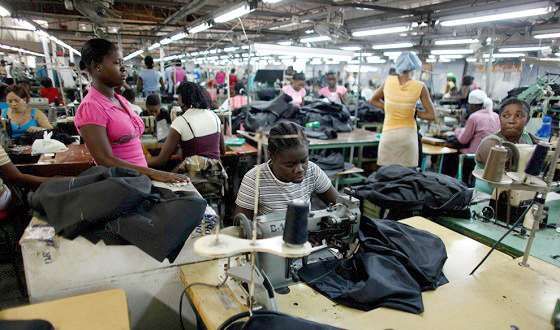
– Aba industrially clusters are fighting back by reducing cost of production
By Adebayo Obajemu
In the face of growing dominance of Chinese and Indian textiles, recently, it has been noticed that Nigeria’s fashion industry is experiencing a resurgence in the use of indigenous fabrics, with Adire—a traditional Yoruba fabric—leading the way.
This pushback against cheap Chinese imports has been seen as a welcome relief for local producers. For long, Nigerian textiles sector had been decimated by imported Chinese products that are dumped in the country, thus pushing the local manufacturers out of business.
Dr. Onimole Ajayi, a cultural scholar informed Business Hallmark that “Nigerian textile makers and local stakeholders are pushing back against cheap Chinese imports, and the main weapon is premium unique authenticity, which Chinese cannot replicate. I’m talking of Adire fabric ( Kampala) , it’s only in Ankara that the Chinese seem to have succeeded.
He noted that local producers are focusing on authenticity, leveraging local production, organizing into manufacturing clusters, and pushing for targeted government interventions.
He stressed that “Local artisans producing traditional fabrics like Adire, Aso-Oke, and Akwete are doubling down on handmade craftsmanship. They actively differentiate authentic Nigerian creations from mass-produced Chinese knockoffs, which has become a vital selling point for consumers seeking authenticity. This premium niche market has ensured the steady recovery from the onslaught launched by Chinese competition.
Clusters Reducing Cost
He further added that industrial clusters and garment hubs like the one in Aba, Abia State, which houses over 100,000 producers) are banding together to boost production capacity. By pooling resources, they aim to achieve economies of scale to counter the low prices of imported apparel from the Chinese.
Otunba Adejumo Adeyemi President of Yoruba Youth Agenda- a cultural organisation that promotes Yoruba culture and seeks to protect Yoruba traditional artisan trades- told BH that ” We are trying our best to organise our local textiles producers into advocacy groups, including the Apparel and Accessories Manufacturers Association of Nigeria (AAMAN) and the Nigerian Textile Manufacturers’ Association (NTMA), which are driving massive awareness campaigns. These initiatives urge Nigerians to prioritize locally made clothing to protect local textiles industry.
He said this approach was yielding results as government policy and procurement are directed at protecting local textile producers.
“Lobbying efforts are continuously directed at the federal and state levels to enforce stricter trade regulations, limit the smuggling of cheap textiles, and ensure government agencies prioritize locally made uniforms. This pushback is producing tangible results.”
Business Hallmark learnt that despite these efforts, the fight is challenging due to macroeconomic headwinds. Local makers frequently struggle to compete because of high costs of diesel to counter poor power supply, foreign exchange pressures, and inadequate access to cheap credit compared to their Chinese competitors.
For the past two decades, textile makers have been facing immense challenges against Chinese competition. Cheaper, mass-produced imports—including counterfeit traditional wear like Adire—flood local markets. High energy costs, smuggling, and severe infrastructure deficits have conspired to cripple domestic mills, forcing many local creators to outsource production to China just to make ends meet.
The battle between the indigenous Nigerian textile industry and foreign competitors is characterized by several major hurdles and shifting dynamics.
Massive Price Disparity:
Chinese manufacturers can produce and ship fabrics at a fraction of local costs. For instance, five yards of locally made fabric might cost N3,000 to produce, while imported replicas are often sold for N1,000.
Design Replication & Counterfeiting:
Chinese manufacturers routinely source authentic Nigerian designs (such as Adire and Batik), mass-produce cheaper, synthetic versions in Asia, and dump them into major hubs like Kano’s Kantin Kwari Market.
High Production Costs:
Domestic mills are disadvantaged by massive operational hurdles. According to the Nigerian Textile Manufacturers’ Association, energy costs in Nigeria are significantly higher than in competing nations, making local manufacturing economically unviable for most.
Economic Pressures:
The rising cost of living and inflation heavily restrict the disposable income of the average Nigerian consumer, forcing them to purchase cheaper Chinese-made alternatives over locally crafted .
Market Adaptation:
Because they cannot compete with Asian pricing, some local Nigerian designers and wholesalers now send their original graphic designs to China for manufacturing and import them back to Nigeria to sell.
The decline has shifted the industry’s landscape drastically over the last few decades. Where Nigeria once boasted over 150 functioning textile mills, fewer than four remain in full operation today. Experts and advocates point to the urgent need for government intervention, stable infrastructure, and policies that support local cotton farmers and textile factories to help revive the sector.