
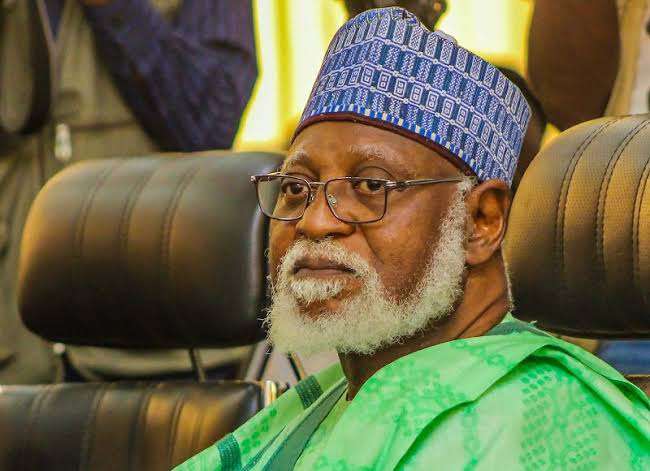
Former Head of State, Gen. Abdulsalami Abubakar (retd.), has disclosed that some leaders of the pro-democracy movement, including members of the National Democratic Coalition (NADECO), privately appealed to him to extend military rule despite their public campaign for a return to democratic governance.
Abdulsalami also revealed that he personally advised former President Olusegun Obasanjo against contesting the 1999 presidential election shortly after his release from prison, insisting that his administration neither endorsed nor sponsored Obasanjo’s emergence as president.
The former military ruler made the disclosures in his autobiography, Call of Duty, unveiled in Abuja during activities marking his 84th birthday.
Giving fresh insight into Nigeria’s transition to democratic rule in 1999, Abdulsalami said many NADECO leaders were initially doubtful about his promise to hand over power because previous military governments had repeatedly failed to honour similar commitments.
According to him, the scepticism changed a few months into his administration when members of the coalition became convinced that he genuinely intended to relinquish power within the stipulated timeframe.
He said some of the same activists who had fought vigorously against military rule later approached him to seek an extension of the transition programme because they felt politically unprepared for the imminent return to civilian governance.
“Two to three months into my administration, some NADECO members realised that I was sincere about the handover date. They felt they had missed the train and wanted more time to organise themselves politically,” he recalled.
Abdulsalami said he rejected the request, insisting that he had already made a commitment to Nigerians and the international community to restore democratic rule.
To test their conviction, he challenged the group to publicly announce their demand and formally communicate it to his government.
“I told them that if they wrote to me and publicly stated that they wanted an extension, I would grant it. They never did, and I knew they wouldn’t,” he said.
The former Head of State noted that pressure to prolong military rule did not come only from domestic political actors. According to him, some foreign leaders and members of the international community also suggested that he remain in office longer because of the stability his administration had restored after the death of Gen. Sani Abacha.
He, however, maintained that he was never tempted to stay beyond his mandate, stressing that Nigeria had reached a point where military rule had become unsustainable.
“By the time I assumed office, Nigeria was at a breaking point. There was enormous pressure from political groups and civil society organisations for the military to leave. The country needed democratic governance,” he stated.
Abdulsalami further revealed that resistance to the transition process also came from within the military establishment, with some officers opposed to handing power over to civilians.
Reflecting on the transition programme inherited from Abacha, he explained that his administration discarded it because it lacked credibility and public confidence.
He recalled that under the Abacha arrangement, all five registered political parties had endorsed the late military ruler as their sole presidential candidate, fuelling widespread belief that he intended to transform himself from military Head of State into a civilian president.
The former ruler said his government instead designed a fresh transition timetable aimed at returning the country to civilian rule in the shortest possible period.
According to him, he initially proposed a six-month programme that would have produced an elected government by March 1999. However, consultations with the judiciary led to an adjustment of the schedule.
He disclosed that the then Chief Justice of Nigeria, Justice Muhammadu Uwais, requested additional time to allow courts dispose of election-related disputes before the inauguration of a new government.
That request, he said, ultimately pushed the handover date to May 29, 1999.
Abdulsalami also shed light on the emergence of the Alliance for Democracy (AD), explaining that his administration deliberately adjusted the party registration guidelines to ensure the South-West was not politically excluded from the transition process.
He said the People’s Democratic Party (PDP) and the All Peoples Party (APP) had clearly met the registration requirements, while the AD struggled to satisfy the stipulated criteria.
To guarantee inclusiveness and national balance, the government amended the rules to allow the third-placed party to qualify.
“We did not want the South-West to feel marginalised. The overriding objective was to promote peace, equity and national cohesion,” he explained.
On Obasanjo’s emergence as president, Abdulsalami insisted that his administration played no role in drafting the former military ruler into politics.
He recounted that Obasanjo visited him after his release from prison in 1998 with two major concerns: a proposed lawsuit against the Federal Government over his incarceration and an invitation from the Peoples Democratic Party to contest the presidency.
According to Abdulsalami, he discouraged Obasanjo from pursuing either course.
“I advised him not to sue the government because the legal process could drag on indefinitely. I told him we would explore ways of addressing the losses he suffered during his imprisonment,” he said.
The former Head of State added that he also advised Obasanjo to abandon thoughts of contesting the presidential election and instead focus on rebuilding his life.
“I told him to go home, thank God he was still alive after all he had been through and forget about becoming president. He said he would think about it and get back to me, but he never did,” Abdulsalami wrote.
He rejected claims that his government facilitated Obasanjo’s rise to power, arguing that the decision to release and pardon political detainees applied to all prisoners and was not designed to favour any individual.
According to him, people only associated the pardon with Obasanjo because he eventually became president.
The former leader acknowledged reports that some retired military officers and influential Nigerians campaigned privately for Obasanjo’s candidacy, believing he possessed the national appeal required to unite the country after years of political turmoil.
However, he insisted those efforts were entirely independent of his administration.
Recalling the final days of military rule, Abdulsalami said he had no anxiety about leaving office and actually looked forward to returning home.
He revealed that after formally handing over power to Obasanjo on May 29, 1999, he departed Abuja for Minna with a deep sense of satisfaction, convinced that his administration had succeeded in stabilising the country and restoring democratic governance.
“As we drove through towns and villages on our way home, people lined the roads to wave at us. I was a very happy man because we had fulfilled our promise and returned Nigeria to democratic rule,” he wrote.