
By Adebayo Obajemu
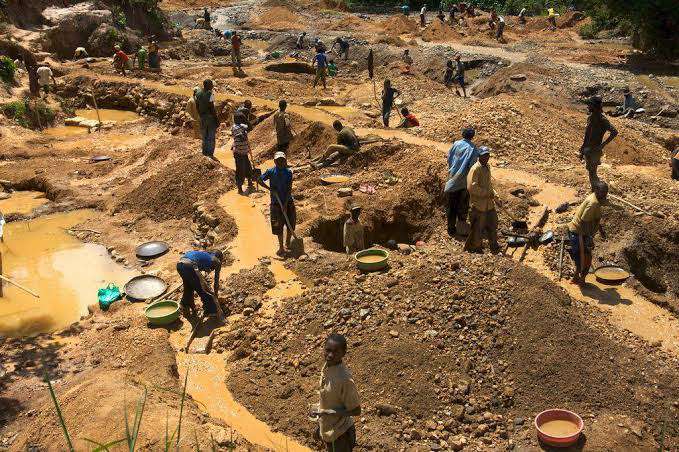
Nigeria may be losing as much as $9 billion annually to illegal mining and gold smuggling as powerful mineral cartels exploit insecurity across the country’s resource-rich regions, according to a new investigative report that links the prolonged violence in several states to competition for strategic solid minerals.
The report, “The Shadow Owners,” published by the Alliance for Economic Research and Ethics (AERE), argues that the persistent insecurity in states such as Zamfara, Kaduna, Plateau, Niger, Nasarawa and Benue is increasingly driven by the struggle to control valuable deposits of gold, lithium and uranium rather than by ethnic, religious or farmer-herder conflicts alone.
According to the report, armed bandits operating in these areas are merely “expendable foot soldiers,” while the real beneficiaries allegedly operate behind offshore shell companies that profit from the illegal exploitation and export of Nigeria’s mineral wealth.
AERE warned that the illicit trade has become a major economic threat, draining an estimated $9 billion from the Nigerian economy every year through illegal mining activities and gold smuggling while simultaneously fuelling insecurity and worsening food inflation.
The report noted that the pattern of violence closely mirrors the location of Nigeria’s richest mineral deposits, raising concerns that terror has become a tool for gaining control of resource-rich communities. It added that by early 2025, more than 1.3 million internally displaced persons (IDPs) had been recorded across the North-Central and North-West, creating conditions that allegedly allow illegal mining operators to expand their activities with little resistance.
Drawing comparisons with the Democratic Republic of Congo, the report warned that Nigeria risks sliding into a similar cycle where armed groups seize mining communities, valuable minerals are smuggled across borders, and the proceeds ultimately end up in foreign tax havens instead of supporting national development.
It further questioned how host communities can exercise their legal rights to free, prior and informed consent under the Nigerian Minerals and Mining Act after many residents have been displaced by violence.
Beyond the direct revenue losses, the report said illegal mining and insecurity are inflicting broader damage on the economy by disrupting agricultural production across the Middle Belt, traditionally regarded as Nigeria’s food basket. According to AERE, the displacement of farming communities and the conversion of farmlands into militarised extraction zones have reduced food output and contributed to rising food prices.Price Comparisons
The report argued that food inflation is no longer driven solely by market forces but increasingly reflects the wider economic consequences of conflict, displacement and the illegal exploitation of Nigeria’s mineral resources.
Meanwhile, Chairman of the Alliance for Economic Research and Ethics, Dr. Dele Oye, also criticised Nigeria’s frequent foreign investment and diplomatic missions, describing many of them as expensive exercises that deliver little economic value.
In a separate policy document titled “The Cultural Key: Why Nigerian Businesses and Government Delegations Fail Abroad and How to Master Cross-Cultural Commerce,” Oye said successive government delegations often return from overseas engagements with little more than photographs, ceremonial handshakes and memoranda of understanding that rarely translate into actual investments.
According to him, many foreign trips are driven by optimism rather than clearly defined commercial objectives.
“The results are predictable, handshake photographs with foreign officials; MOUs signed in glittering hotel ballrooms that collapse within months; investment roadshows that consume hundreds of millions of naira and return with nothing but jet lag and duty-free shopping,” he said.
The former President of the Nigerian Association of Chambers of Commerce, Industry, Mines and Agriculture (NACCIMA) identified poor understanding of international business culture as one of the biggest obstacles limiting Nigeria’s ability to attract sustainable foreign investment.Business & Industrial
He explained that countries such as Japan, Germany, China, Türkiye, Canada and the United States conduct business through different cultural and institutional frameworks built around trust, hierarchy and structured decision-making, requiring greater preparation before negotiations.
Oye also criticised the practice of travelling with oversized government delegations, arguing that public funds would be better spent on technical preparation and implementing agreements reached abroad.
To improve Nigeria’s international investment outcomes, he recommended compulsory cross-cultural training for official delegations, stronger engagement with the Nigerian diaspora, strict monitoring of all memoranda of understanding signed during foreign trips, and the establishment of cultural advisory units across government institutions.
According to him, such reforms would strengthen Nigeria’s negotiating capacity, improve investor confidence and ensure that future international engagements deliver measurable economic benefits rather than symbolic diplomatic successes.