
... It is another ‘money pit’ – Stakeholders
By AYOOLA OLAOLUWA
A fresh controversy is trailing the latest move by the Nigerian National Petroleum Company Limited (NNPCL) to rehabilitate the moribund Port Harcourt and Warri refineries located in Rivers and Delta States, Business Hallmark can report.
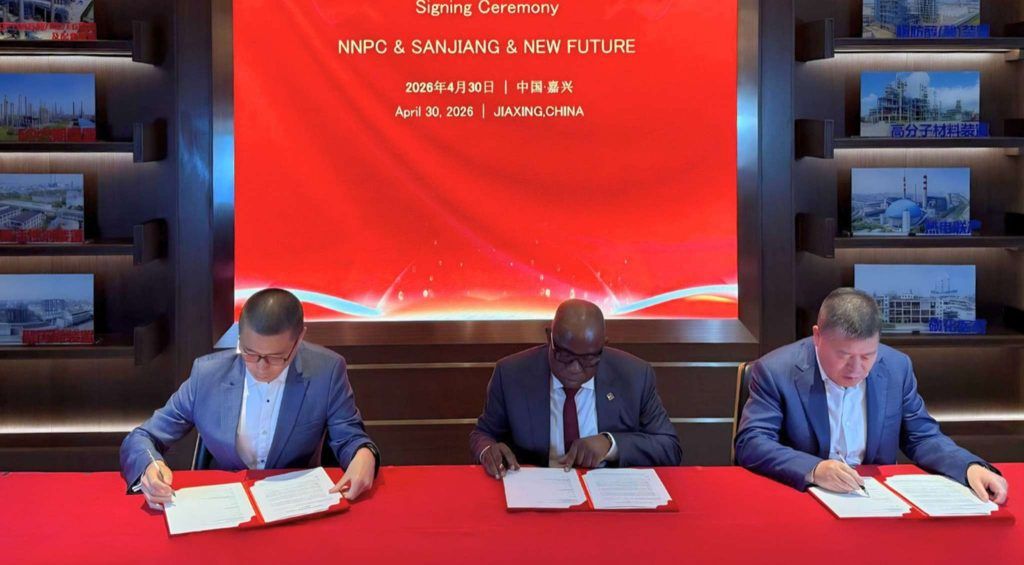
The uproar followed the recent signing of a Memorandum of Understanding (MoU) between the NNPCL and two relatively unknown Chinese firms, Sanjiang Chemical Company Limited and Xingcheng (Fuzhou) Industrial Park Operation and Management Co. Ltd in Jiaxing City, China on May 4, 2026.
Speaking after the signing ceremony, the Chief Executive Officer (GCEO) of NNPC Limited, Bayo Ojulari, said that the agreement is expected to cover the full rehabilitation, maintenance and expansion of the troubled refineries to achieve best-in-class and sustainable performance under a proposed technical equity partnership model.
“Planned expansion and upgrades would elevate both facilities to cleaner, more profitable product standards. The potential collaboration also contemplates expanding the refineries’ petrochemical capacities and harnessing gas and downstream opportunities through the development of co-located, gas-based industrial hubs.
“All parties recognise mutually beneficial opportunities for the development and long-term sustainable profitability of NNPC’s refining assets in Nigeria, and the collective weight required for success”, Ojulari had explained.
His sudden volte face on the issue of the refineries is perplexing, given the fact as last year he had proposed to sell them because they are irreparable and could only be managed by the private sector.
Growing Scepticism
However, the new initiative by the NNPCL has triggered widespread alarm across the nation, with opposition politicians, energy experts, organised private sector groups and transparency advocacy groups warning that Nigeria risks falling deeper into another costly cycle of failed refinery revamps.
The stakeholders scepticism is fuelled by two major factors: failed turnaround maintenance on the refineries by successive administrations in the last two decades that gulped $3.14 billions by Mele Kyari with little or nothing to show for it, and the relative inexperience of the two Chinese firms pencilled down for the Warri and Port Harcourt refineries rehabilitation projects in crude oil refining.
According to available data, Nigeria pumped over $25 billion (about N11 trillion) between 2010 and 2023 into the rehabilitation and turnaround maintenance of the four state-owned petroleum refineries, Port Harcourt I, Port Harcourt II, Kaduna and Warri refineries.
Between 2021 and 2023 alone, the administration of former President Muhammadu Buhari, ploughed $3.14 billion into the rehabilitation of the refineries. According to the breakdown of the financial outlay, the sum of $897.6 million was spent on Warri, $740.67 million on Kaduna and $1.5 billion on Port Harcourt.
However, the attempt to revamp the moribund refineries by the Buhari administration ended as one of Nigeria’s most expensive public sector failures. Besides brief restarts of the Port Harcourt and Warri refineries in late 2024, the facilities have remained non-operational till date.
Instead of lifting the heavy cloud hanging over the moribund refineries, the latest move to rehabilitate them have further rattled the petroleum industry, with concerned stakeholders warning that the Chinese-backed arrangement could become yet another “money pit” unless there is full transparency, accountability and a radical departure from past practices.
Shady Signs
Particularly troubling for stakeholders is the competency and shadowy nature of Sanjiang Chemical Company Limited and Xingcheng (Fuzhou) Industrial Park Operation and Management Co. Ltd, the two Chinese companies saddled with the task of salvaging the nation’s derelict refineries from total collapse.
While Xingcheng (Fuzhou) Industrial Park Operation and Management Co. Ltd is a property management company with a Free Trade Zone (FTZ) franchise, Sanjiang Chemical Company Limited on the other hand has no experience or expertise whatsoever in petrol, diesel, kerosene and aviation fuel production.
Business Hallmark’s extensive checks revealed that though Sanjiang Chemical Company is a legitimate petrochemical company listed on the Hong Kong Stock Exchange, it specialises only in the production of chemicals, such as ethylene oxide, methanol-to-olefins, surfactants, light hydrocarbon processing, but lacks experience in crude oil refining.
In the same vein, Sanjiang Chemical Company Limited is a well known industrial park designed like the Lekki Free Trade Zone (LFTZ) in the Ibeju-Lekki area of Lagos. The park houses several industrial concerns.
Largely because of this, Nigerians have faulted the choice of the two Chinese companies. According to them, the firms have nothing to offer the nation as they are technically unqualified and financially questionable.
In his reaction, a former president of the Organised Private Sector of Nigeria (OPSN), Dele Oye, demanded the immediate cancellation of the refineries’ rehabilitation contract.
According to Oye, who is also the Executive Director of Alliance for Economic Research and Ethics (AERE), the two companies have no business handling the revamping of Nigeria’s ’s complex refineries.
“These two companies have nothing to offer Nigeria. They have no professional experience. They have no engineering experience. They have never been in the industry to run a refinery of this magnitude.
“Sanjiang Chemical is not an EPC company. It is not an engineering company. They are into the downstream. They are more into chemicals. They have never run any refinery. They have never rehabilitated one. It doesn’t have the technical competence. It has never done any similar business. The company is currently running low on cash and carrying short-term borrowings”, Oye noted.
The former OPSN president also dismissed the credentials of Sanjiang Chemical Company Limited as a crude refining expert, insisting that the company is merely a real estate company.
“They are into industrial parks. There is no evidence anywhere in the world where they have been involved in any refinery or where they run a refinery”, Oye maintained.
Also speaking, the Nigeria Employers’ Consultative Association (NECA), raised serious concerns over the signed MoU, warning that Nigeria could not afford another failed refinery rehabilitation project.
The Director-General of NECA, Adewale-Smatt Oyerinde, described the new refinery turnaround maintenance contract as troubling, in view of the billions of dollars previously spent on past endeavours without the desired results.
“While we note that the nation desperately needs functional refineries, we cannot ignore the decade-long pattern of billion-dollar rehabilitation contracts that have delivered zero sustained refining output. It will be unpatriotic to endorse another opaque deal while questions on past spending remain unanswered.
“The gamble of over $1.5 billion on the Port Harcourt refinery is still fresh in the minds of Nigerians. Despite purported claims of 90 per cent readiness by 2026, the facility has not been recorded to produce sufficient barrels of refined product on a sustainable basis”.
Cost Without Value
While Oyerinde throws the weight of his association behind the revamping of the nation’s public refineries because of their potentials for job creation and ending the country’s unhealthy dependence on imported fuel, he argued that it must be done with transparency, accountability and a proven business model.
“It will be unpatriotic to clap for another MoU while about $25 billion from past revamps produced almost zero result. The era of announcing MoUs and turnaround maintenance projects, while citizens continue to buy fuel at extortionate prices, must end. We demand answers, not agreements”, Oyerinde demanded.
In the same vein, former Vice President Atiku Abubakar, kicked against the choice of the two shortlisted Chinese firms for the rehabilitation of the nation’s non-functional refineries.
While accusing the President Bola Tinubu’s All Progressives Congress (APC) administration of attempting to mortgage critical national assets through opaque arrangements lacking technical credibility, transparency and national accountability, the ADC chieftain described the agreement as another dangerous gamble with Nigeria’s economic future,
“It is both shocking and insulting that after wasting over $2.5 billion on endless refinery rehabilitation scandals, the NNPC is once again asking Nigerians to trust another experiment built on secrecy and questionable competence.
“There is no publicly available evidence anywhere in the world showing that Sanjiang has ever built, operated, or managed a full-scale crude oil refinery of the magnitude and complexity of Port Harcourt or Warri refineries.
“Processing petrochemical derivatives is not the same as running an aging national refinery burdened with decades of operational decay.
“The second firm appears to have absolutely no verifiable experience in petroleum engineering, refinery operations, or hydrocarbon processing. It is like handing over a hospital’s intensive care unit to a real estate developer simply because they can construct buildings.
“If a company is already battling financial compression and liquidity concerns in its own operations, how exactly does it intend to shoulder the burden of reviving two of Africa’s most troubled refineries?” the former vice president queried.
Other industry stakeholders argued that the continued focus on reviving ageing refineries no longer make strong commercial sense in an increasingly competitive market shaped by newer and more efficient private refining assets like the Dangote Refinery.
They noted that the Federal Government may ultimately be forced to consider complete scrapping of the refineries if the latest arrangement to revamp them for sustainable output fails.
It would be recalled that the Port Harcourt and Warri refineries, once considered strategic national assets, have remained largely dormant despite several turnaround maintenance exercises financed by successive administrations.
Their prolonged shutdown has continued to fuel Nigeria’s dependence on imported petroleum products, while citizens grapple with rising fuel costs.